AI agents and creative work statistics point to gains with limits: a randomized ad-production experiment found 50% more ads per human worker, 81% of Luma's surveyed creatives had released AI-assisted work, and 32% of LangChain's respondents named quality as a production barrier. These measure different populations and outcomes; none is a representative rate of autonomous creative production.
The short version: agents can help with a bounded creative task, but output volume, accepted quality and production cost need separate checks. Use the 25 findings below to choose a pilot, then measure accepted work, revision time and complete cost before expanding it.
Key takeaways
- A randomized ad-production experiment found 50% more ads per human worker, without establishing a universal creative-agent productivity rate.
- In Luma’s survey, 81% of respondents had released AI-assisted work; this does not measure autonomous creative-agent adoption.
- Creative-agent pilots should measure accepted deliverables, revision time and complete production cost before expanding.
We read the original research linked below on 29 October 2026. Dates and methods accompany each group. This is an editorial synthesis, not our own agent benchmark; the worked scorecard is hypothetical. Voyager, the desktop app our team builds, connects an agent with creative apps and its own Design, Video and DAW editors, with editable handoffs that depend on the chosen workflow. These studies do not measure its performance.
What counts as a creative AI agent?
For this reference, an agent can choose and carry out steps using tools, observe the result and continue toward a goal. A chat assistant supplying a draft or a generator returning one image measures a narrower interaction. This operational distinction follows BCG's observe, plan and act model, read 29 October 2026; product labels alone do not establish autonomy.
A hypothetical creative-agent workflow would read an approved campaign brief, select assets, edit copy and layout in an app, inspect the export and return source files for a requested revision. The outcome to measure is an accepted, revisable handoff. A good paragraph or image tests only part of that workflow.
At a glance: choose the right evidence
| Your question | Evidence to use | Keep this limit attached |
|---|---|---|
| Can an agent partner help produce creative work? | Ju and Aral, figure 1 | Ad experiment; human–AI versus human–human teams |
| Where are creatives using AI? | Luma and Adobe, figures 2–9 | General AI surveys, not agent adoption |
| Are enterprises scaling agents? | McKinsey, figures 10–12 | Cross-industry self-report |
| What blocks dependable deployment? | LangChain and Deloitte, figures 13–17 | Technical/vendor and enterprise survey populations |
| Can assistance improve writing or ideas? | Writing, story and multi-agent studies, figures 18–21 and 25 | Task-specific ratings; not finished-project performance |
| Can assistance also worsen results? | BCG experiment, figures 22–24 | Different tasks produced different outcomes |
Sources: the primary studies and survey methods linked in each section, read 29 October 2026. This reference covers creative workflows and deployment decisions; market-size forecasts do not measure either team's delivery performance.
Agent-assisted ads: more output has tradeoffs
1. Human–AI teams produced 50% more ads per human worker than human–human teams in Ju and Aral's preprint, version 4, dated 15 October 2026. The randomized Pairit experiment involved 2,234 participants and 11,024 ads. The agent could edit copy, select or generate images and message its partner; humans submitted ads.
Text ratings improved, but image ratings and output diversity fell. There was no human-alone condition, so the result cannot quantify the benefit over working solo. Ads per worker is not a conversion-rate gain or a guarantee of completed client work.
Choose this kind of pilot if you can review copy, imagery and distinctiveness separately, then require human approval before delivery.
Creative AI use: adoption and concern
Luma's vendor-published survey: 760 US marketing/creative professionals, July 2026, fielded with Michele Madansky Consulting.
| # | Reported finding | Share |
|---|---|---|
| 2 | Released AI-assisted work | 81% |
| 3 | Good or excellent AI-tool access | 72% |
| 4 | Very/extremely concerned about reliance at creativity's expense | 62% |
| 5 | Very/extremely concerned about accuracy/factual errors | 60% |
| 6 | Very/extremely concerned about job displacement | 56% |
Source: Luma's public findings, read 29 October 2026. General AI use, not autonomous agents. The full report is gated; the public page does not establish representative sampling.
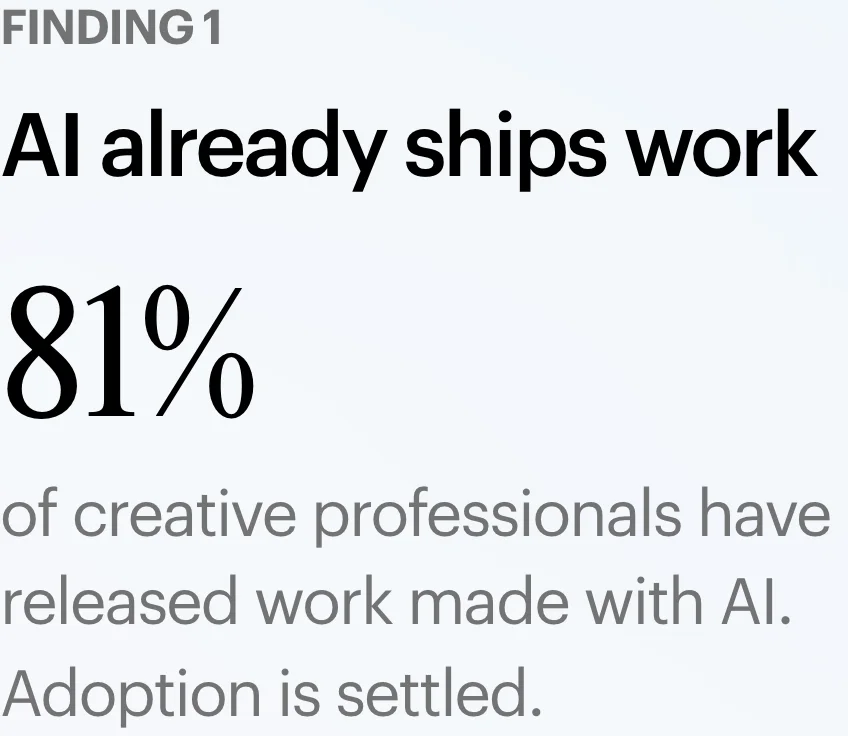
Open the survey chart at full resolution.
Separate permission to experiment from permission to deliver. Decide who checks factual claims and who accepts the final source files before assigning a task to an agent.
Creative workflows: measure the stage
Adobe's June 2026 research includes a brand-blind 1,433-person US/UK survey, fielded 27–30 April 2026: 403 US creative professionals, 203 UK professionals, 485 US creators and 342 UK creators. The following are different US task-specific groups; discipline subgroup sizes are not supplied beside the findings.
| # | Population and reported measure | Share |
|---|---|---|
| 7 | US creative professionals rating brainstorming/ideation highly enabled by AI | 81.7% |
| 8 | US photo professionals reporting substantial generative AI use for background-element removal | 57.6% |
| 9 | US video creators reporting substantial generative AI use for visual effects | 48.6% |
Source: Adobe findings and methodology, read 29 October 2026. Enablement is a perception of AI's capability, not measured adoption or time saved. These general AI findings cannot establish agent use. Adobe does not directly measure project time allocation.
Choose a workflow-stage pilot if you can identify the specific operation you want to delegate. For example, separate background cleanup from art direction and client approval; measure each stage rather than calling the whole project automated.
Enterprise agents: scaling and cost
McKinsey's 25 August 2026 survey covers 1,719 respondents in 97 nations; fieldwork ran 4 May–8 June, weighted by national GDP. These are cross-industry respondent reports.
| # | Measure | Share |
|---|---|---|
| 10 | Scaling agents in one or more functions, organizations above $1bn annual revenue | 40% |
| 11 | Scaling agents in one or more functions, smaller organizations | 22% |
| 12 | AI-related operating costs constrained AI use | About 20% |
Source: McKinsey's findings and methodology, read 29 October 2026. The cost measure covers AI generally. None of these is a creative-team adoption or return-on-investment rate.
Use deployment data as context for investigating a workflow, then ask for evidence that it meets your delivery requirement. Scaling in one function does not establish an autonomous enterprise or a successful creative handoff.
Agent reliability: quality and oversight
LangChain's report, published 12 June 2026, draws on a public survey of 1,340 respondents, fielded 18 November–2 December 2025. Technology accounts for 63% of respondents. It is a self-selected vendor survey, not a representative creative-industry sample.
| # | Respondent-reported measure | Share |
|---|---|---|
| 13 | Quality cited as a top production barrier | 32% |
| 14 | Latency cited as a production challenge | 20% |
| 15 | Running offline evaluations on test sets | 52.4% |
| 16 | Detailed tracing of individual steps/tool calls | 62% |
Source: LangChain findings and methodology, read 29 October 2026. Quality includes accuracy, relevance, consistency and adherence to tone, brand or policy. Traces help locate failures; their presence does not establish that output passes evaluation.
17. Only 21% reported mature agentic-AI governance in Deloitte's 24 April 2026 account of its enterprise survey: 3,235 IT/business leaders across 24 countries, all directly involved in their organizations' AI programs. This is self-reported governance maturity among AI-involved leaders, not an audit or a creative-team rate.
Choose an agent integration pilot if you can inspect the steps between input and handoff. Give it explicit app/file permissions, log tool failures and retries, and define when a person must approve or recover the work. Test a missing asset or failed import as well as a successful export. Evaluation checks the result; tracing explains how it happened.
Writing: gains on short assignments
Noy and Zhang's July 2023 Science study randomized access to ChatGPT using GPT-3.5 among 453 college-educated professionals. The January–February experiment used occupation-specific writing assignments; experienced professionals evaluated output without knowing the treatment. The authors' manuscript reports:
| # | Experimental result | Change |
|---|---|---|
| 18 | Average task time | 40% lower |
| 19 | Rated output quality | 18% higher |
These are historical writing-task effects, not a current agent benchmark. The tasks included press releases and short reports, rather than complete creative productions.
Choose a writing pilot if the deliverable has a clear length, audience and review standard. Keep factual checking and approval in the timing: a useful first draft is only one part of delivering client copy. The relevant purchase check is whether the chosen tool can work with the team's source material under its approved data policy, not whether it advertises the same percentage gain.
Story ideas: ratings and similarity
Doshi and Hauser's 12 July 2024 Science Advances experiment used 293 writers and 600 evaluators. Writers were randomized to no AI, one GPT-4 idea or access to up to five ideas for an eight-sentence story. Against no AI, the five-idea condition produced these results in the original article:
| # | Evaluator-rated outcome | Change |
|---|---|---|
| 20 | Novelty | 8.1% higher |
| 21 | Usefulness | 9.0% higher |
The participants were not professional writers. The researchers also found AI-assisted stories more similar to one another. Usefulness concerned audience fit and potential development into a publishable product, not actual sales.
Choose an ideation pilot if you can compare distinct directions before committing to one. We would ask reviewers to select concepts without knowing their origin, then check the whole set for repetition. That catches a different problem from judging the quality of each option individually. A generator that offers many variations still needs a process for rejecting variations that express the same underlying idea.
Knowledge tasks: gains and errors
Published 11 March 2026 in Organization Science, Dell'Acqua and colleagues' preregistered BCG experiment assigned 758 knowledge workers to two nonoverlapping task groups: 385 inside the tested capability boundary and 373 outside it. Within each group, participants were randomized to no AI, GPT-4 or GPT-4 plus a prompting overview. The model was GPT-4 as available at the end of April 2023 (full text).
| # | Task and outcome | AI-assisted result |
|---|---|---|
| 22 | Eighteen tasks within the tested capability boundary | 12.2% more tasks completed |
| 23 | Time to reach the final question after 17 subtasks | 25.1% less time |
| 24 | A separate complex managerial task outside that boundary | 19 percentage points lower correctness |
The timing result measures reaching question 18 after the first 17 subtasks. Participants had to use the full allotted session, including the final question, so it does not establish a 25.1% reduction in time to complete all 18 tasks. Correctness uses percentage points per the full text. These consulting tasks are not production-editing trials.
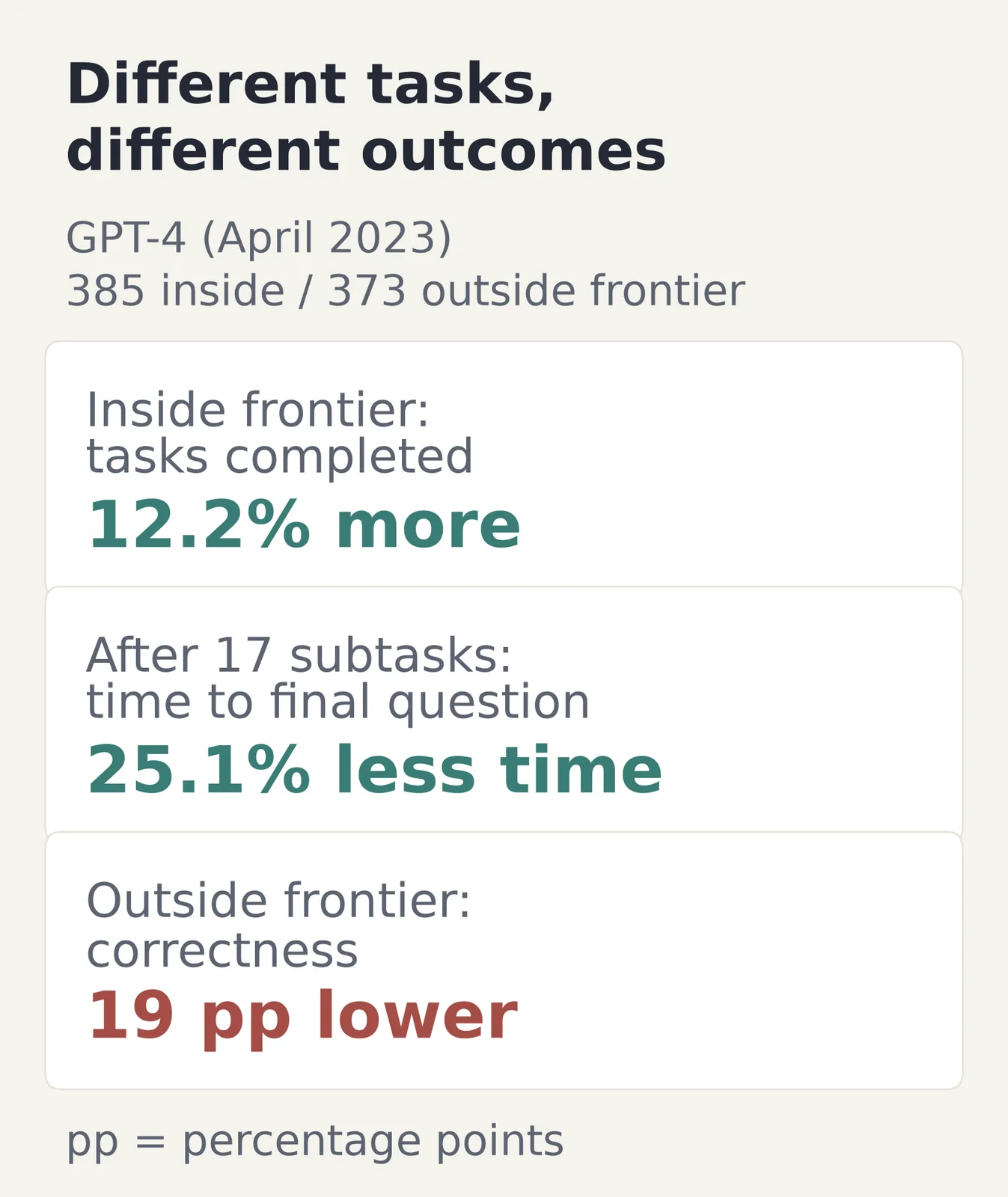
Open the task-results chart at full resolution.
Choose a production pilot if you can define and inspect its failure cases. For an editable handoff, test a requested change after the first render: change the title, replace one asset, reopen the project and export again. Check the chosen app's import route before buying or expanding access. A good render alone does not demonstrate that the next editor can make those changes.
Multiple agents: idea ratings
25. Multi-agent teams had a creativity advantage of Cohen's d = 1.50 over human teams in Hu and colleagues' 18 May 2026 preprint. The comparison used 4,541 multi-agent LLM ideas and 341 human-team ideas across six problem-solving tasks. Five human raters judged ideas blind to source; creativity combined novelty and usefulness. The advantage was driven by novelty, with comparable usefulness.
Cohen's d expresses a standardized difference, not a percentage improvement. The study evaluates ideation, not agents operating a design canvas, editing a timeline or delivering client revisions. Its result does not establish that adding more agents improves any arbitrary workflow.
Choose a multi-agent ideation trial if you can evaluate the resulting shortlist and account for coordination cost. Keep the number of ideas reviewed and the available time comparable with your existing process. For a team buying a production tool, the unresolved question remains whether it can carry an accepted idea through the required apps and return usable source files.
Set acceptance measures before a pilot
These are our proposed acceptance measures, not findings from the surveys. Set the threshold before a trial so an attractive first result does not change the definition of success.
| If your work is mostly… | Start by measuring… | Expand only when… |
|---|---|---|
| Drafting copy | Reviewer-accepted drafts and total revision time | The same factual and style checks pass |
| Exploring campaign concepts | Accepted distinct directions per review session | Reviewers can explain the difference between options |
| Revising designs or video | Successful requested changes in reopened source files | Another editor can continue the work |
| Coordinating several creative apps | Accepted handoffs, interventions and recovery time | Failures can be found and corrected before delivery |
| Planning a team rollout | Total spend and labor per accepted deliverable | The improvement survives normal review and revisions |
A worked scorecard: more attempts can cost more
This is a hypothetical calculation, not a run or an industry benchmark. Suppose a campaign team compares two batches of 10 matched briefs, each requiring an editable ad, a specified text revision and a successful export by another editor. Each brief gets one initial submission and at most one retry. Reviewers use the same factual, brand, rights and source-file checks, blind to the workflow where practical.
Set these illustrative gates beforehand: at least 8 of 10 briefs accepted after the permitted retry, every accepted project passing the revision/reopen check, no unresolved rights or factual failures, and no higher total cost per accepted deliverable. A brief counts once; rejected versions stay in the cost and labor totals.
| Pilot measure | Existing | Agent |
|---|---|---|
| Matched briefs | 10 | 10 |
| Submitted versions, including retries | 12 | 18 |
| Rejected versions | 4 | 10 |
| Accepted deliverables | 8 | 8 |
| Accepted projects passing revision/reopen check | 8/8 | 8/8 |
| Unresolved rights/factual failures | 0 | 0 |
| Production/operator labor, including rejected work | 12 h | 7 h |
| Review and correction labor | 4 h | 5.5 h |
| Integration setup and recovery labor | 0 h | 3 h |
| Total labor | 16 h | 15.5 h |
| Allocated tools/model spend, including retries | $0 | $90 |
| Labor at an assumed loaded rate of $50/h | $800 | $775 |
| Total trial cost | $800 | $865 |
| Cost per accepted deliverable | $100.00 | $108.13 |
Total cost = all allocated tool/model spend + all labor hours × loaded hourly rate. Divide by accepted deliverables: ($90 + 15.5 × $50) / 8 = $108.125, rounded to $108.13. For simplicity, the example assumes no incremental tool charge for the existing workflow; substitute your actual allocated subscription and infrastructure costs on both sides.
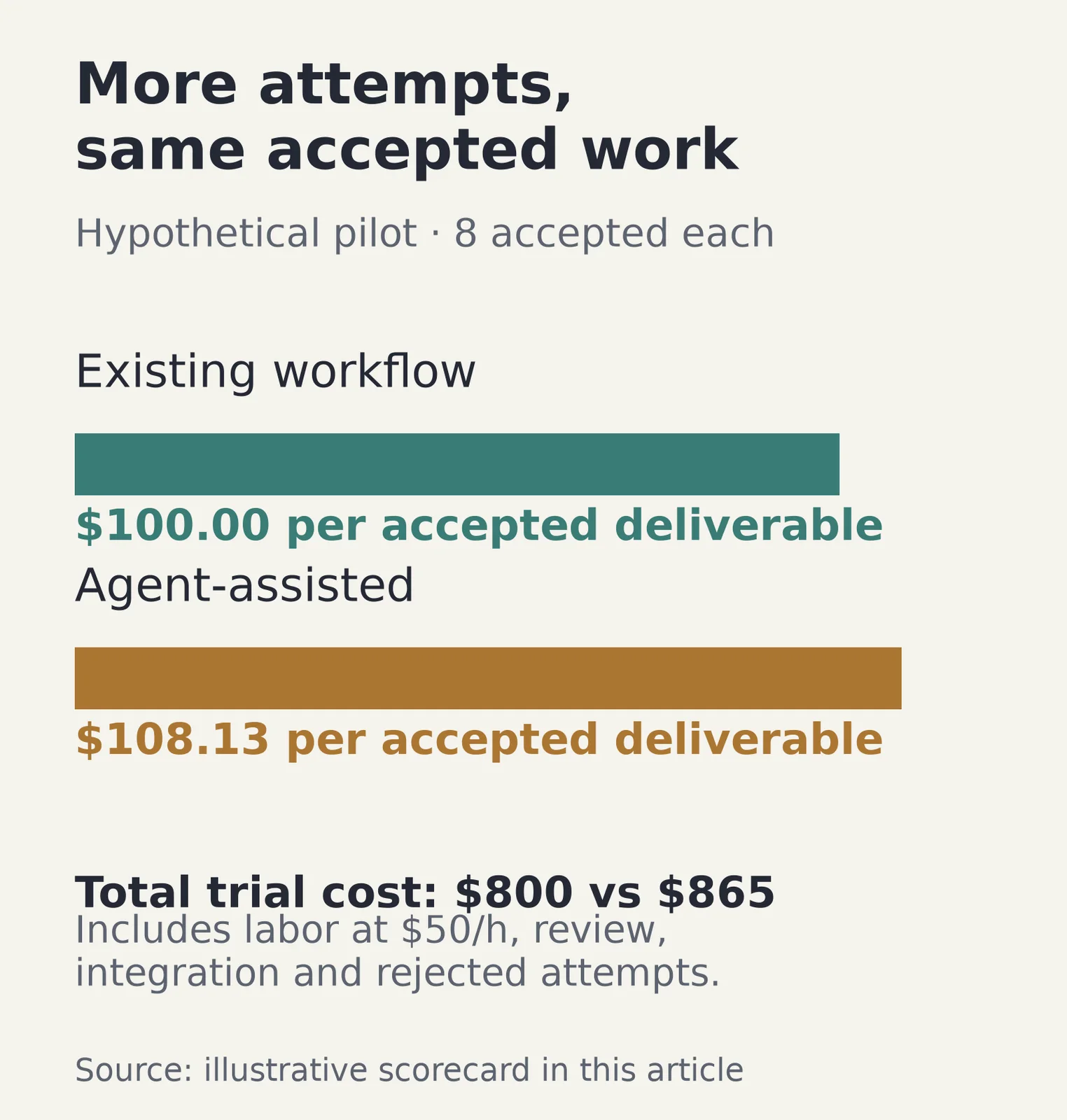
Decision in this example: keep the pilot bounded. It meets the quality/handoff gates but misses the cost gate. Production labor falls, while review and setup consume most of the saving. Record setup separately so a later steady-state estimate can be calculated transparently; do not remove it from the observed trial cost. A small batch is a diagnostic, not proof of a durable gain.
For app-specific prerequisites, use the creative-app reference. Build the trial around the file format and revision the next person needs, then choose the model or agent that can meet that requirement.
Frequently asked questions
How many creative professionals use AI agents?
The research cited here does not establish a representative rate of autonomous creative-agent use. Keep the surveyed population and the definition of use attached when citing an adoption figure.
What is the difference between AI adoption and agent adoption?
Luma and Adobe ask about broader AI use or perceived capability. An agent-adoption claim also needs evidence that a system takes steps through tools. Do not relabel an AI-assisted image or draft as autonomous production. See the survey methods beside figures 2–9.
Why can agent quality matter more than output count?
In LangChain's survey, quality was a leading production barrier. A creative trial should count accepted, revisable deliverables and review labor; generating more candidates can also create more work for reviewers.
How should we calculate creative-agent ROI?
Use a matched baseline and the same acceptance checks. Include rejected attempts, model/tool charges, operator time, review, integration and recovery on both sides. The worked scorecard shows why faster production alone can still miss a cost gate. Keep hypothetical estimates separate from measured trial results.
Does AI make creative work faster?
The controlled writing and knowledge-task experiments found gains on their assigned tasks. They do not supply a speed guarantee for another task, model or production workflow. Measure the time to an accepted deliverable, including review.
Do these statistics show that agents replace creative teams?
No. An adoption response, a rated idea and a correctly completed production are different outcomes. None of the cited studies demonstrates that an agent can replace every responsibility in a creative team.
Which figure belongs in a business case?
Choose the figure whose population and outcome match the claim, and cite its original research with the date and method. For an investment decision, add your own trial's accepted-work rate, revision time and complete cost. Industry context cannot substitute for those measurements.
Voyager is a desktop AI agent for creative work
Describe what you want to make; Voyager plans it, uses your apps and tools, and keeps everything editable.