Choose Claude Code to write, refactor and test code. Choose OpenClaw when you want a standing assistant you can message, on a machine and model you control, and are willing to keep that machine running. OpenClaw's own FAQ recommends Claude Code or Codex for the direct coding loop inside a repository.
The short version: a phone connection or a nightly repository chore no longer requires OpenClaw. Claude Code has channels, Remote Control and cloud scheduled tasks. OpenClaw earns its upkeep when the assistant itself needs a continuing presence across chat apps and devices. You can also combine them, but using Claude Code as OpenClaw's model runtime differs from starting a separate coding session.
We checked primary documentation, pricing, terms, releases and issue reports on 29 October 2026. This is a documentation comparison; neither agent was installed or run. The retained visuals were recorded on 20 October. Voyager, the desktop app our team builds, also supports using Claude Code with creative skills and tools; this comparison concerns coding and a standing assistant (Voyager plugin).
At a glance: choose by job
| Your main job | Start with | The condition that matters |
|---|---|---|
| Edit a repository, run tests and review diffs | Claude Code | Its file, shell and Git tools work inside your coding session |
| Steer that session from your phone | Claude Code | Remote Control and channels need the host and session running |
| Run repository chores with your laptop closed | Claude Code cloud tasks | Runs in the cloud, with a fresh clone rather than your local files |
| Keep an assistant in WhatsApp, Signal or several chat apps | OpenClaw | Its Gateway must stay running somewhere |
| Pick another model provider or a local runtime | OpenClaw | You configure and pay for the model and host |
| Start a dedicated coding session from an OpenClaw conversation | Both, through ACP | The coding session has its own tools and permission profile |
Sources, read 29 October: Claude Code's overview, Remote Control and scheduling comparison; OpenClaw's channels, model providers and ACP agents.
Keep the harness and model choices separate. Comparing OpenClaw on one model with Claude Code on another changes both. Even with Claude behind both, their instructions, tools and approvals differ; sharing a model does not establish equal results.
Where Claude Code overlaps with OpenClaw
Reaching a coding session from your phone
Remote Control lets the Claude app or browser steer a session on your computer. It requires a Pro, Max, Team or Enterprise subscription; API-key authentication is unsupported. The host must remain on.
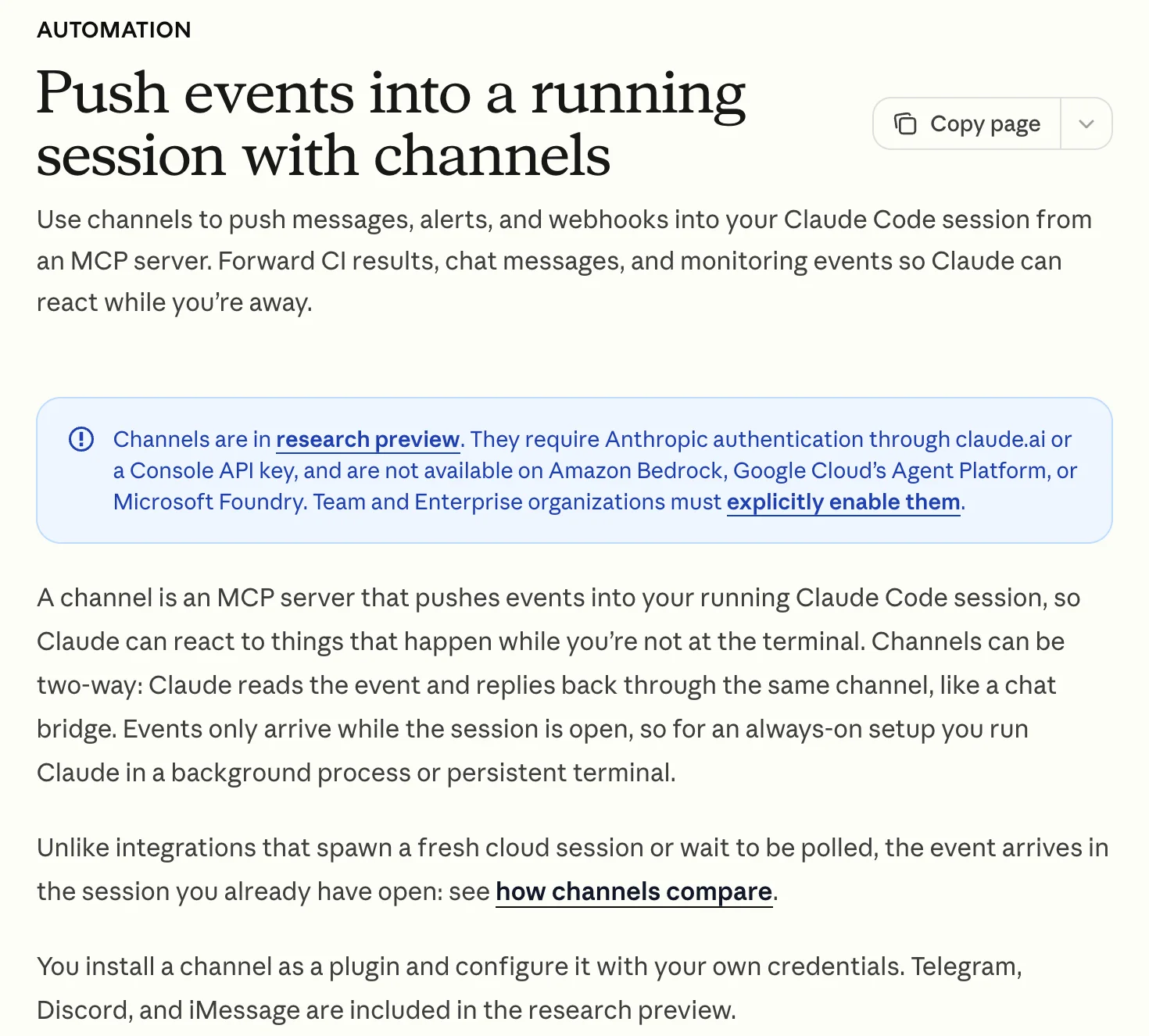
Channels connect Telegram, Discord or iMessage to a running Claude Code session. They remain a research preview, require Anthropic authentication, and exclude Bedrock, Google Cloud's Agent Platform and Foundry. Team and Enterprise organizations must enable them. The included plugins require Bun; preview channels must be on Anthropic's or your organization's allowlist. Events arrive only while the session stays open; permission prompts can pause work unless the channel relays approvals. The official plugins relay them on Telegram and Discord, while iMessage limits approval requests to self-chat (plugin source).
OpenClaw's Gateway holds its chat connections independently of a coding session. Put it on another machine that stays awake if you want replies while your laptop is closed. iMessage still needs a Mac signed in to Messages, either as the host or reached remotely (iMessage).
Running work on a schedule
| Claude Code option | What must stay on | Local files | Minimum interval |
|---|---|---|---|
| Cloud task | Anthropic's cloud by default | Fresh clone | 1 hour |
| Desktop task | Your computer | Yes | 1 minute when Claude sets it; 1 hour in the forms |
/loop | Your computer and session | Yes | 1 minute |
Source: scheduling comparison, read 29 October. Fixed-interval loops expire after seven days. Cloud tasks remain a research preview on Pro, Max, Team and Enterprise, support schedule, API and GitHub triggers, and consume the account's usage limits. New cloud sessions start in auto mode when available; an ask rule or repeated classifier blocks can leave a run waiting for approval.
OpenClaw owns its schedules on the Gateway. In stable v2026.10.9, heartbeat checks default to 30 minutes, or one hour with Anthropic subscription authentication including Claude CLI reuse, unless you set a cadence. They use the main session by default; isolatedSession: true starts a fresh one without its conversation history (release-pinned heartbeat docs). Its live heartbeat page already describes migration to ordinary automation jobs, so follow the documentation for the version you install. Choose cloud tasks for repository chores; choose OpenClaw when the schedule belongs to your continuing chat assistant.
For inbox, calendar and document work, Claude Cowork vs OpenClaw covers that decision. For other standing assistants, use OpenClaw alternatives.
Approval defaults and upkeep
Claude Code's interactive terminal and VS Code sessions start in auto mode: a classifier reviews actions that rules do not settle. Manual mode asks before most edits, commands and network access (permission modes).
OpenClaw documents host commands without approval as the default; configure approvals and tool policy before connecting accounts that matter (exec). Its sandbox is off by default. Our recommendation is a separate host or user account with only the files and accounts the assistant needs. That limits its reach; it does not prevent mistakes through connected services.
OpenClaw also needs service maintenance: an awake host, updates, backups and working provider logins. Its extended-stable channel never updates automatically, and it documents backup and recovery. The latest stable releases checked on 29 October were Claude Code v2.1.312, published 27 October, and OpenClaw v2026.10.9, published 29 October. A standing assistant is worth choosing only if you want to operate that service.
Running OpenClaw on your Claude subscription
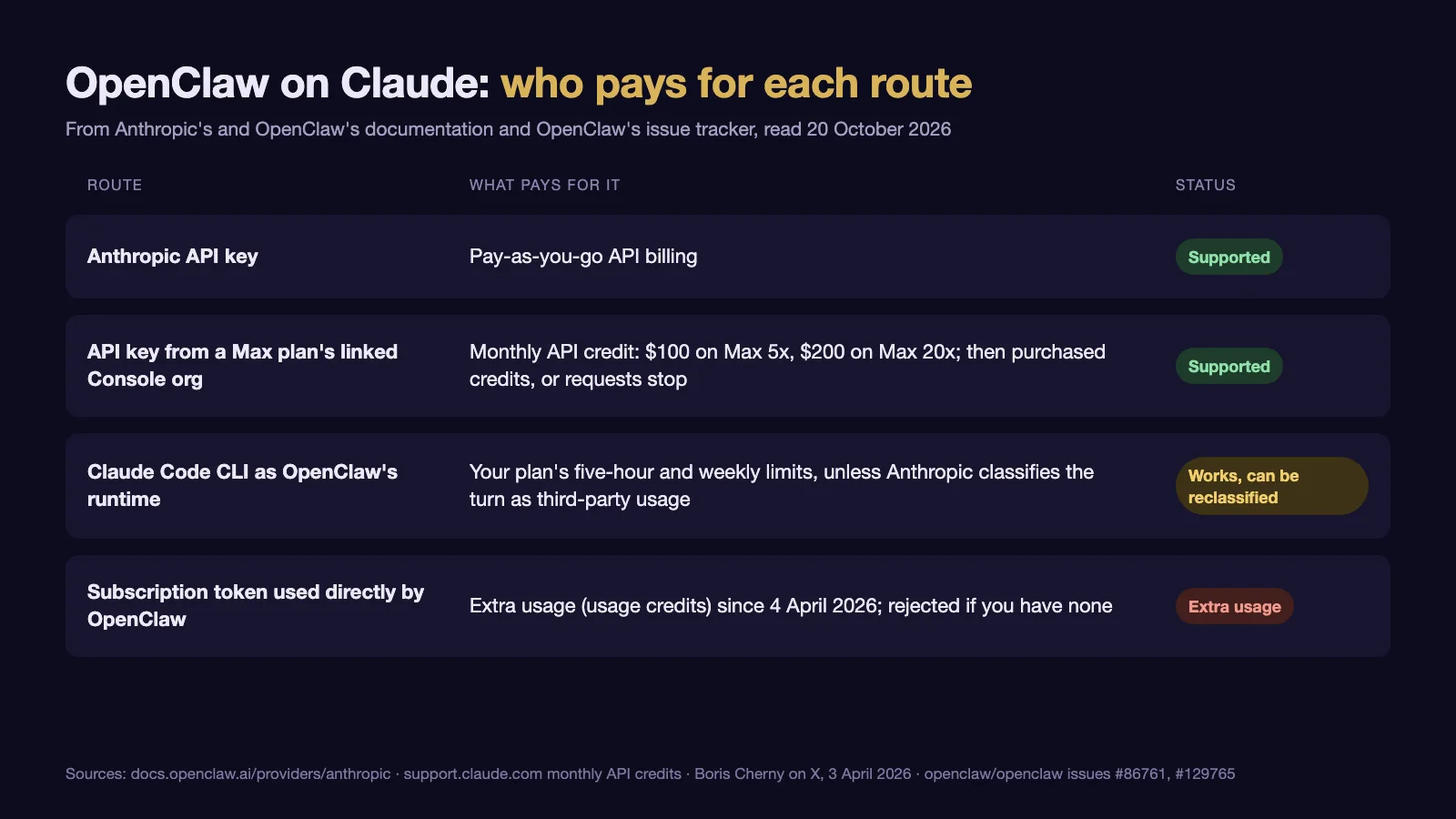
Claude Code is included with Claude Pro, $20 monthly or $200 annually (advertised as $17 per month), and Max, $100 or $200 monthly, before applicable taxes on web subscriptions. Free excludes Claude Code (pricing, Max plans, read 29 October). OpenClaw itself is free and MIT-licensed; model usage and hosting are your costs (repository).
Our default recommendation is an API key, especially if you rely on Claude Code for work or other people message your Gateway. It separates the assistant's consumption from the subscription limits your coding needs. A Pro user can set a Console workspace spend limit. OpenClaw also recommends API keys for shared automation (Anthropic provider); Anthropic's Consumer Terms prohibit making your account available to others.
| Route | What pays |
|---|---|
| API key from a Console organization | That organization's API balance, including a linked Max plan's monthly API credit |
| Installed Claude Code CLI, signed in with your plan | Subscription limits under the current Agent SDK policy, subject to Anthropic's third-party billing reservation |
| Subscription token sent directly to the API | Metered extra usage, or rejection without balance; distinct from a saved token forwarded through the CLI |
Sources: Anthropic's Agent SDK article, login rules and OpenClaw's released backend source, read 29 October.
On Max: use the linked organization's API credit first
Max 5x includes $100 monthly API credit, Max 20x $200. After seven days on an eligible plan, link a Console organization from Claude's billing settings and create your key there. Pro is ineligible; Anthropic still notes a gradual rollout. The credit expires each billing cycle and cannot pay for interactive Claude Code or extra usage. If the organization has no purchased credits, auto-reload or invoiced billing, requests stop when the credit runs out (monthly API credits).
These are separate balances: Console API credits fund API calls, while Claude usage credits fund extra usage. Check Console billing for the first and Claude's usage settings for the second (usage credits).
Upgrading monthly Pro to Max 5x costs $80 more per month. We would do it for OpenClaw only if you expect to use enough of the expiring API credit to justify the difference, or already need more Claude capacity. For the broader plan choice, see Claude usage limits.
On Pro: the CLI is an option, with billing caveats
OpenClaw can launch the installed Claude Code program with its existing login. Choose Claude CLI in onboarding, or use the documented CLI login configuration. Native login remains under Claude Code's control. OpenClaw clears inherited Anthropic key overrides before launching it (released environment rules).
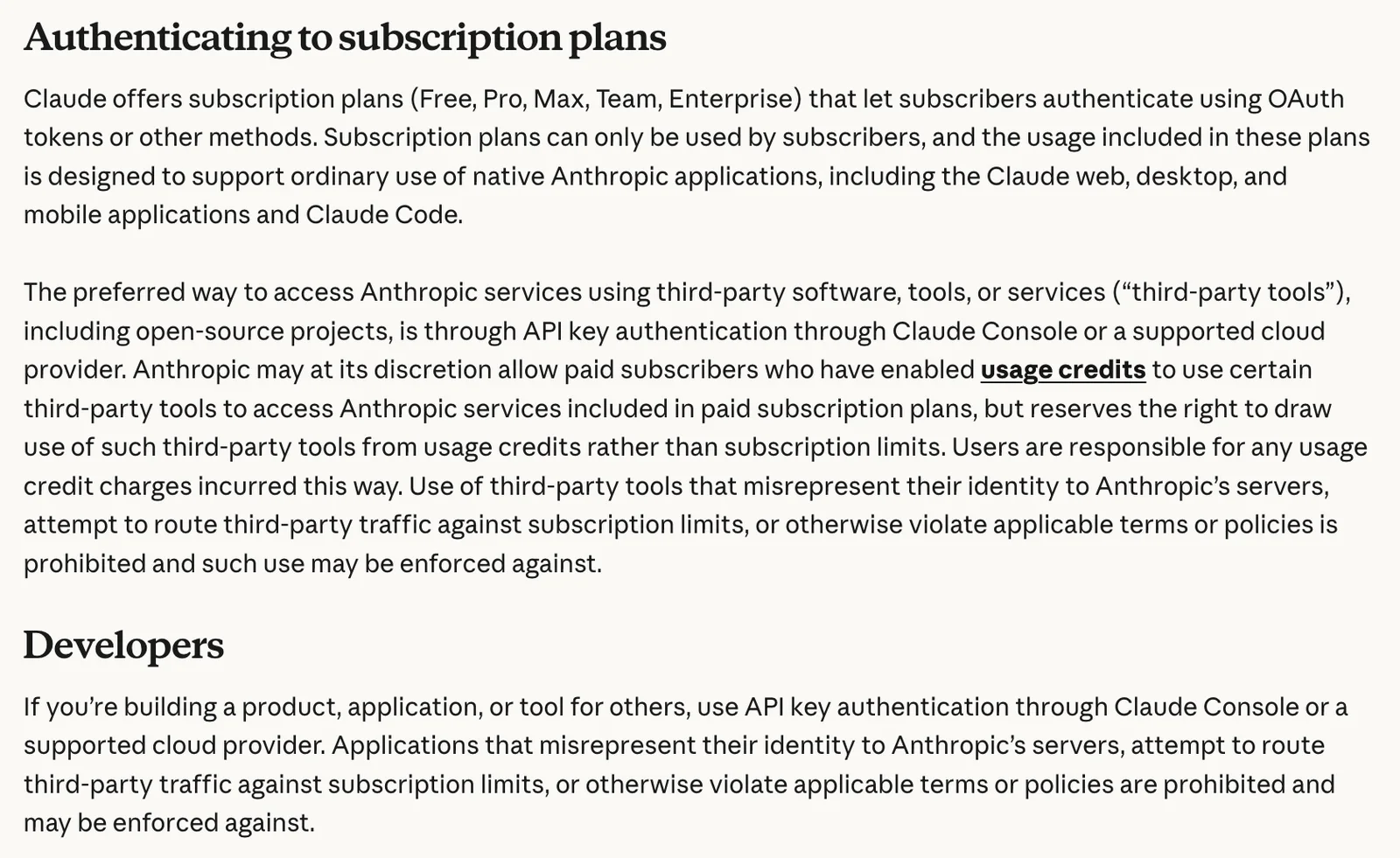
Anthropic's Agent SDK article says third-party app usage still draws from subscription limits, following its 15 June pause; its 7 October update retains plan accounting for signed-in SDK and claude -p usage. Its legal page allows products to run the unmodified binary under stated conditions, with each end user authenticating independently. Plan allowances assume ordinary individual usage.
But the login article prefers API keys for third-party tools and reserves the right to bill them from usage credits instead. Our reading is that subscription use remains available under the SDK policy, with no guarantee every OpenClaw turn stays on plan limits. Avoid treating it as an unlimited or guaranteed allowance.
OpenClaw's issue tracker contains older CLI-route billing rejections even when direct claude -p worked. On 24 October, maintainers closed #86761 because they could not confirm the original failure on current main; #129765 also lacks a reliable current reproduction. That does not establish reliability on today's release. If trying the CLI route, keep usage credits off unless you accept metered charges, and configure a fallback model whose bill you understand. A rejected turn can fail or move to that fallback.
Using both: runtime or separate coding session?
The runtime route supplies OpenClaw's ordinary turns; ACP starts a dedicated Claude Code session. This distinction matters more than whether both say “Claude”.
| Claude Code as runtime | Claude Code through ACP | |
|---|---|---|
| Instructions and memory | OpenClaw's managed context | Coding session in the working directory you choose |
| Tools | Policy-filtered OpenClaw tools over MCP | Claude Code's native tools |
| Your Claude Code customizations | Managed turns exclude user/project settings, instruction files, auto memory, hooks, plugins and Claude-only MCP servers | A separate harness session; check its environment and configuration |
| Permissions | OpenClaw policy | ACP defaults approve reads; writes or commands requiring prompts fail headless |
Sources: OpenClaw's v2026.10.9 CLI backend documentation describes those managed-turn exclusions, and its ACP setup documents the permission defaults.
For example, send /acp spawn claude --bind here in a supported Telegram thread, then describe a repository fix. OpenClaw starts the session on the Gateway host and binds subsequent thread messages to it. Output returns to the thread; /acp status inspects it and /acp close ends it (runbook, delivery). Configure an appropriate ACP permission profile before expecting unattended edits. ACP runs on the host, outside OpenClaw's sandbox.
Choose Claude Code alone for hands-on coding. Add OpenClaw and ACP when reaching a dedicated coding session through your standing assistant justifies operating the Gateway. Use the CLI runtime when you want OpenClaw's context and tools with Claude behind them.
Frequently asked questions
Did Anthropic ban OpenClaw subscriptions? Its 3 April announcement removed third-party tools from subscription coverage effective 4 April. The current Agent SDK article records later policy changes. Neither that history nor older account-ban reports establish a ban on today's unmodified CLI route; the current billing reservation still matters.
Does a setup token mean subscription billing? No. The transport matters. OpenClaw's current provider docs can forward saved subscription credentials through Claude CLI; direct API calls with a subscription token have different billing. For a new setup, choose the API-key or native CLI-login route explicitly.
Can Claude Code replace OpenClaw? For coding, phone access to a session and scheduled repository chores, often yes. Choose OpenClaw for the standing chat assistant, broader channel choice and control over the model and host.
Voyager is a desktop AI agent for creative work
Describe what you want to make; Voyager plans it, uses your apps and tools, and keeps everything editable.