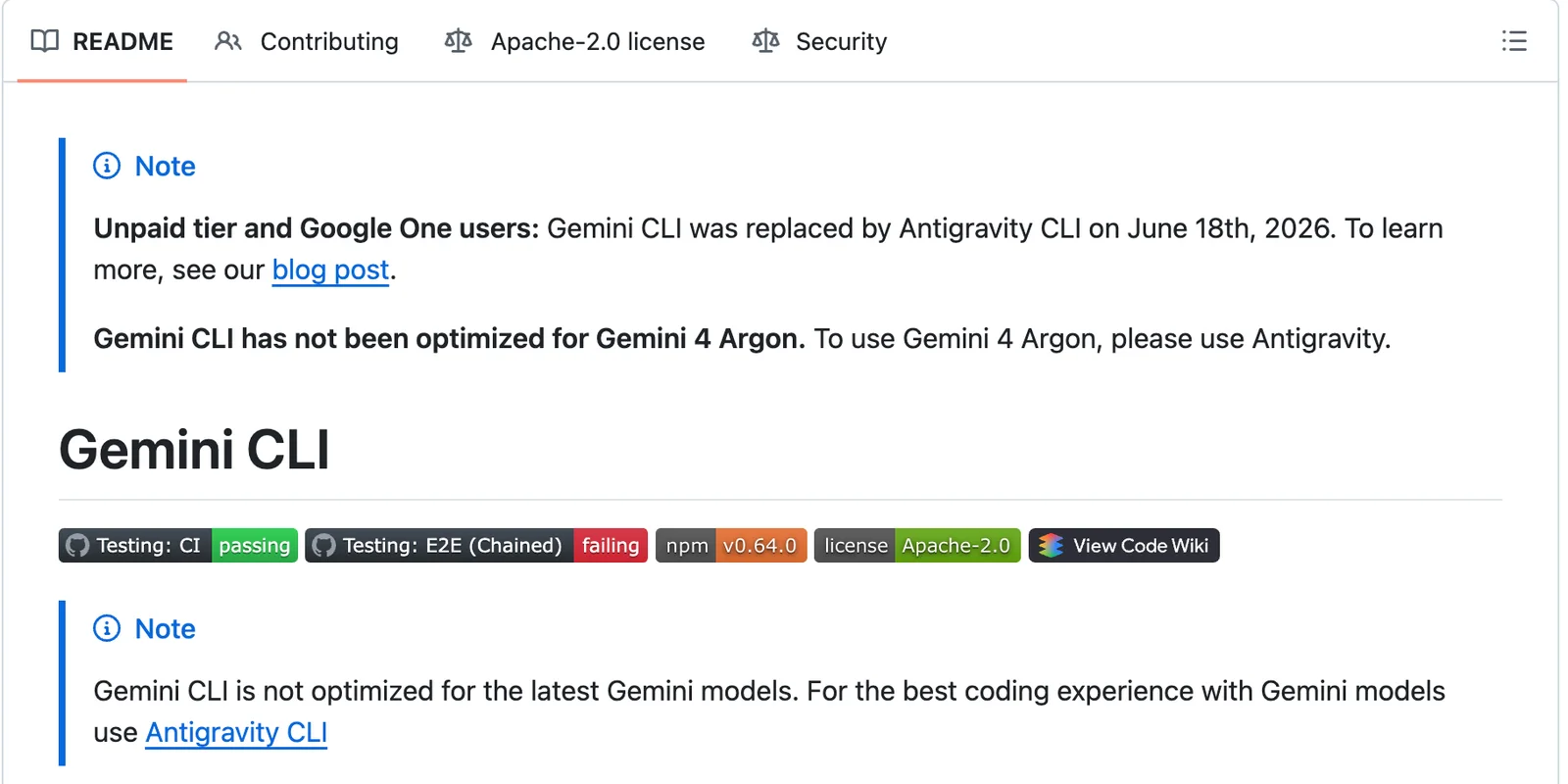
Gemini CLI vs Claude Code is a different choice than it was a year ago. Since 18 June 2026, Gemini CLI no longer accepts consumer Google sign-ins: free accounts and Google AI Pro and Ultra subscribers were moved to a new Google tool, Antigravity CLI (Google's announcement). Gemini CLI itself is still open source, still released weekly, and still works for anyone who pays per token with a Gemini API key, uses Vertex AI, or has a company Gemini Code Assist Standard or Enterprise seat. Claude Code has not changed shape: it needs a paid Claude plan or an Anthropic API key and defaults to Opus 5.5 (model configuration).
The short version: for a developer picking a daily coding agent on a $20 subscription, the choice is now Claude Code with Claude Pro or Antigravity CLI with Google AI Pro, and Google's plan also includes Claude Sonnet 5.5 and Opus 5.5 inside Antigravity on paid, non-trial subscriptions (Antigravity models). Choose Claude Code if Claude is your model and you want the harness, limits and features Anthropic builds around it: a reviewing model in auto mode (permission modes), the most hook events (hooks), cloud sessions and a GitHub Action. Choose Antigravity CLI if you want Gemini 4 Argon, Google's newest model, or one Google plan that covers Gemini and some Claude use. Choose Gemini CLI if your company pays for Code Assist, or if you want an Apache-2.0 agent you can read, fork and bill per token.
Plans, prices, models and features were read from Google's and Anthropic's documentation, pricing pages, source code and GitHub releases on 20 October 2026, signed out, in the US. We installed Gemini CLI 0.64.0 from npm to read its commands but did not sign in to either Google tool, so this is a comparison of access, cost and documented capability, not a measurement of which agent writes better code. Voyager, the desktop app our team builds, runs Claude Code and Codex on your own plans; it is not part of this comparison.
Who can still use Gemini CLI
What matters is how you sign in, not who you are. An individual can still run Gemini CLI with a paid API key; what ended was the consumer sign-in route. As of 20 October 2026:
| How you access Google's models | Gemini CLI | Antigravity CLI |
|---|---|---|
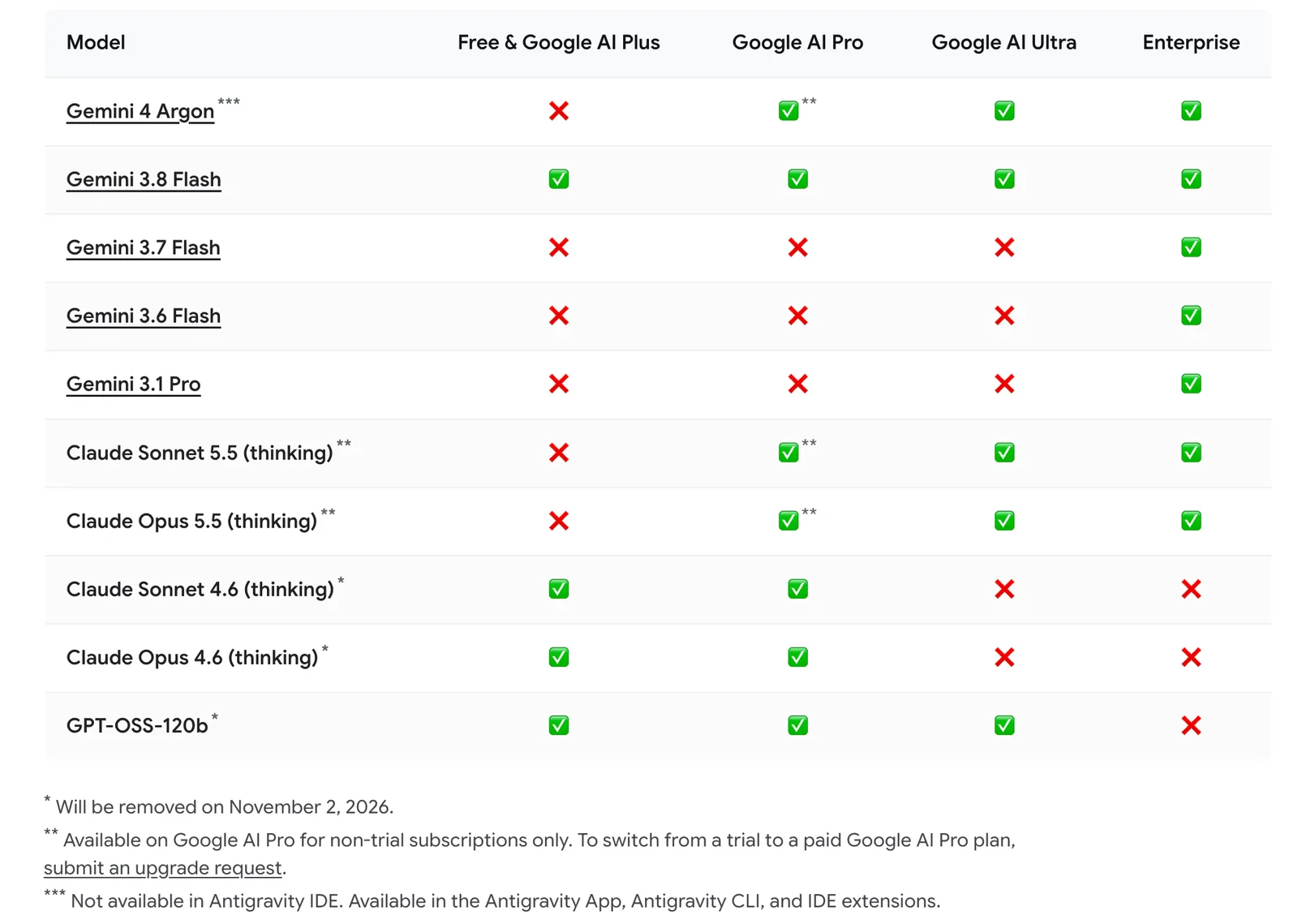
| Sign in with a free Google account | Ended 18 June 2026 | Yes: Gemini 3.8 Flash on a weekly quota |
| Sign in with Google AI Plus ($4.99 a month) | Ended | Yes, same models as free |
| Sign in with Google AI Pro ($19.99) or Ultra ($99.99 or $199.99), paid, non-trial | Ended | Yes: adds Gemini 4 Argon and Claude Sonnet and Opus 5.5 |
| Company Gemini Code Assist Standard or Enterprise seat | Yes: "your access remains unchanged" | Yes, with Google Cloud projects |
| Paid Gemini API key or Vertex AI | Yes, billed per token | Yes, with an API key or Google Cloud credentials |
| Unpaid Gemini API key | Listed in Gemini CLI's quota docs (250 Flash requests a day); not confirmed in the announcement | Uses the key's own API limits |
Sources: transition announcement, Gemini CLI README, Gemini CLI quota and pricing, Antigravity models, Antigravity plans, Antigravity authentication, Google AI subscriptions; read 20 October 2026.
Gemini CLI's quota page still also lists the old 1,000-a-day free Google login and the Pro and Ultra allowances, under a banner saying those users moved on 18 June; trust the banner. The announcement says "Gemini CLI will remain accessible via paid Gemini and Gemini Enterprise Agent Platform API keys" and does not mention unpaid keys. Gemini 3.8 Flash does have a free API tier, which Google lists as used to improve its products (Gemini API pricing).
What each is
Claude Code is Anthropic's coding agent, in the terminal, VS Code and JetBrains, the Claude desktop app, the web and mobile (overview). It is proprietary (licence). It needs Claude Pro, Max, Team or Enterprise, or API billing; the free Claude plan does not include it (pricing).
Gemini CLI is Google's open-source terminal agent, Apache-2.0, written in TypeScript and installed with npm or Homebrew (README). It launched in June 2025 with a free Google login and 1,000 requests a day (Google, 2025). That offer ended, the project did not: stable releases have shipped every week since the cutoff, most recently 0.64.0 on 13 October 2026 (releases). Its README now says it "has not been optimized for Gemini 4 Argon" and recommends Antigravity CLI for the latest Gemini models.
Antigravity CLI (agy) is the terminal side of Google Antigravity, written in Go and sharing its agent harness with the Antigravity desktop app (announcement). It installs from a script (getting started). Its public GitHub repository held a changelog, examples and the issue tracker on 20 October 2026, with no implementation source or licence file (repository).
At a glance
| Claude Code | Gemini CLI | Antigravity CLI | |
|---|---|---|---|
| Ways to pay | Claude Pro from $20 a month; Max; Team; Enterprise; API billing | Code Assist seat; Gemini API or Vertex AI billing | Free; Google AI Plus, Pro or Ultra; Google Cloud; Gemini API key |
| Default model | Opus 5.5 | "Auto": Pro and Flash routing, versions set by access and rollout flags | Not stated in the docs read; /model lists what your plan allows |
| Gemini 4 Argon | No | No built-in entry in 0.64.0 | Yes, on paid Pro and Ultra |
| Claude models | Yes, only Claude | No | Sonnet and Opus 5.5 on paid Pro and Ultra |
| Context window | 1M tokens (Opus and Sonnet 5.5) | 1,048,576 tokens (Gemini 3.x models) | 1,048,576 tokens, input and output combined (Argon) |
| Source | Proprietary | Apache-2.0 | No source in its public repository |
| Instructions file | CLAUDE.md, or AGENTS.md if no CLAUDE.md applies | GEMINI.md; AGENTS.md if configured | GEMINI.md and AGENTS.md |
| Undo agent edits | /rewind | /rewind, plus opt-in Git checkpoints | Not covered in the CLI docs read |
| Hook events | 33 | 11 | 6 |
| OS sandbox | Off by default | Off by default | Off by default in the CLI |
| Headless | claude -p | gemini -p | agy -p |
Sources: Claude Code model configuration, checkpointing, hooks, sandboxing, memory; Gemini CLI models.ts, v0.64.0, rewind, hooks, sandbox, GEMINI.md, Gemini 3.1 Pro Preview; Antigravity models, Gemini 4 Argon, rules, hooks, sandbox; all read 20 October 2026. Hook counts are the event types in each vendor's hooks reference that day.
How they compare
Choosing a model
Claude Code runs Claude models only: Opus 5.5 by default on every paid plan and the API, with Sonnet 5.5, Haiku 5.5 and Fable 5.1 a /model away; Opus and Sonnet 5.5 have a 1M-token window by default (model configuration). Anthropic "doesn't support routing Claude Code to non-Claude models through any gateway" (LLM gateway).
Gemini CLI runs Google's models: Gemini, plus experimental Gemma 4 (models.ts, v0.64.0). In 2025 a maintainer said the team was not "planning on supporting models from other parties", and closed the request (issue #2743). Its default, "Auto", routes between a Pro and a Flash model. In the 0.64.0 source the Pro side resolves to Gemini 3 Pro Preview or Gemini 3.1 Pro Preview, depending on rollout flags, or to Gemini 2.5 Pro without preview access; the Flash side can resolve to Gemini 3.8 Flash. Gemini 4 Argon has no entry in that file. You can pass a model name with -m, and a pull request to add Argon properly was still open on 20 October (PR #29737), but Google points Argon users to Antigravity. The Gemini 3.x models accept 1,048,576 input tokens (Gemini 3.1 Pro Preview).
Antigravity CLI is the only one of the three that runs both families. On paid, non-trial Google AI Pro and Ultra its list includes Gemini 4 Argon, Gemini 3.8 Flash, and Claude Sonnet 5.5 and Opus 5.5 with thinking; free and AI Plus accounts get Gemini 3.8 Flash, plus Claude 4.6 models and GPT-OSS-120B until those are removed on 2 November 2026 (Antigravity models).
Why pay for Claude Code if Google AI Pro includes Claude?
Three differences matter:
- A separate allowance of unknown size. In Antigravity, non-Gemini models "remain on a separate fixed rate limit" because of capacity; the five-times and twenty-times multipliers of the Ultra plans apply to the Gemini pool (Antigravity plan changes). Google does not publish that Claude limit, and Anthropic does not publish token counts for Claude Pro either (Claude Code with Pro or Max), so no like-for-like comparison is possible. A Claude plan is simply an independent allowance on top.
- A different harness. Claude in Antigravity runs with Google's system prompts, tools, hooks and permission model, not Anthropic's (Antigravity hooks, permissions). We found no public benchmark of Claude in Antigravity, so whether that helps or hurts is unknown.
- What comes with it. A Claude plan also covers Claude Code's cloud sessions, which keep running when your laptop sleeps, and its official GitHub Action (Claude Code on the web, GitHub Actions).
If you already pay Google AI Pro, try Claude inside Antigravity first. When a limit runs out, each vendor lets you wait for the reset or pay for overage: Google AI Pro and Ultra can spend purchased AI credits (Antigravity plans), and paid Claude plans can switch to usage credits at standard API rates (usage credits). Remember that Claude chat, Claude Code and its cloud sessions all draw on the same Claude plan limits. If Antigravity's Claude limit runs out too often, a Claude plan adds Claude capacity of its own. Note that Google's terms do not allow driving Antigravity from third-party tools on consumer plans (Antigravity FAQ).
Paying for it
The three meter usage differently, so compare by your situation. As of 20 October 2026:
| Situation | Claude Code | Gemini CLI | Antigravity CLI |
|---|---|---|---|
| $0 | Not available | Unpaid API key (see the access table above) | Free account: Gemini 3.8 Flash, weekly quota |
| About $20 a month | Claude Pro: $20, or $200 a year | No personal subscription | Google AI Pro: $19.99, five-hour quota up to a weekly cap |
| $100 to $200 a month | Max 5x $100, Max 20x $200 | No personal subscription | Ultra $99.99 (5x Pro's Gemini tokens) or $199.99 (20x) |
| Company seat | Team Standard $25 a seat a month, $20 billed annually | Code Assist Standard $22.80 a user a month, $19 annually; Enterprise $54 or $45 | Gemini Enterprise through Google Cloud |
| Pay per token (per 1M, input / output) | Opus 5.5 $4 / $20; Sonnet 5.5 $2 / $10; Haiku 5.5 $0.10 / $0.50 | Gemini 3.1 Pro Preview $2 / $12; Gemini 3.8 Flash $0.75 / $3.75 | Gemini API rates, Argon $2 / $10 |
Sources: Claude pricing, Max plan, Anthropic API pricing; Code Assist pricing, Gemini API pricing; Google AI subscriptions, Antigravity plans, Antigravity plan changes; read 20 October 2026. Gemini rates are standard tier for prompts up to 200,000 tokens; Haiku 5.5's rate is for prompts up to 100,000 tokens.
Three things the table cannot show:
- Subscriptions do not promise a number. Claude Pro and Max have five-hour and weekly limits with no published token count (Claude Code with Pro or Max). Antigravity's limits depend on how much work the agent does and "are subject to modification" (plans). Code Assist is the exception: 1,500 model requests per user per day on Standard and 2,000 on Enterprise, shared between Gemini CLI and IDE agent mode, and one prompt can use several requests (Code Assist quotas).
- Two prices change soon. Gemini 4 Argon goes from $2 and $10 to $4 and $20 per million tokens on 1 December 2026, the same as Opus 5.5; Gemini 3.8 Flash doubles to $1.50 and $7.50 on 1 January 2027 (Gemini API pricing).
- Token price is not cost per task. One API request with 100,000 uncached input tokens and 5,000 output tokens (thinking included) costs, at the standard rates above, $0.50 on Opus 5.5, $0.25 on Sonnet 5.5 or on Argon until December, $0.26 on Gemini 3.1 Pro Preview, about $0.09 on Gemini 3.8 Flash and about $0.01 on Haiku 5.5 (Anthropic API pricing, Gemini API pricing). An agent makes many such requests per task, cache hits can cut the cost of repeated input (writing and storing caches can add charges), and how many requests a task takes depends on the model and harness, which no price list tells you.
For occasional or automated use, an API key with either tool means paying only for what runs; for daily interactive use, a subscription caps the monthly bill.
Day-to-day coding: plan, review, undo
- Planning. All three have a planning mode that researches and proposes changes before making them: Claude Code's
planpermission mode, Gemini CLI's--approval-mode plan, and Antigravity'splanmode, which ends with a plan for you to approve. How strictly each blocks writes differs, so keep permissions in place too (Claude Code permission modes, Gemini CLI configuration, Antigravity modes). - Reviewing edits. Gemini CLI's VS Code companion shows proposed changes as native diffs you can edit, accept or reject; Antigravity's default mode shows an inline diff to accept or reject; Claude Code asks before edits in manual mode, while auto mode lets routine edits through (Gemini CLI IDE integration, Antigravity modes, Claude Code permission modes).
- Undo. Claude Code and Gemini CLI both have
/rewind, also on a double Escape with an empty prompt, which can roll back the conversation, the agent's file edits, or both (Claude Code checkpointing, Gemini CLI rewind). In both, it covers edits made through the agent's file tools, not changes made by shell commands or by hand, and Claude Code's rewind usually misses edits made by subagents, so git is still your real safety net. Gemini CLI adds opt-in checkpoints in a shadow git repository, restored with/restoreonce you setgeneral.checkpointing.enabled(checkpointing). - Resuming. Claude Code and Gemini CLI both save sessions and resume them with
--resume(Claude Code CLI reference, Gemini CLI sessions); Antigravity uses--continueor a conversation ID (headless). - Parallel work. Claude Code starts a session in a new git worktree with
-w(CLI reference). Gemini CLI 0.64.0 has the same flag, but worktrees are experimental there and needexperimental.worktreesturned on and a restart first (git worktrees). Antigravity runs concurrent background agents you monitor with/agents(Antigravity CLI). - Editors. Claude Code has VS Code and JetBrains extensions (overview). Gemini CLI has a VS Code companion for open-file context and native diffs, and speaks the Agent Client Protocol natively with
--acp(IDE integration, ACP mode). Zed runs both, Claude through an adapter (Zed external agents, Zed on its Claude adapter).
Long sessions are handled differently too. Claude Code compacts the conversation at about 967,000 tokens by default on its 1M-token models (model configuration); Gemini CLI compresses when half the context is used, a fraction you can change with model.compressionThreshold (configuration). Neither default tells you which keeps track of a task better. With any of them, commit before long unattended runs.
Customizing it: MCP, skills, hooks and subagents
All three load MCP servers, Agent Skills, subagents and hooks; the formats and the depth differ.
- MCP. Claude Code stores servers in
.mcp.jsonor~/.claude.jsonviaclaude mcp add(Claude Code MCP). Gemini CLI reads anmcpServersblock in.gemini/settings.json(Gemini CLI MCP). Antigravity moved them tomcp_config.jsonand renamed remoteurlandhttpUrltoserverUrl, so configs do not copy across unchanged (Antigravity MCP). - Skills. All three follow the Agent Skills format, a folder with a
SKILL.md. Gemini CLI reads.gemini/skillsor.agents/skills, Antigravity.agents/skills, Claude Code.claude/skills(Gemini CLI skills, Antigravity skills, Claude Code skills). - Packaging. Claude Code bundles skills, agents, hooks and MCP servers into plugins installed from marketplaces (plugins). Gemini CLI's extensions do the same and can add custom commands written in TOML (extensions). Antigravity has plugins and converts old extensions with
agy plugin import gemini(migration guide). - Hooks. Claude Code lists 33 hook events, covering failed tool calls, file changes, worktrees and permission requests among others (Claude Code hooks). Gemini CLI lists 11, but three have no Claude Code counterpart:
BeforeModelandAfterModel, which can rewrite or redact what goes to and comes back from the model, andBeforeToolSelection, which can filter the tools the model sees (Gemini CLI hooks). Antigravity lists six, and its 1.4.3 release notes warn that a Claude Code hooks file is misread as a single hook (Antigravity hooks, release 1.4.3). - Subagents. Claude Code and Gemini CLI both define custom agents as Markdown files, in
.claude/agents/and.gemini/agents/(Claude Code subagents, Gemini CLI subagents), and Gemini CLI can also call remote agents over the A2A protocol (remote agents).
Choose Claude Code if you rely on hooks across many lifecycle events. Choose Gemini CLI if you need to intercept model requests themselves, for example to strip secrets before they leave the machine.
Keeping it contained
No terminal tool here turns on an operating-system sandbox by default; what differs is what each does instead.
Claude Code starts interactive sessions in auto mode, where a classifier model approves routine actions and stops risky ones; claude -p starts in manual mode (permission modes). Its sandbox, switched on with /sandbox, wraps shell commands with Seatbelt on macOS and bubblewrap on Linux; native Windows is not supported, and Anthropic points Windows users to WSL2 (sandboxing).
Gemini CLI's default mode asks before most writes and lets read-only tools run; auto_edit approves edits and yolo approves everything. A TOML policy engine can allow, deny or ask by tool and command prefix (policy engine). Its sandbox, switched on with -s, can wrap the whole CLI process, with the widest choice of backends: macOS Seatbelt profiles, Docker or Podman, gVisor on Linux, LXC, and a native Windows sandbox; a newer setting, security.toolSandboxing (off by default; set it to true and restart), isolates individual tool calls instead (sandbox, configuration). The default macOS profile limits writes to the project but leaves reads and the network open; stricter profiles exist.
Antigravity CLI reviews edits by default, with accept-edits, plan and, since 1.3.5, an auto mode on macOS and Linux in which a separate agent reviews commands that would leave the sandbox (modes, release 1.3.5). Its sandbox is off by default in the CLI, on by default in the desktop app on macOS and Linux, and when on it closes the network except for domains you allow (sandbox).
Choose Gemini CLI if you want the agent inside a container you define, or a sandbox on native Windows. Choose Claude Code if you want a reviewing model to cut prompts in interactive work; turn on /sandbox as well if you leave it unattended.
Scripts and CI
All three run non-interactively with -p and emit json or stream-json (Claude Code headless, Gemini CLI headless, Antigravity headless). For GitHub, Anthropic maintains anthropics/claude-code-action and Google maintains google-github-actions/run-gemini-cli, which authenticates with an API key or Workload Identity Federation (Claude Code GitHub Actions, run-gemini-cli). In headless runs, Gemini CLI's policy engine turns any rule that would ask a person into a denial (policy engine).
Antigravity's headless mode "is intended for direct scripting and CI workflows", but wrapping agy inside third-party coding agents or apps, or rotating accounts, is not supported on consumer plans (Antigravity FAQ). For CI, use API or Cloud credentials with any of them rather than a personal subscription.
Open source, data and the next change
Gemini CLI is the only open-source agent of the three, which means the code can be forked and maintained by others if Google narrows access again (licence). The transition is also the reason to weigh that: Google ended consumer access a month after announcing it, users asked whether the replacement would be open source (issue #27304), and Google AI Pro subscribers reported sign-in rejections after the cutoff (issue #28229).
On data, your plan decides. Anthropic trains on Claude Code sessions from Free, Pro and Max accounts only if you allow it in your privacy settings; Team, Enterprise and API traffic is excluded unless an organization opts into a data-sharing program (data usage). Standard paid Gemini API traffic is not used to improve Google's products, while the free tier is (Gemini API pricing). Antigravity's terms for personal accounts let Google use interactions to improve its products unless you opt out in settings (Antigravity terms). Gemini CLI sends usage statistics by default; set privacy.usageStatisticsEnabled to false and restart to stop them (configuration).
What the benchmarks show
The independent results are historical and do not name a winner for today's versions. In the maintainer-run Terminal-Bench 2.1 records, Gemini CLI 0.40.0 with Gemini 3.1 Pro Preview at high effort scored 65.8% (standard error 1.7), against 65.6% for the same model in the generic Terminus 2 harness; Claude Code 2.1.123 with Opus 4.7 at max effort scored 68.9% (1.4) against 66.1% (1.4), and Claude Code 2.1.205 with Opus 4.8 at high effort, run in July, 78.9% (Terminal-Bench 2.1 submissions). A July paper on generating and updating tests in Java projects found the two native harnesses level, 77.5% each on test generation with Opus 4.7 and Gemini 3.1 Pro, and both ahead of the same models in SWE-agent (TestEvo-Bench). None of these uses Opus 5.5 or Gemini 4 Argon, and none tests Antigravity.
User reports are not measurements, but they show what people trip over. In an April 2026 thread on why Gemini CLI trailed Claude Code, users named model availability, repeated permission prompts and stalled responses, while another wrote of Gemini 3.1 Pro, "So far it's working great" (r/GeminiCLI). In a March 2026 Hacker News discussion, the poster found Gemini slower but roomier and wrote, "Claude is pretty fast but I usually run out of tokens" (Hacker News).
Moving between them, or using both
One AGENTS.md can serve all three:
- Claude Code reads
AGENTS.mdwhen noCLAUDE.mdorCLAUDE.local.mdapplies in the working directory or above it; otherwise add a line reading@AGENTS.mdto yourCLAUDE.md(memory). - Gemini CLI reads
GEMINI.mdunless you listAGENTS.mdincontext.fileNamein.gemini/settings.json(GEMINI.md):
{ "context": { "fileName": ["AGENTS.md", "GEMINI.md"] } }
- Antigravity CLI reads both
AGENTS.mdandGEMINI.md(rules).
For skills, keep one folder at .agents/skills, which both Google tools read, and point Claude Code at it. If .claude/skills already exists, move its contents into .agents/skills and remove the empty folder first, or the link lands inside it:
mkdir -p .claude && ln -s ../.agents/skills .claude/skills
If you lost Gemini CLI access in June, Antigravity's migration guide covers the moves: extensions through agy plugin import gemini, skills from .gemini/skills to .agents/skills, and MCP servers from settings.json to mcp_config.json (migration guide). Moving to Claude Code instead means re-adding MCP servers with claude mcp add and rewriting hooks, since the event names differ. And if you want a Gemini second opinion inside Claude Code, it can run gemini -p as an ordinary shell command on your Gemini billing.
Which to choose
| If you | Choose | Because |
|---|---|---|
| Want Claude in Anthropic's own harness | Claude Code | Opus 5.5 by default, auto mode, cloud sessions, 33 hook events |
| Already pay Google AI Pro or Ultra | Antigravity CLI first | Gemini 4 Argon and some Claude 5.5 use at no extra cost |
| Want Gemini 4 Argon | Antigravity CLI | Gemini CLI has no built-in entry for it and Google recommends Antigravity |
| Have a Code Assist Standard or Enterprise seat at work | Gemini CLI | Included, with 1,500 or 2,000 model requests a day |
| Want an open-source agent you can fork | Gemini CLI | Apache-2.0, weekly releases |
| Need the agent inside a container, or a sandbox on native Windows | Gemini CLI | Docker, Podman, gVisor, LXC and Windows sandboxes |
| Pay per token for occasional or CI use | Either, with an API key | Gemini 3.8 Flash is cheaper than Sonnet 5.5; Haiku 5.5 is cheaper than both on short prompts |
| Want to redact or rewrite model requests in hooks | Gemini CLI | BeforeModel and AfterModel hooks |
Sources: Antigravity models, Gemini CLI README, Code Assist quotas, Gemini CLI sandbox, Gemini CLI hooks, Claude Code hooks, Anthropic API pricing, Gemini API pricing; read 20 October 2026.
Frequently asked questions
Is Gemini CLI still free? Not through a Google sign-in, which ended on 18 June 2026 (Google's announcement). An unpaid API key may still work, as described in the access table above. Google's free terminal agent is now Antigravity CLI, with Gemini 3.8 Flash on a weekly quota (Antigravity models).
Is Gemini CLI discontinued? No. It ships weekly stable releases and serves paid API keys, Vertex AI and Code Assist Standard and Enterprise (releases); Google recommends Antigravity CLI for the newest Gemini models (README).
Can Claude Code use Gemini models? Not officially: Anthropic does not support routing Claude Code to non-Claude models through any gateway (LLM gateway).
Which has the bigger context window? They are level at about a million tokens: Opus 5.5 and Sonnet 5.5 have 1M by default in Claude Code, and the Gemini models in both Google tools have 1,048,576 (Claude Code model configuration, Gemini models). Gemini 4 Argon's window counts input and output together (Gemini 4 Argon).
Is Antigravity CLI open source? Its public GitHub repository, on 20 October 2026, held a changelog, examples and an issue tracker, and no implementation source or licence file (repository). Gemini CLI remains Apache-2.0.
Voyager is a desktop AI agent for creative work
Describe what you want to make; Voyager plans it, uses your apps and tools, and keeps everything editable.