Choose GitHub Copilot for completions as you type, one subscription across model vendors, an agent you assign from GitHub issues, or seats and policies your company already runs. Choose Claude Code if Claude does most of your agent work and a Claude plan's limits fit it. Published comparisons of the two agents on the same model have not shown either one producing reliably better code, so if you already use Opus in Copilot, a Claude plan buys you a different agent loop and a different meter, not demonstrably better results.
The meter is the bigger difference for a heavy Claude user: Copilot debits Claude per token at Anthropic's list prices from a monthly credit allowance, while a Claude plan meters Claude Code by five-hour and weekly limits. You can also run both: Copilot for completions (Free, or Pro at $10) and Claude Pro at $20 for the agent, $20 to $30 a month at monthly prices, against $39 for Copilot Pro+ alone.
Plans, prices, model lists and capabilities come from GitHub's and Anthropic's documentation, pricing pages and changelogs, read signed out on 20 October 2026 in the US. I have not run either product for this post; results and token figures come from the published studies credited where they appear. Voyager, the desktop app our team builds, also runs Claude Code with your existing Claude sign-in and plan limits for creative work in Photoshop and Blender, with those apps installed.
Which to choose
| If your work is mostly | Choose | Because |
|---|---|---|
| Writing code yourself, with suggestions as you type | Copilot Pro, or Free | Unlimited completions on paid plans, 2,000 a month on Free; Claude Code has none |
| Daily agent work on Claude, especially Opus | Claude Code on Pro, then Max if you hit limits | Within its limits, a Claude plan holds far more Claude than the same money in credits, by the one published estimate below |
| Light agent use, or you would rather pay per token than wait for a limit to reset | Copilot Pro or Pro+ | No five-hour window; extra credits cost list price, but only if you have never subscribed through GitHub Mobile (purchase eligibility); check the bills below |
| Agents across Claude, GPT and Gemini | Copilot Pro+ or Max | One allowance and one CLI across vendors |
| Assigning issues and getting pull requests back | Copilot cloud agent | Built into GitHub with policies included; sessions stop at 59 minutes |
| Claude in CI, on your own runners and triggers | Claude Code GitHub Action | Any workflow event, billed to a Claude plan or an API key |
| Visual Studio, Xcode or Eclipse | Copilot | Its agent mode runs there; Claude Code integrates with VS Code and JetBrains |
| Work already pays for Copilot Business | Keep it; add a personal Claude plan only if your employer allows another agent on its code | Your Copilot seat costs you nothing; measure whether its pooled credits run out |
What each product is
Claude Code is Anthropic's coding agent. It reads a repository, edits files and runs commands from a terminal, IDE, desktop app or browser (Claude Code overview).
GitHub Copilot is GitHub's AI coding assistant. It combines suggestions as you type with chat, code review and agents that work on assigned tasks (about GitHub Copilot).
Model, harness and bill are three separate choices
"Claude in Copilot" can mean several setups. They differ in the agent loop doing the work (the harness) and in who bills you:
| Setup | Harness | Who pays for Claude |
|---|---|---|
| A Claude model picked in Copilot chat, agent mode, the CLI or the cloud agent | Copilot's own; VS Code offers two, the Copilot harness (GitHub Copilot SDK) and Local (VS Code's built-in agent) | Copilot AI credits; Local also accepts your own model credentials |
| The Claude harness in VS Code | Anthropic's Claude Agent SDK | Copilot credits, or your own Claude API key |
| The Claude coding agent on GitHub (public preview) | Anthropic's Claude Agent SDK | Copilot credits plus GitHub Actions minutes |
| Claude Code in the terminal, an IDE, the desktop app or the cloud | Claude Code | Your Claude plan's limits, or an API key |
| The Claude Code GitHub Action | Claude Code, on your runners | A Claude plan token or an API key, plus your Actions minutes |
Sources: supported models, third-party coding agents, VS Code agent harnesses, Claude Code platforms, Claude Code GitHub Actions; read 20 October 2026.
Three consequences:
- Picking Opus in a Copilot or Local harness session is not trying Claude Code. VS Code's docs: "selecting a Claude model in a Copilot harness session still uses the Copilot harness." VS Code shows the active harness as a prefix in the chat title, and you choose it in the Session Target control before the first prompt (agent harnesses).
- I found no documented Copilot route that spends a Claude Pro or Max subscription. VS Code's Claude harness bills Copilot credits or a Claude API key. To use your plan in VS Code or JetBrains, install Anthropic's Claude Code extension, which runs alongside Copilot;
/usagein Claude Code shows how much of your plan's limits you have used (commands). - Opus on Copilot Pro is unclear. The model-picker table excludes Opus and Fable on Pro; the Claude coding agent is listed for Pro and above, and its model list (Sonnet 4.6 and 5, Opus 4.8 and 5, Fable 5.1, no 5.5 models yet) includes Opus without saying which plans get which models (supported models, third-party agents). Plan on Pro+ for Opus.
At a glance
| Claude Code | GitHub Copilot | |
|---|---|---|
| Completions and next edit suggestions | None | Unlimited on paid plans; 2,000 completions a month on Free |
| Agent in the editor | VS Code and forks, JetBrains | VS Code, Visual Studio, JetBrains, Xcode, Eclipse |
| Cloud agent | Cloud sessions, on Anthropic's VMs by default | Copilot cloud agent, in GitHub Actions-powered environments |
| Pull request review | /code-review on any plan; managed Code Review on Team and Enterprise | Copilot code review on paid plans and Student |
| Models | Claude only; Opus 5.5 by default on Anthropic accounts | Claude, GPT, Gemini, Grok, Kimi and Microsoft models, by plan |
| Context for Opus 5.5 | 1M tokens by default | 1M opt-in, in VS Code and the CLI only |
Sources: Copilot feature matrix, plans, supported models; Claude Code platforms, model configuration, cloud sessions, Code Review; all read 20 October 2026.
Claude Code has no completions as you type: in VS Code it is a chat panel with inline diffs, and in JetBrains a plugin connects the terminal CLI to the IDE's diff viewer (VS Code, JetBrains). Copilot's next edit suggestions are in VS Code and Visual Studio, and in preview in JetBrains, Xcode and Eclipse (feature matrix).
What is known about results
I found no large, independent comparison of the two agents on the same model for general coding as of 20 October 2026. What has been published compares Copilot CLI and the Claude Code CLI, not the IDE agents or cloud agents:
- GitHub's own benchmark, June 2026, on Sonnet 4.6 and Opus 4.7, run single-turn and non-interactively with settings normalized. Copilot CLI resolved tasks within about 3 percentage points of Claude Code on SWE-bench Verified, SWE-bench Pro and TerminalBench 2, 2.4 and 7.1 points more on GitHub's internal Windows benchmark, and 5.4 and 8.0 points fewer on SkillsBench, which tests use of skills. It used 31% to 65% fewer median tokens on every benchmark (GitHub, 25 June 2026). GitHub ran it and chose the settings, reported the best of five runs on benchmarks under 100 tasks, and both models have since been replaced.
- A small independent study, July 2026, mostly testing add-on configuration frameworks, included bare runs of both CLIs on Opus 4.8 with the same prompt. On a small command-line tool both passed all 12 acceptance checks, Claude Code in 8 minutes 38 seconds and Copilot CLI in 4 minutes 32 seconds; on a larger Rust service both passed 24 of 26 tests, in 36 and 20 minutes. Two AI reviewers scored Claude Code a little higher on both (95 to 92, 84.5 to 77.5). There was one run per cell, and the author found a repeated cell varied 44% in time and flipped a correctness check (kenhia/harness-eval).
- Practitioners disagree. In an r/GithubCopilot thread on exactly this question, started 7 August 2026, several people who use both daily see little difference with the same model; others prefer Claude Code's permission handling and memory across sessions, or Copilot's one-click view of raw tool output and its debug logs (r/GithubCopilot).
So the evidence is thin and points both ways: Copilot CLI has been leaner in GitHub's test and faster in one small independent one, Claude Code scored slightly higher in that one, and none of it predicts what you will see on your own repository. To find out, start both from the same commit with the same model and effort, give the same written task with tests that define done, and compare whether the tests pass, how often you had to step in, how long the diff takes to review, and what the run cost in credits or limit used.
How each meters Claude
GitHub replaced premium requests with GitHub AI Credits on 1 June 2026: "premium request units (PRUs) will be replaced by GitHub AI Credits", charged on input, output and cached tokens (GitHub's announcement). One credit is $0.01. Model multipliers, the "Opus costs 3 premium requests" rule you may remember, survive only for Pro and Pro+ subscribers who kept an annual plan, and those plans "will not receive access to new models and features" (legacy multipliers).
| Copilot plan | Price | AI credits included each month | Claude models in the picker |
|---|---|---|---|
| Free | $0 | Unspecified allowance | Auto selection only |
| Student | $0, verified students | Unspecified allowance | Auto selection only |
| Pro | $10 | 1,000 base + 500 flex = 1,500 ($15) | Haiku 4.5 and 5.5, Sonnet 5 and 5.5 |
| Pro+ | $39 | 3,900 base + 3,100 flex = 7,000 ($70) | Adds Opus 4.8, 5 and 5.5 and Fable 5 and 5.1 |
| Max | $100 | 10,000 base + 10,000 flex = 20,000 ($200) | Same as Pro+, with priority access |
| Business | $19 a seat | 1,900 a seat, pooled across the organization | Same as Pro+ |
| Enterprise | $39 a seat | 3,900 a seat, pooled | Same as Pro+ |
Sources: plans, billing for individuals, for organizations; read 20 October 2026.
- Claude is debited at Anthropic's list prices. Opus 5.5 costs $4 per million input tokens, $0.20 cached, $5 for cache writes and $20 for output; Sonnet 5.5 costs $2, $0.10, $2.50 and $10 (Copilot models and pricing). Those are Anthropic's API rates, with the cache write at Anthropic's five-minute price (Claude API pricing). The saving is in the allowance: individual plans include more credits than they cost, so fully used, Pro+ buys $70 of list-price Claude for $39 and Max $200 for $100. Business and Enterprise include exactly their seat price. On paid plans, letting Auto choose the model takes 10% off model costs in Copilot Chat, the CLI, the Copilot app and cloud agent.
- Half of Max is flex. Base credits "match with your subscription price and they never change"; the flex allotment "is designed to adapt as the economics of AI evolve" (billing for individuals). Credits reset at 00:00 UTC on the first of the month and do not roll over.
- Running out stops the agents, not completions. Completions stay unlimited on paid plans; chat, the CLI, cloud agent and third-party agents need credits. Individuals can upgrade, set a budget for more at the same rates, or wait. Buying additional credits is unavailable if you currently subscribe, or previously subscribed, to a Copilot plan through GitHub Mobile on iOS or Android (purchase eligibility). Organizations have additional usage "enabled by default", and "There is no automatic fallback to lower-cost models when a budget is exhausted" (organization billing).
- Context you do not see is billed. System prompts and tool definitions are input tokens on every model call; one Copilot Pro user saw 9.39 credits charged for "hi there" in the CLI (r/GithubCopilot, 4 June 2026).
A Claude plan meters differently. Pro and Max have "a session limit that resets every five hours, and weekly limits that reset once every week": an allowance per window, not five hours of coding time (usage and length limits). The limits are shared between Claude chat and Claude Code; Claude Code warns as you approach one, and at the five-hour limit it may keep working briefly to finish the step in progress (using Claude Code with Pro or Max). Anthropic publishes no token figure. At a limit you wait for the reset, upgrade, or pay usage credits at API rates (usage credits). Max 5x and 20x give 5 and 20 times Pro's per-session allowance; Fable needs usage credits on Pro and is capped at half the weekly limit on Max (Max plan, Claude pricing).
What the money buys
Neither vendor converts its allowance into work, so here are the published reference points and what they cannot tell you.
Anthropic's average for Claude Code. Across enterprise deployments, Anthropic puts Claude Code at "around $13 per developer per active day and $150-250 per developer per month" at API rates, "with costs remaining below $30 per active day for 90% of users" (Claude Code costs). Copilot debits the same rates, so if the same work used the same tokens, which neither vendor publishes and GitHub disputes (see above), here is what each month's bill would be with additional usage turned on, before tax and Actions minutes. This assumes your account is eligible to buy additional Copilot credits:
| Monthly Claude usage at list prices | Copilot Pro+ ($39, $70 included) | Copilot Max ($100, $200 included) | Claude Pro or Max 5x |
|---|---|---|---|
| $70 | $39 | $100 | $20 or $100, if it fits the limits |
| $150 (low end of Anthropic's average) | $119 | $100 | $20 or $100, if it fits the limits |
| $250 (high end) | $219 | $150 | $20 or $100, if it fits the limits |
| $500 | $469 | $400 | $20 or $100, if it fits the limits; usage credits at API rates past them |
This is arithmetic, not a measured workload: Pro+ and Max cost the same at $131 of monthly usage, and above that Max is cheaper. Copilot Pro ($10, $15 included, no Opus in the picker) costs $10 up to $15 of usage, equals Claude Pro's $20 at $25 of usage, and exceeds it above $25, if that work fits Claude Pro's limits (Copilot allowances and rates, Claude pricing). Copilot could also use fewer tokens for the same task (GitHub reported 31% to 65% fewer, on older models), but those studies do not establish the dollar effect on this table: token types are priced very differently, and cached input, 96.6% of tokens in the workload below, costs a twentieth of fresh input on Opus 5.5.
A third-party estimate of what Claude plans hold. SemiAnalysis measured how far each token type moves the Claude Code usage meter, then priced each plan's monthly limit, capped by the weekly limits, at list API rates, for an agentic workload of 0.4% input, 96.6% cached input, 2.6% cache writes and 0.3% output. In its 5 October 2026 snapshot, a month of Opus 5.5 came to $1,178 on Pro, $5,725 on Max 5x and $11,726 on Max 20x, 57 to 59 times the fee (SemiAnalysis). That is a modelled ceiling for one workload, worth it only if you use those limits, and not a measure of completed work; SemiAnalysis is not affiliated with Anthropic.
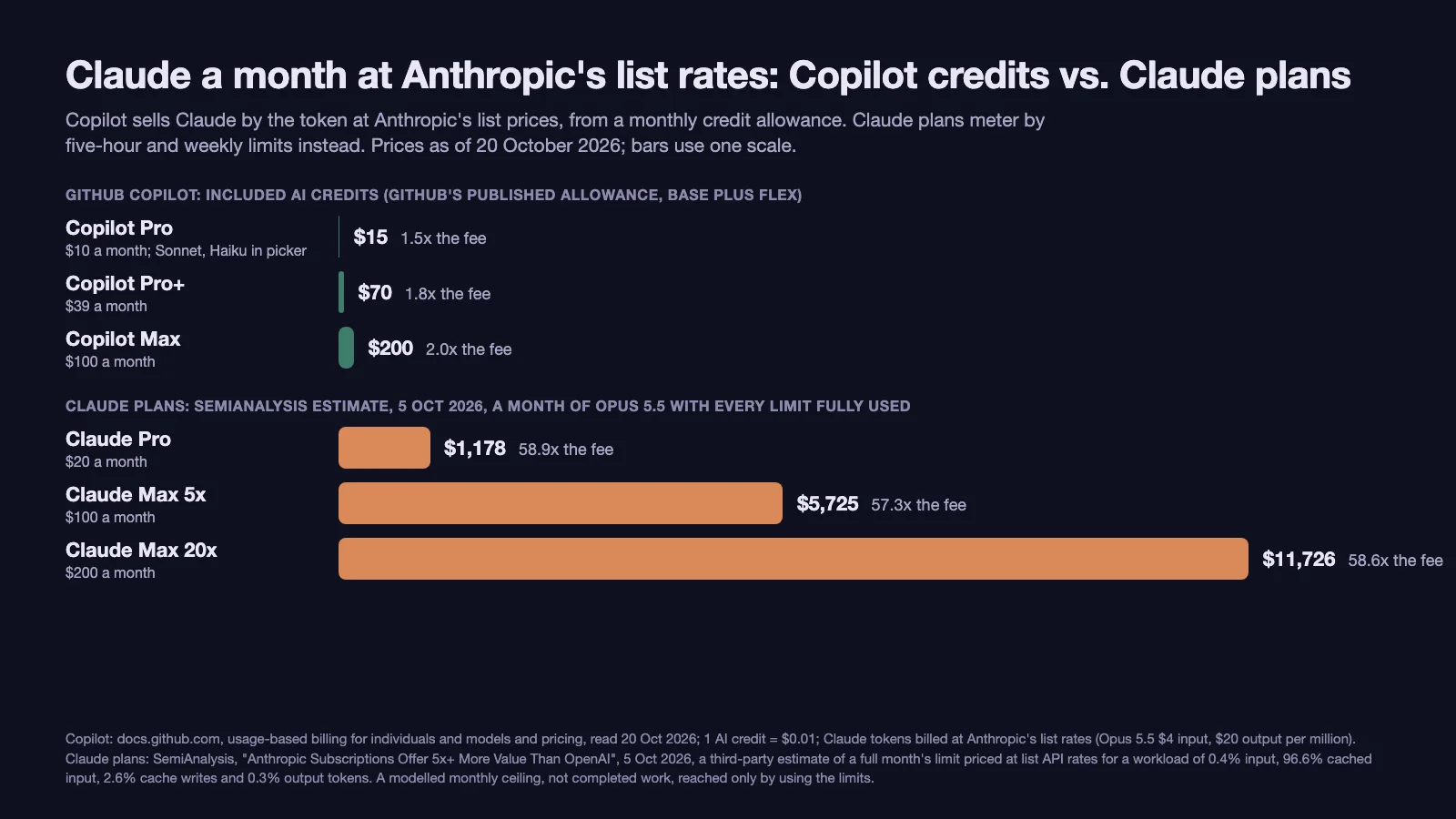
What this means for buying. If you would use Opus in an agent most workdays, the published estimate puts far more list-price Claude inside a $20 or $100 Claude plan than inside any Copilot plan's credits. Within the included limits the Claude fee stays fixed; past them you wait for a reset or pay usage credits at API rates, while a Copilot bill rises with every token past its allowance. Copilot's pool has no five-hour window, which suits you if you would rather pay than wait and are eligible to buy additional credits, but whether it is cheaper depends on your model and monthly spend, not on how bursty your use is, so price it with the table above. On a Claude plan, start with Pro and move to Max when /usage shows you reaching the five-hour or weekly limit often; on Copilot, the usage dashboard shows credits spent, and the CLI has soft spending limits in public preview (session limits).
To price your own history, the open-source ccusage tool reads the token counts both CLIs write to local logs and estimates their cost at API list prices. For Claude Code users that is roughly what the same tokens would cost in Copilot credits, though not what your plan actually charged and not a forecast of Copilot's own token use; Copilot CLI users can run the same report on theirs:
npx ccusage@latest claude daily
npx ccusage@latest copilot daily
Decide by workflow
Writing code with an assistant in the editor
Only Copilot does this. Completions predict code at the cursor and next edit suggestions predict your next change; both are unlimited on paid plans and outside credit billing (Copilot in IDEs). Claude Code does not do this. If you mostly type code yourself, Copilot is the tool and Claude Code an addition.
Handing a multi-file change to a local agent
Both CLIs plan, edit, run tests, use subagents and run headless with -p. Copilot CLI adds an autopilot mode, a /delegate command that hands the task to the cloud agent, a native OS sandbox generally available since 7 October 2026, and switching between model vendors mid-session (command reference, local sandboxing GA).
Stopping and undoing work differs in a way that matters on a long run. In Claude Code, Esc stops the running turn and keeps the work done so far (interactive mode); in Copilot CLI, pressing it twice does. Both have a /rewind command that restores files to an earlier prompt. Claude Code's restores only edits made with its own file-editing tools: files changed by shell commands, and most subagent edits, stay changed (checkpointing). Copilot CLI's tracks file changes per turn across editing tools, shell commands and subagents, and skips files you have since edited yourself; its experimental /diff reviews the changes in the terminal (command reference). In Claude Code you review diffs in VS Code or JetBrains, or with git. Commit before a long run either way.
Claude Code's other differences are context and the meter. Opus and Sonnet 5.5 run with the full 1M-token window by default (model configuration); in Copilot it is an opt-in "available in Visual Studio Code and Copilot CLI only", which GitHub warns uses more credits (supported models). On a Claude plan a three-hour Opus session draws on limits; on Copilot each model call bills its context, cached or not, at per-token rates.
Choose Claude Code for long Opus sessions where a Claude plan's limits fit and you want the 1M window by default. Choose Copilot CLI for one terminal agent across model vendors, with broader undo and the cloud agent one command away.
Assigning GitHub issues to an agent
Assign an issue to Copilot, mention @copilot on a pull request, or start a task from the Agents tab, your IDE, Slack, Teams or Linear; the cloud agent works in an ephemeral GitHub Actions-powered environment, and assigning an issue opens a pull request (starting sessions). It costs AI credits plus Actions minutes. The documented limits: one repository, one branch and one pull request per task, and a hard 59-minute session maximum (Copilot on GitHub.com). Only users with write access can trigger it, it cannot approve or merge its own pull request, and workflows on its pull requests wait for a human by default (risks and mitigations).
Claude Code has two GitHub routes. Cloud sessions, started from the browser, phone, desktop app or claude --cloud, run on Anthropic's VMs by default, count against your plan's limits "and there's no separate charge for the cloud VM", and push a branch you open as a pull request; with the Claude GitHub App installed, auto-fix pushes fixes for CI failures and review comments (cloud sessions). The Claude Code GitHub Action runs in your own workflows on an @claude mention or any event you configure, on your Actions minutes, billing the model to an API key, a cloud provider, or your Claude plan through a token from claude setup-token (GitHub Actions). By default it pushes a branch and replies with a link to open the pull request (claude-code-action security).
Choose Copilot cloud agent for issue-to-pull-request without writing a workflow, under policies your GitHub admins already control. Choose the Claude Code Action for any trigger you can write in YAML, on your runners, billed to a Claude plan or an API key.
Reviewing pull requests
Copilot code review runs on paid plans and estimates $0.25 to $5 of credits per review at the default Balanced level, plus Actions minutes. GitHub selects a model mix that users cannot switch, and review "may use models that are not enabled on your organization's 'Models' settings page", which controls only Copilot Chat. Copilot approvals, in public preview, are off by default; when enabled in repository, organization and enterprise settings, an approving Copilot review satisfies a required-approval rule the way a teammate's would, and new commits dismiss it (code review). Anthropic's managed Code Review, for Team and Enterprise, runs several agents and verifies findings before posting inline; it bills tokens to organization usage credits with "no flat per-review price" (Code Review, costs). Any Claude plan can run /code-review on a branch. I found no published accuracy figures for either, so if you consider both, run them on the same pull requests and count confirmed findings, false alarms and misses.
Running both
| Setup | Subscriptions a month, before extra usage | Fits |
|---|---|---|
| Copilot Free + Claude Pro | $20 | Up to 2,000 completions a month, Claude Code for the agent |
| Copilot Pro + Claude Pro | $30 | Unlimited completions and light Copilot chat, Claude Code within Pro's limits |
| Copilot Pro + Claude Max 5x | $110 | The same, with five times Pro's per-session allowance |
| Employer's Copilot Business + your own Claude plan | $20 to $200, yours | Check that your employer allows another agent on its code |
| Copilot Pro+ alone | $39 | One allowance for agents on any vendor's models, $70 of credits |
Sources: Copilot plans, Claude pricing; read 20 October 2026.
What splitting costs you: two interfaces, two meters to watch, and Claude inside Copilot's own agent still billing credits. In VS Code they run side by side, Copilot for completions and its chat, the Claude Code extension in its own panel on your Claude plan. On GitHub, Copilot code review can review what the Claude Code Action or a cloud session pushes, as a separate reviewer.
Moving between them
Copilot CLI reads much of a repository set up for Claude Code. Before switching, or sharing a repository between both, check these:
- Instructions. Copilot reads
.github/copilot-instructions.mdand path instructions; its CLI and cloud agent also readAGENTS.md,CLAUDE.mdandGEMINI.md, while IDE support varies (custom instructions support). Claude Code, from v2.1.277, falls back toAGENTS.mdonly when no projectCLAUDE.md,.claude/CLAUDE.mdorCLAUDE.local.mdapplies, so adding even a personalCLAUDE.local.mdstopsAGENTS.mdfrom loading. To load both, run/configand set Project instructions toclaude-md-and-agents-md(memory). Claude Code's docs list neither.github/copilot-instructions.mdnor.github/skills. - Skills. Copilot loads project skills from
.github/skills,.agents/skillsand.claude/skills(agent skills), so.claude/skillsserves both. - Rules, commands and agents. Copilot CLI reads
.claude/rules/**/*.mdas path instructions,.claude/commands/as commands, and.claude/agents/after.github/agents/. A custom agent spawned as a subagent does not get repository instruction files unless its frontmatter setsinclude-custom-instructions: true(CLI command reference). - Hooks. Copilot CLI reads hooks from
.claude/settings.json; with PascalCase event names such asPreToolUseit uses a compatible snake_case payload and Claude's matcher semantics and tool names (hooks reference). Claude Code documents 33 hook events and Copilot CLI 14 (Claude Code hooks); events Copilot lacks never fire, so test before relying on them. - MCP. Copilot CLI also reads
.mcp.json. The cloud agent takes MCP configuration in repository settings, supports tools only, and not OAuth-authenticated remote servers (CLI MCP, cloud agent MCP). - Billing. An
ANTHROPIC_API_KEYin your environment makes Claude Code "use this API key for authentication instead of your Claude subscription" (using Claude Code with Pro or Max). Monthly Claude API credits are still rolling out, so seven days on an eligible plan does not guarantee that the offer is available in your account yet (rollout and eligibility). Once available, the credits ($100 on Max 5x, $200 on Max 20x; $20 or $100 per Team seat, pooled up to $500), claimed by linking a Console organization, cover your own API and Agent SDK work, includingclaude -pwith that organization's key, but not interactive Claude Code or runs started by the Claude Code GitHub Action, which "count as Claude Code usage" (monthly API credits).
Enterprise controls
Copilot Business and Enterprise sit inside GitHub's governance: seats, model and feature policies per enterprise or organization, MCP allow and deny lists for the Copilot app, CLI and VS Code, audit log events for agent actions, usage dashboards and content exclusion (policies, MCP allowlists, agent audit events). Coverage varies by surface: GitHub's own table shows content exclusion does not apply to third-party agents, and the public-code filter blocks in IDEs but only annotates cloud and third-party agent output (supported surfaces for policies). Fable is off by default for organizations because Anthropic retains Fable prompts and outputs for safety classifiers; eligible enterprises can request a time-limited zero-retention exemption through the end of 2026 (model hosting).
Claude Code on Team and Enterprise has server-managed settings (which Anthropic calls "a client-side control, not a security boundary", pointing to endpoint management for enforcement), managed permissions, MCP allowlists and model restrictions, SSO on Team and Enterprise, and SCIM, audit logs and the Compliance API on Enterprise (server-managed settings, managed settings). It can also run on Bedrock, Vertex AI or Foundry (Bedrock). Both vendors offer IP indemnity on business plans, with conditions (Copilot plans, Anthropic commercial terms).
Seats: Copilot Business is $19 with $19 of pooled credits, Enterprise $39 with $39. Claude Team Standard is $25 a seat monthly or $20 billed annually, from two seats, with plan-style limits; Claude Enterprise is $20 a seat billed annually, minimum 20 seats, plus usage at API rates (Claude pricing). If your developers' agent use resembles Anthropic's $150 to $250 monthly average, each Copilot seat's pooled credits cover a small part of it, so compare Copilot overage at list price against Claude Team limits, or against Claude Enterprise usage billed at the same list price.
On individual plans the training defaults differ. GitHub "may use Copilot interaction data, including prompts (inputs), suggestions (outputs), and code snippets" from Free, Pro, Pro+ and Max to train models unless you opt out, and does not use Business or Enterprise data (model hosting). Anthropic trains on Free, Pro and Max accounts, Claude Code included, only with your model-improvement setting on, keeping that data five years if on and 30 days if off; Team and Enterprise data is not used for training by default (data usage).
Frequently asked questions
Is Claude Code better than GitHub Copilot? They do different jobs. Copilot covers completions, an editor agent in five IDEs, a GitHub cloud agent and many models; Claude Code is a Claude-only agent with a 1M default context and plan-based billing (feature matrix, Claude Code overview). Published comparisons of the two agents on the same model are small or vendor-run and have not shown a consistent winner.
Can I use Claude in GitHub Copilot? Yes. Pro includes Sonnet and Haiku in the model picker; Pro+, Max, Business and Enterprise add Opus and Fable, debited from AI credits at Anthropic's list prices (supported models, models and pricing). Free and Student get Claude only when Auto picks it.
Is Claude Opus in Copilot the same as in Claude Code? The same version is the same model, and Copilot's token rates match Anthropic's API, but the agent loop differs unless you choose the Claude harness, and Copilot's 1M context is an opt-in (agent harnesses). On a Claude plan, Opus is metered by limits rather than per token.
Can I use my Claude Pro or Max subscription in Copilot? No documented route. VS Code's Claude harness bills Copilot credits or a Claude API key, and the Claude coding agent on GitHub bills Copilot credits (agent harnesses, third-party agents). Install the Claude Code extension to use your plan in VS Code.
Is GitHub Copilot cheaper than Claude Code? To start, yes: Copilot Pro is $10 a month and Claude Pro $20 billed monthly ($200 a year billed annually). For sustained Claude use that fits a Claude plan's limits, the one published estimate favors the Claude plan: eligible Copilot accounts pay list price beyond $15 to $200 of monthly credits (purchase eligibility), while SemiAnalysis puts a fully used month of Opus on Claude Pro at $1,178 at list prices (billing for individuals, SemiAnalysis, Claude pricing). That is one modelled workload, not every heavy user's bill, and past a Claude plan's limits you pay usage credits at API rates.
Voyager is a desktop AI agent for creative work
Describe what you want to make; Voyager plans it, uses your apps and tools, and keeps everything editable.