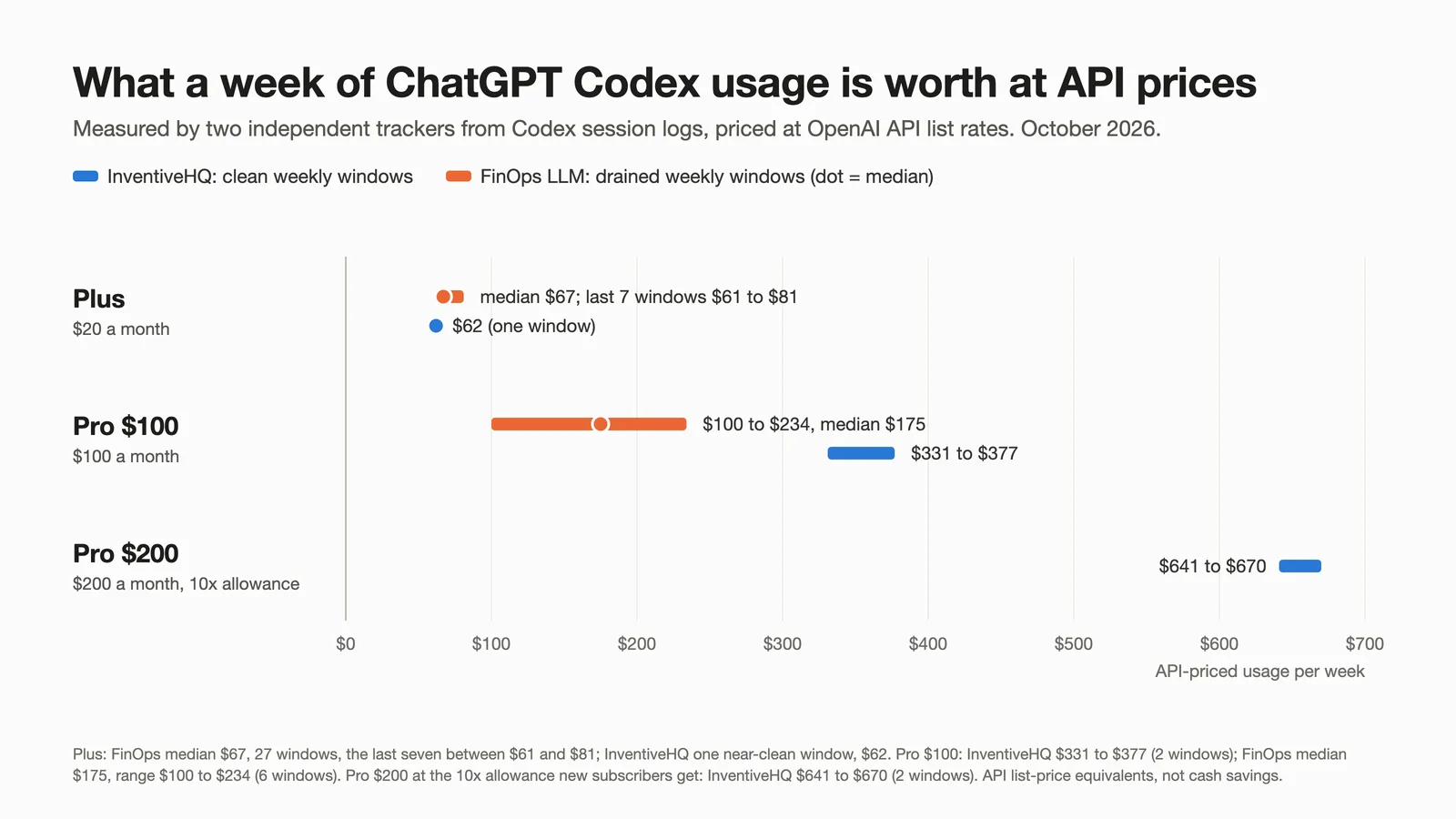
ChatGPT Pro is worth it if you use Codex or ChatGPT Work hard enough to run out of Plus, or if you need GPT-6 Pro in chat. As of October 2026 Plus costs $20 a month and Pro comes in three tiers at $100, $200 and $500. OpenAI does not say how much Codex any of them includes, but people who priced their own Codex logs at API list rates found a full Plus week worth about $67, a Pro $100 week $175 by one tracker's count and $330 to $380 by another's, and a Pro $200 week about $650. Every plan returns many times its price, but only for the weeks you actually use it.
The short version: stay on Plus, and buy credits in a bad week, if you hit the limit now and then. Move to Pro $100 if you hit Plus's five-hour or weekly limit most weeks. Pro $200 makes sense only if you would use most of a 10x allowance, and from 30 October 2026 that is what every Pro $200 subscriber gets. Pro $500 is for people who need Ultrafast mode. If you use Codex only occasionally, an API key can cost less than a subscription you leave idle.
Plan prices, model access and limits come from OpenAI's own pages, read signed out on 19 October 2026: the ChatGPT pricing page, the Codex pricing docs and the OpenAI Help Center articles linked beside each claim. The dollar values of each allowance are third-party measurements, credited where they appear. OpenAI changes these plans often, so treat the date as part of every number.
The plans, as of October 2026
| Plan | Price | Codex and ChatGPT Work | Five-hour limit | Chat models | Notable extras |
|---|---|---|---|---|---|
| Free | $0 | Limited, desktop app | Not published | GPT-6 for text, GPT-5.6 Luna for thinking | None |
| Go | $8 a month | Limited, desktop app | Not published | GPT-5.6 Luna for thinking | May include ads |
| Plus | $20 a month | Every surface, 1x allowance | Yes | GPT-6 at Medium and High thinking | Deep research, projects, scheduled tasks |
| Pro $100 | $100 a month | 5x Plus | None | Adds Extra High and GPT-6 Pro | Dot, unlimited image creation, 400K reasoning context |
| Pro $200 | $200 a month | 10x Plus for new subscribers | None | Same as Pro $100, higher Pro-model limits | Same as Pro $100 |
| Pro $500 | $500 a month | Highest of the three, multiplier not published | None | Pro reasoning on the pricing card | Ultrafast mode for GPT-6 Astra and GPT-6.1 Sol |
Sources: the ChatGPT pricing page for prices, card features and the context-window rows; About ChatGPT Pro tiers for the three Pro plans and Ultrafast; GPT-6 and other models in ChatGPT for thinking levels and GPT-6 Pro; Managing usage with GPT-6 Astra for "Pro 100, Pro 200 and Pro 500 currently have no five-hour usage limit in Work and Codex". All read 19 October 2026. The 1x, 5x and 10x multipliers are not on OpenAI's signed-out pages; they come from a public post on X by Tibo Sottiaux on 29 September, who works on Codex and ChatGPT at OpenAI, not from an official OpenAI page: "Plus = 1X, Pro 100 = 5X, Pro 200 = 10X". Pro is billed monthly only; the Pro tiers article says "Annual billing and payment for multiple months in advance are not available."
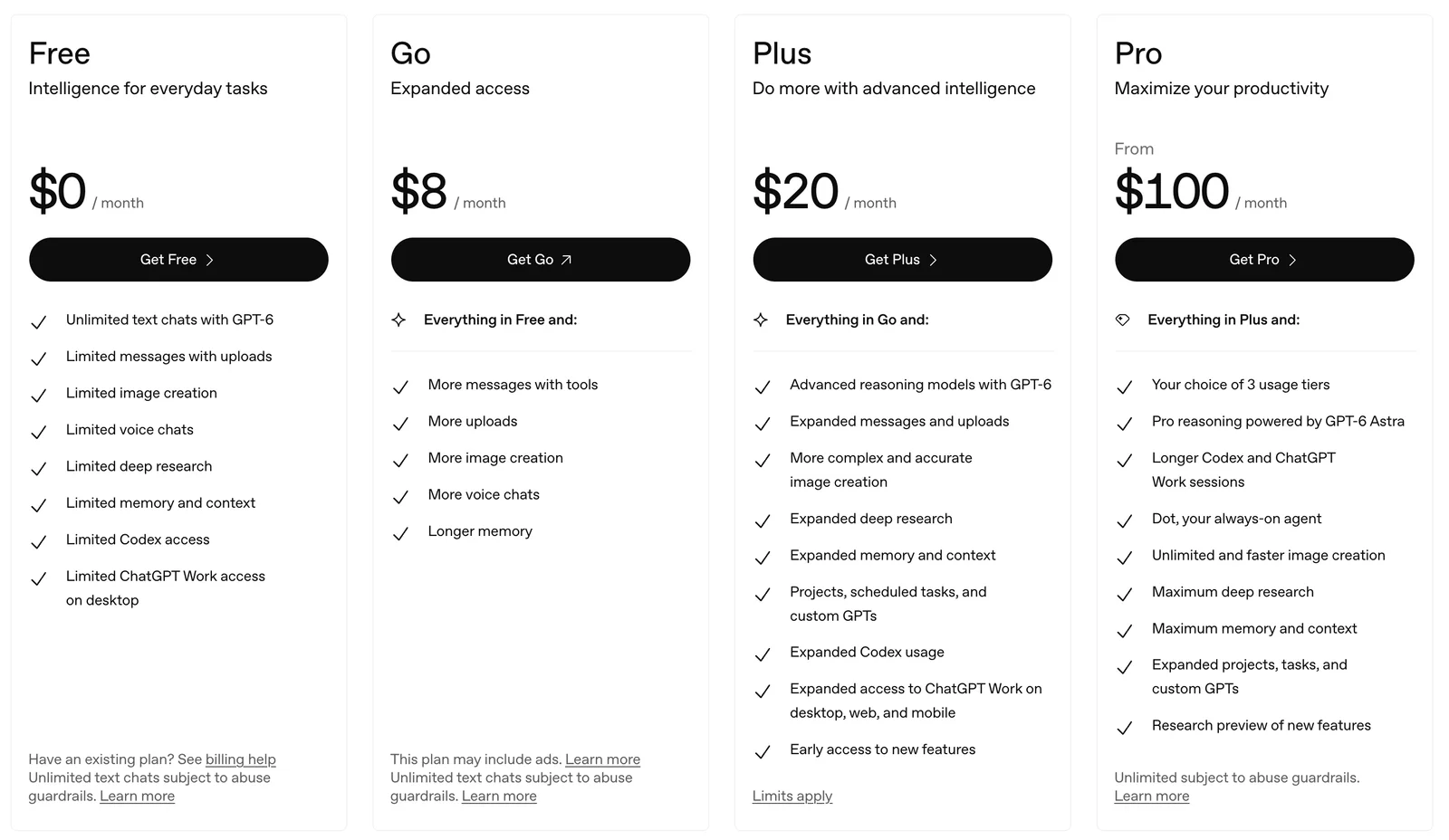
Two things in the table matter more than they look. First, Codex and ChatGPT Work draw on one allowance: the Codex docs say "ChatGPT Work usage inside ChatGPT uses the same pricing, credits, and usage limits as Codex", and the credits article adds that ChatGPT for Excel, PowerPoint and Word share it on Plus and Pro. Second, at the published multipliers the three tiers buy the same allowance per dollar: 1x for $20, 5x for $100, 10x for $200. Upgrading buys a bigger weekly bucket and removes the five-hour cap; it does not buy cheaper usage. The grandfathered 20x Pro $200 plan was the exception, and it ends this month (see the 30 October change).
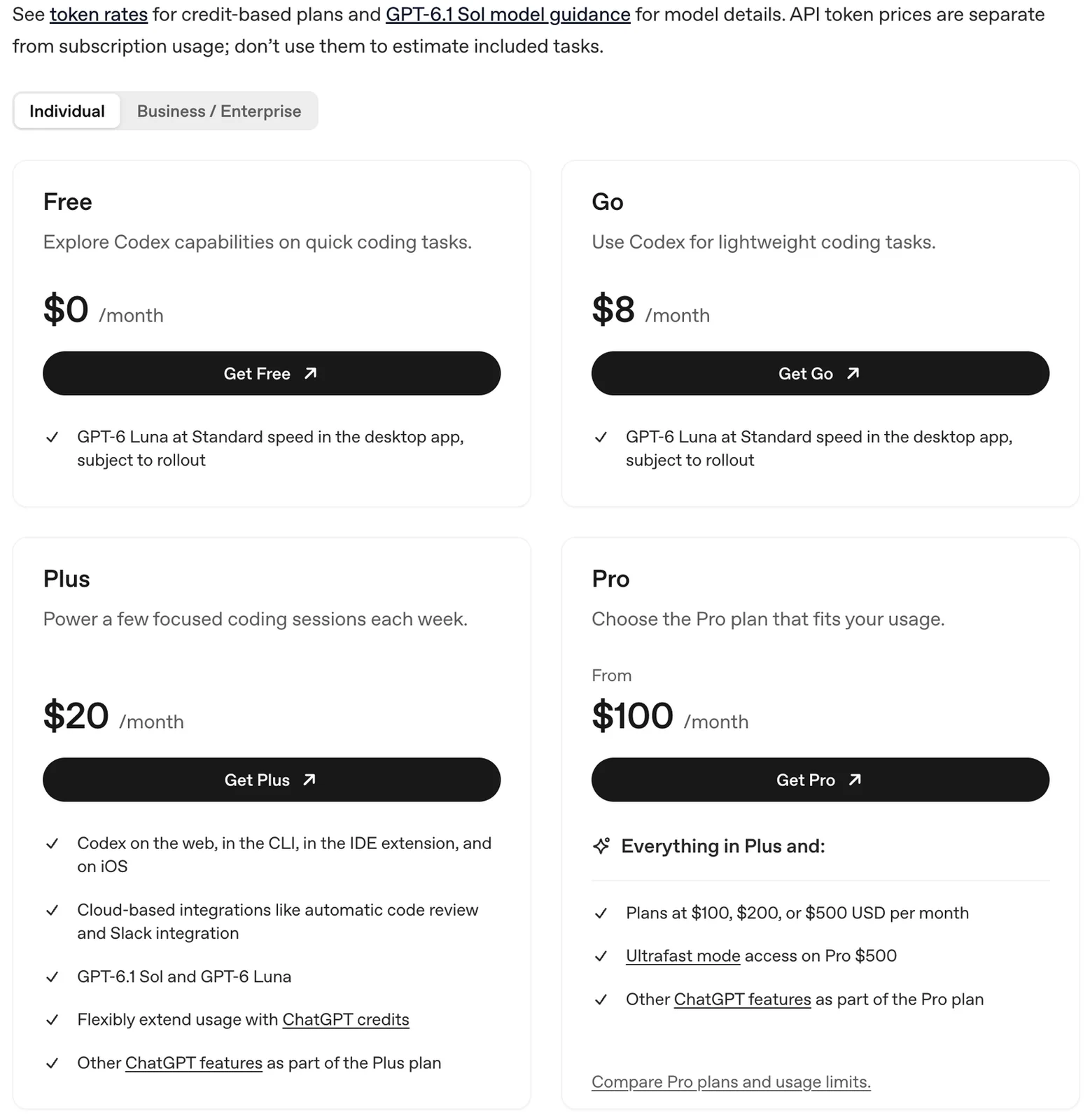
On Plus, OpenAI publishes rough five-hour ranges for local Codex messages: 15 to 160 on GPT-6.1 Sol, 5 to 45 on GPT-6 Astra and 350 to 3,000 on GPT-6 Luna, "not fixed message limits", with weekly limits on top (Codex pricing FAQ). Pro plans publish no message counts at all.
What a week of Codex is worth at API prices
OpenAI shows Codex usage as a percentage bar with a reset date. Codex also writes every turn's token counts and the current bar reading to local session files, so it is possible to price each turn at OpenAI's API list rates and divide by the percentage points it used. Two trackers have published results, mostly on the GPT-6 models and all since August 2026:
| Plan | Estimated API-priced Codex usage per week | Who measured, and how |
|---|---|---|
| Plus ($20) | Median $67; the last seven of 27 windows ran $61 to $81 | FinOps LLM, 27 full weekly windows since August 2026, updated 10 October |
| Plus ($20) | About $62 (one near-clean window), projected about $66 | InventiveHQ, one Plus window on 26 September |
| Pro $100 | $331 to $377 | InventiveHQ, two clean windows resetting 30 September and 3 October, mostly GPT-6 Sol |
| Pro $100 | Median $175, range $100 to $234 | FinOps LLM, six drained windows between 27 September and 8 October |
| Pro $200, new 10x allowance | $641 to $670 | InventiveHQ, two clean windows resetting 6 and 9 October |
| Pro $200, grandfathered 20x | About $1,300 (projection, not measured) | InventiveHQ, Pro $200 measurement scaled by 2 |
| Pro $500 | About $1,640 (projection from a reported 25x, not measured) | InventiveHQ; OpenAI publishes no multiplier for Pro $500 |
Methods, briefly. InventiveHQ (published 4 October 2026) merged session logs from three machines on one account and kept only "clean" windows, where each 1% of the bar cost a steady amount, priced GPT-6 Sol at $2 input, $0.20 cached input and $10 output per million tokens and GPT-6 Astra at $10, $1 and $50. Its workload was 94% GPT-6 Sol with 96% of input served from cache. FinOps LLM priced each request at the list price on the day and divided by the share of the weekly bar used; its Pro $100 windows were 97.6% cached input, and the cheap GPT-6 Luna model made up 49% of its tokens but 8% of its dollars. Both are one team's workload each, a handful of windows per plan, and neither is affiliated with OpenAI.
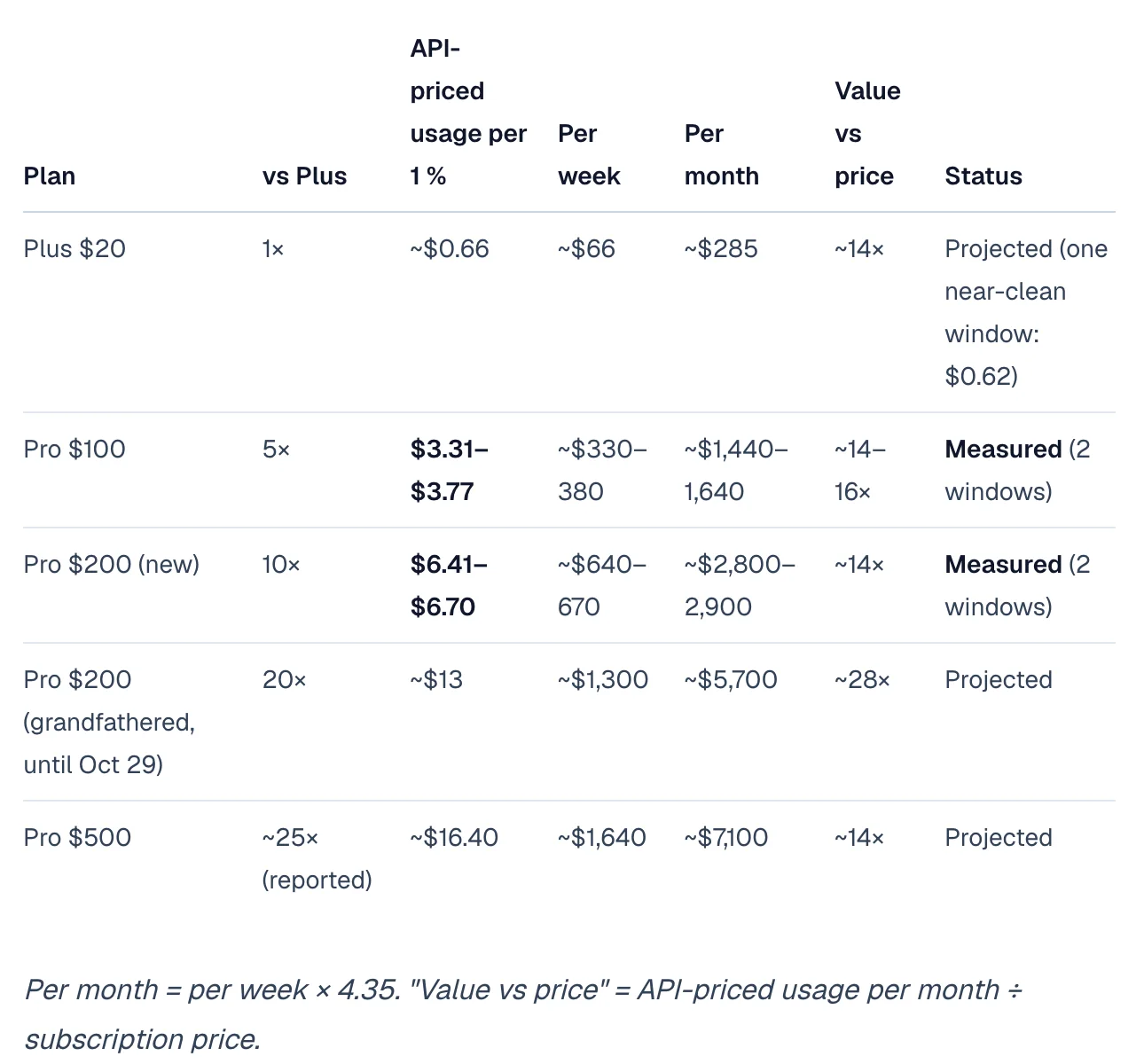
Why the two Pro $100 numbers disagree. The measurements overlap in time and still differ by about two times. FinOps names the likely reasons itself: OpenAI meters usage in its own units, so a model like Luna may draw on the bar faster than its API price suggests, and its Pro windows ran longer, more cache-heavy sessions than its Plus weeks. InventiveHQ's Pro $200 result is 1.7 to 2.0 times its Pro $100 result, as 10x against 5x predicts, and both sit close to 5x and 10x FinOps' measured $67 Plus week. If your Codex work is mostly GPT-6 Sol or Astra, the higher figure is the better guide; if it is mostly Luna, expect less.
What these numbers are not. They are list-price equivalents, not money you save. A subscription is worth its API equivalent only in weeks you would otherwise have paid for that usage; unused allowance is worth nothing, while the API bills only for what you use. InventiveHQ puts the break-even at about 7% of the allowance on any tier: below that, an API key is cheaper. OpenAI itself warns against the conversion in the other direction, from API prices to included work: "API token prices are separate from subscription usage; don't use them to estimate included tasks" (Codex pricing). And the rate moves with model generations: InventiveHQ measured about $5.80 per 1% of the Pro $100 bar under GPT-5.6 in August against $3.31 to $3.77 under GPT-6.
OpenAI does talk about the allowance in API dollars when it suits the explanation. Announcing the new Pro $200 allowance in a public post, Tibo Sottiaux wrote that "it will net out at half the dollar in API spend compared to the old Pro $200 plan", and that OpenAI is "committing to not reintroducing the 5h limit". InventiveHQ's $641 to $670 a week for the new tier, against a projected $1,300 for the old one, matches that halving.
What Pro adds beyond Codex
If you never open Codex or ChatGPT Work, the case for Pro rests on chat, and it is narrower. From OpenAI's pages on 19 October 2026:
- GPT-6 Pro in chat. The Pro thinking level, powered by GPT-6 Astra, is available on Pro $100 and Pro $200, not Plus; Plus gets Astra only inside Work and Codex. Plus tops out at High thinking; Pro adds Extra High (GPT-6 and other models). It is not unlimited: "A Pro subscription does not include unlimited use of the GPT-6 Pro model." On Pro $100, GPT-6 Pro and GPT-5.6 Sol Pro share one weekly allowance; Pro $200 has higher limits and falls back to GPT-5.6 Thinking at Medium when the weekly GPT-6 Pro limit runs out.
- Bigger context. The pricing page lists a 400K reasoning context window on Pro against 256K on Plus (about 680 pages of input against 320), and 128K against 54K for Instant (pricing comparison).
- Unlimited image creation and maximum deep research. Pro's card says "Unlimited and faster image creation" and "Maximum deep research", with unlimited use "subject to abuse guardrails"; Plus's card says "More complex and accurate image creation" and "Expanded deep research".
- Dot. Pro's card lists "Dot, your always-on agent"; Plus's card does not.
- Ultrafast, on Pro $500 only. It uses included usage at 8 times the Standard rate for the selected model, and buying credits on Pro $100 or Pro $200 does not unlock it (About ChatGPT Pro tiers).
For chat alone, Pro $100 is $80 a month more than Plus for GPT-6 Pro, longer context and fewer caps. That is worth it for people whose work depends on the hardest reasoning setting or very long documents. For everyone else, Plus already includes GPT-6 thinking, deep research, projects and Codex.
The Pro $200 change on 30 October
OpenAI paused new Pro $200 subscriptions and reopened them on 29 September 2026 with a smaller allowance at the same price ("we are reopening subscriptions for Pro 200 (we had paused it)", Tibo Sottiaux). The Pro tiers help article says new subscriptions "include a lower usage allowance than previously offered with Pro 200 to reflect our increasingly efficient models", and sets the end date for existing subscribers: if you had an active Pro 200 subscription at any point from 22 September 2026 through 10 a.m. Pacific on 29 September, you keep the previous allowance "through October 29, 2026 while their Pro 200 subscription is active", then move to the lower one at $200 a month.
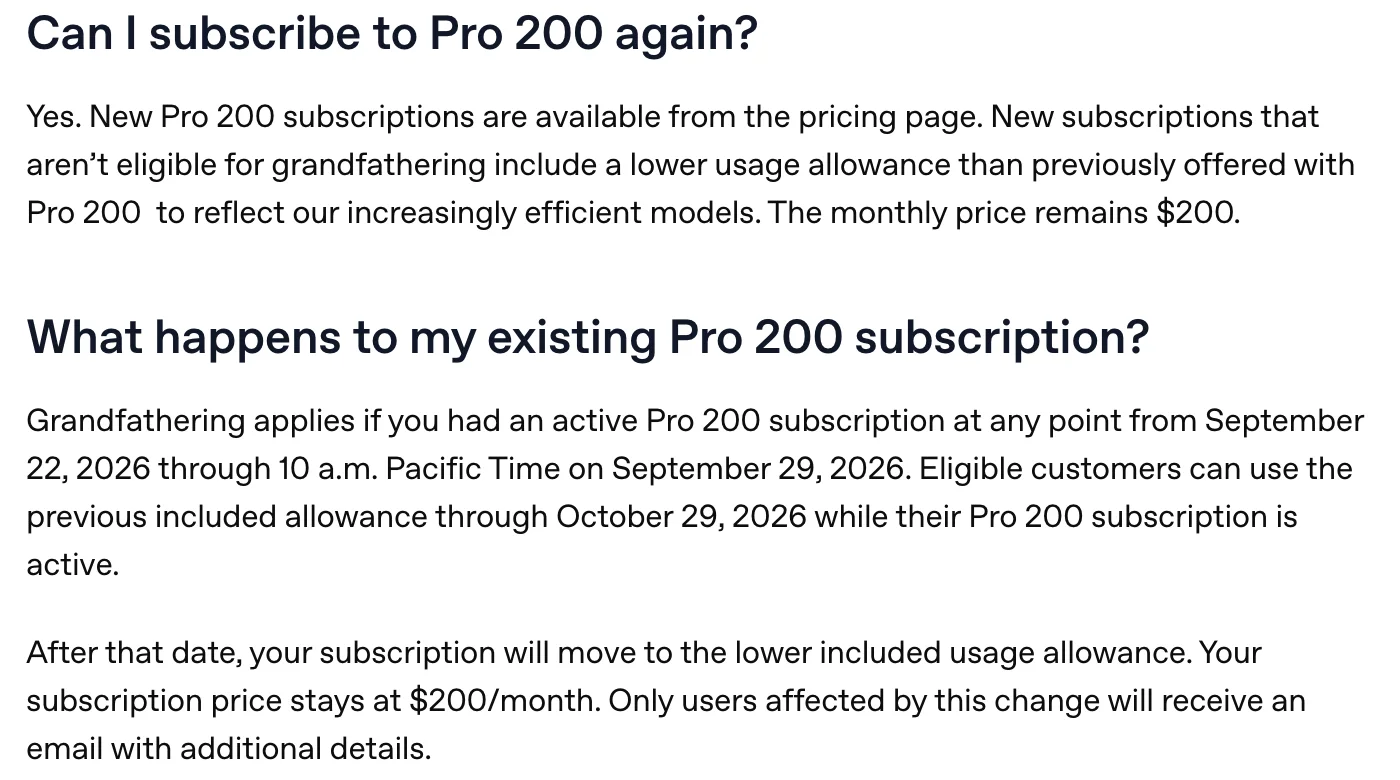
OpenAI's help article does not put numbers on "previous" and "lower". The numbers come from Tibo Sottiaux's public posts on X rather than an official OpenAI page: the old plan was "quite precisely 20X the usage of the Plus subscription" (31 August), and the new one is 10X, with existing subscribers keeping "the 20X multiplier for a bit" plus "a lot of additional credits" (29 September). So 30 October is the first day every Pro $200 subscriber is on the 10x allowance. OpenAI has not published the size of the credit grant.
What it means for a grandfathered subscriber: after 29 October, Pro $200 is twice Pro $100's allowance for twice the price, with higher GPT-6 Pro limits in chat. If you were on Pro $200 for the 20x Codex bucket and rarely used more than half of it, Pro $100 now covers the same work. Changes are made under Settings, then My Plan.
Two Plus accounts instead of Pro?
Two Plus accounts cost $40 and, at the published multipliers, hold 2x a Plus allowance, against 5x for Pro $100. Per dollar that is the same rate as Pro, but each account keeps Plus's five-hour cap and lacks GPT-6 Pro. Whether it is allowed is the question people actually ask, so here is what OpenAI's documents say and do not say.
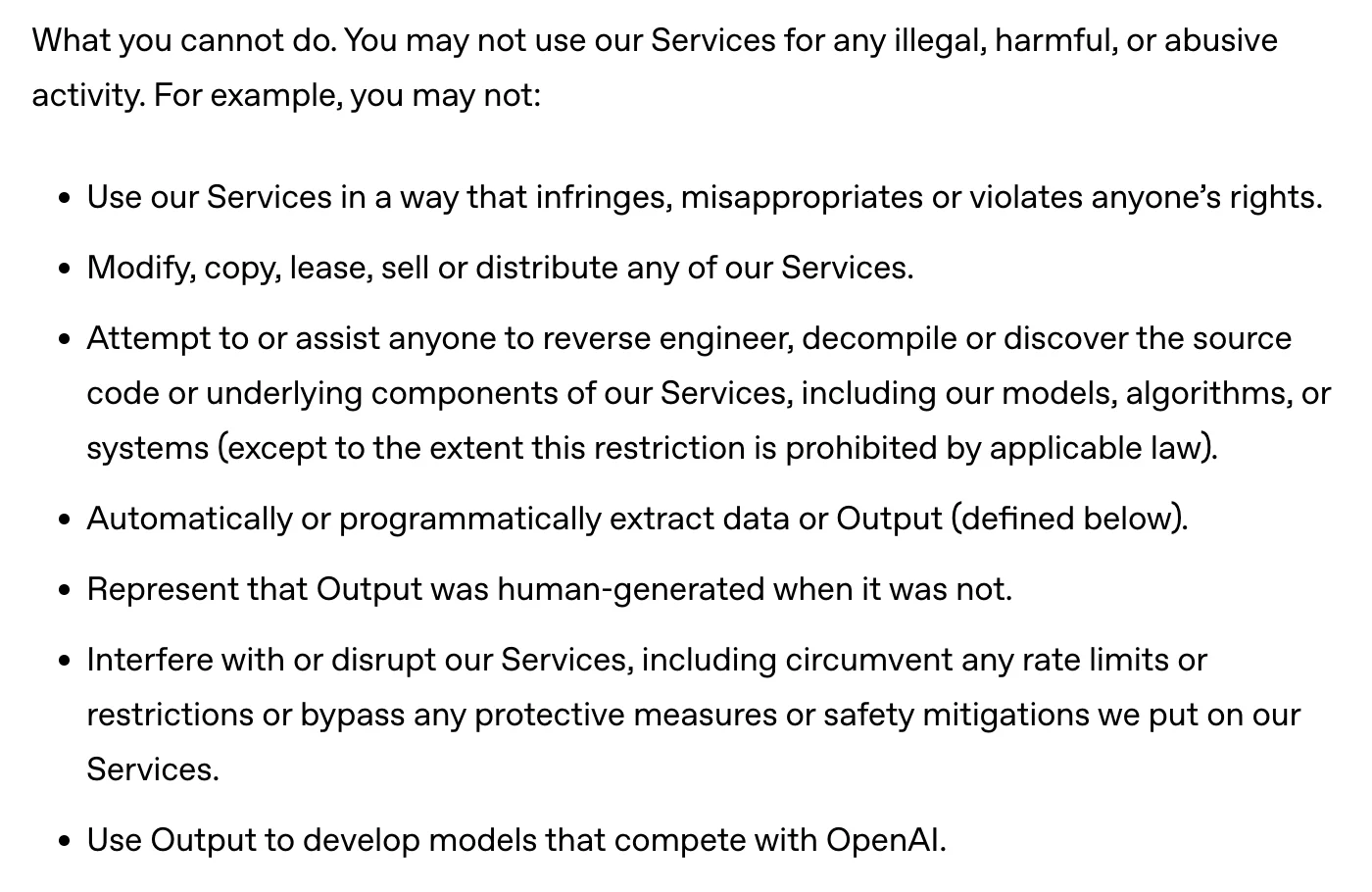
What the Terms prohibit. The Terms of Use (effective 1 January 2026) say "You may not share your account credentials or make your account available to anyone else". Among the things you may not do: "Interfere with or disrupt our Services, including circumvent any rate limits or restrictions or bypass any protective measures or safety mitigations we put on our Services." OpenAI may suspend or terminate access if it determines you breached the Terms. The Pro tiers article repeats that "Sharing account credentials, reselling access and automatically extracting data are prohibited."
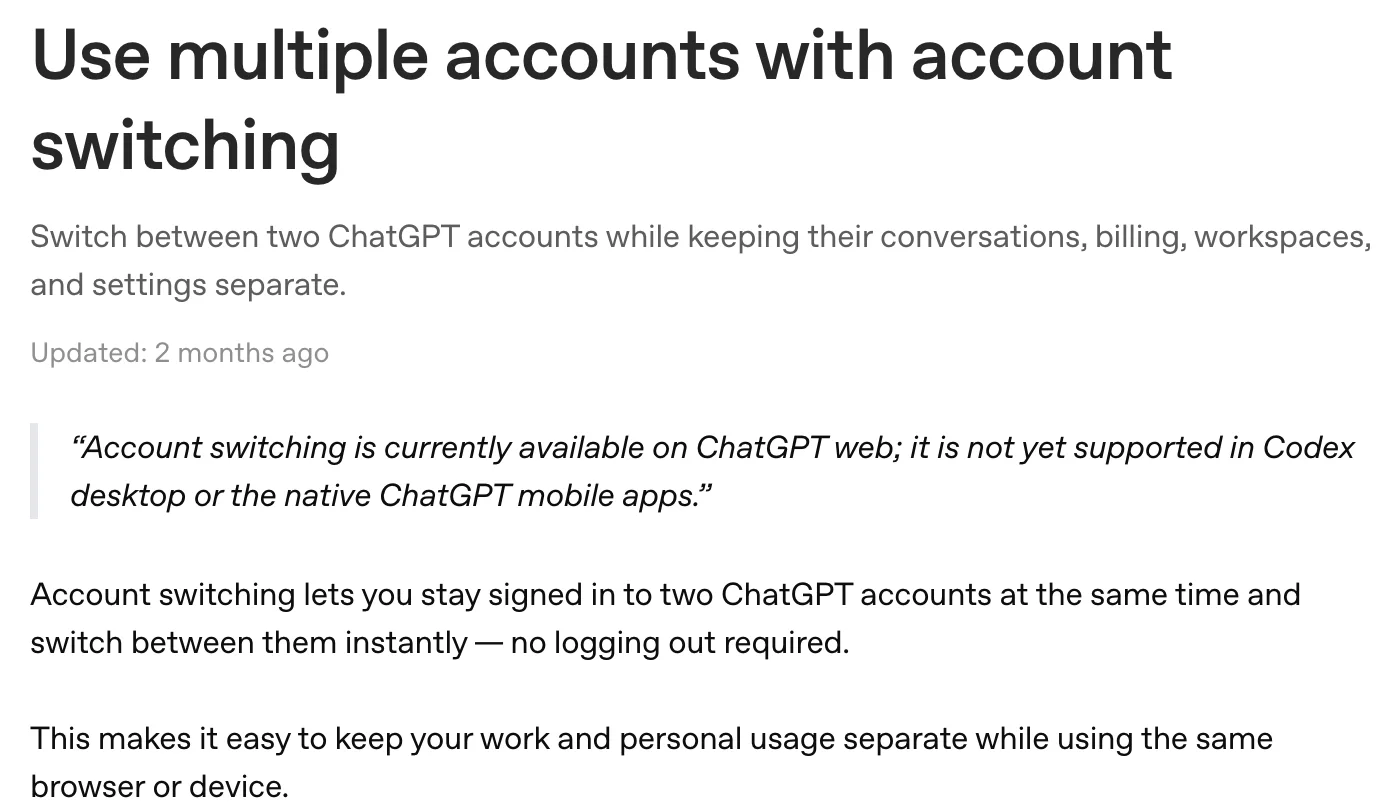
What OpenAI supports. Holding more than one account is not banned in the Terms, and OpenAI documents it. The account switching article lets you stay signed in to two ChatGPT accounts on the web, says "You can still create additional accounts", and lists "Different billing or subscription plans" among reasons to keep a second one. Its examples are a personal account and a work account. It also says account switching "is not yet supported in Codex desktop or the native ChatGPT mobile apps".
What nobody at OpenAI has said. OpenAI has made no public statement either allowing or forbidding one person using several paid accounts to get more Codex usage. Separate accounts for separate purposes, such as personal and employer work, are plainly what the switcher is for. Using a second account specifically to keep working after the first hits its limit sits closer to the "circumvent any rate limits or restrictions" clause, and the downside is losing access to both. The supported ways to get more usage from one account are buying credits, a purchased or banked reset where offered, upgrading, or an API key.
When the API or credits make more sense
Credits on Plus. When a Plus or Pro account hits its Codex limit it can buy credits instead of upgrading; included usage is spent first, then credits (Codex pricing FAQ). Credits are valid for 12 months, cannot be transferred, and are "not API credits" (credits article). For someone who runs out one week in four, Plus plus credits usually beats an $80 upgrade; prices "can vary by account, region, and plan", so check Settings, then Usage, before deciding.
An API key. Codex also runs on an OpenAI API key in the CLI, SDK and IDE extension, billed at API rates, without cloud features such as GitHub code review or Slack (Codex pricing). As of 19 October 2026 the API price list has GPT-6.1 Sol at $2 per million input tokens, $0.10 cached and $10 output, GPT-6 Astra at $10, $1 and $50, and GPT-6 Luna at $0.10, $0.01 and $0.50. Agentic coding re-sends the conversation every turn, so cached input dominates the bill: 96% of InventiveHQ's input tokens were cache hits. If a month of your Codex use would price at under $20 at those rates, which InventiveHQ puts at roughly 2.8 million uncached-input-plus-output tokens of GPT-6 Sol, the key is cheaper than Plus. OpenAI pitches the API key route as "great for automation in shared environments like CI".
Other apps on your plan. Go, Plus and Pro subscribers can let participating apps use their plan through Sign in with ChatGPT, and those requests count against the same Work and Codex allowance, with a per-app weekly cap you set (using your ChatGPT plan in other apps). If you already pay for Plus or Pro, Voyager, the desktop app our team builds, can run Codex on that same ChatGPT sign-in without charging for the agent chat; the work counts against the allowance described here.
Which plan to choose
| If your use is mostly | Choose | Because |
|---|---|---|
| Chat, occasional Codex, rarely see a limit | Plus | A full Plus week is worth about $67 at API prices and you are not using it all |
| Codex most days, hitting the five-hour or weekly limit once a month | Plus, plus credits | Credits cover the bad week for less than the $80 jump |
| Codex daily, hitting Plus limits most weeks | Pro $100 | 5x the allowance and no five-hour cap; measured at a median $175 by one tracker, $331 to $377 by another |
| Long agent sessions with GPT-6 Sol or Astra, would fill 5x | Pro $200 | 10x the allowance, about $650 a week measured, same rate per dollar as Pro $100 |
| Grandfathered Pro $200, using under half of it | Pro $100 after 29 October | The 20x allowance ends; at 10x, Pro $200 is simply two Pro $100 buckets |
| Latency-sensitive work that needs Ultrafast | Pro $500 | The only plan with Ultrafast; it burns usage at 8x Standard |
| Hard reasoning or very long documents in chat, little Codex | Pro $100 | GPT-6 Pro, Extra High thinking and a 400K reasoning context |
| Light, bursty or automated Codex use | API key | Pay only for what you use; cheaper below about 7% of a plan's allowance |
Frequently asked questions
Is ChatGPT Pro worth it for coding? Yes, if you run out of Plus. Measured at API list prices, a full Pro $100 week of Codex measured at a median $175 by one tracker and $331 to $377 by another, and a Pro $200 week about $650 in October 2026 (InventiveHQ, FinOps LLM). If you rarely hit Plus's limits, the extra allowance goes unused.
What is the difference between ChatGPT Plus and Pro? Plus is $20 a month with a 1x Codex allowance, a five-hour limit and GPT-6 thinking up to High. Pro is $100, $200 or $500 a month with 5x, 10x or the highest allowance, no five-hour limit, GPT-6 Pro and Extra High in chat, a 400K reasoning context, Dot and unlimited image creation (pricing, Pro tiers).
Is ChatGPT Pro unlimited? No. Codex and Work have a weekly allowance on every Pro tier, and GPT-6 Pro in chat has weekly limits; OpenAI says "A Pro subscription does not include unlimited use of the GPT-6 Pro model" (GPT-6 models). Everyday text chat and image creation are listed as unlimited, subject to abuse guardrails.
How much Codex usage do you get on ChatGPT Plus? OpenAI estimates 15 to 160 local GPT-6.1 Sol messages per five hours, with weekly limits on top (Codex pricing). Priced at API rates, a full Plus week has measured at a median $67 since August 2026 (FinOps LLM).
Does ChatGPT Pro have a five-hour limit in Codex? No. Pro $100, Pro $200 and Pro $500 have no five-hour limit in Work and Codex, only the weekly allowance (Astra usage guide). Tibo Sottiaux of OpenAI has said publicly that OpenAI is "committing to not reintroducing the 5h limit".
What happens to my Pro $200 plan after 29 October? If you were subscribed between 22 and 29 September 2026, you keep the previous allowance through 29 October 2026, then move to the lower allowance at the same $200 (Pro tiers). Tibo Sottiaux of OpenAI has described that in public posts as 20x Plus falling to 10x.
Can I have two ChatGPT accounts? Yes. OpenAI's account switcher keeps two accounts signed in on ChatGPT web, and you can create more (account switching). The Terms prohibit sharing credentials and circumventing rate limits, and OpenAI has not said whether using several accounts to extend Codex usage is acceptable.
Is ChatGPT Pro billed annually? No. Pro is billed monthly, and annual or multi-month prepayment is not available (Pro tiers).
Voyager is a desktop AI agent for creative work
Describe what you want to make; Voyager plans it, uses your apps and tools, and keeps everything editable.