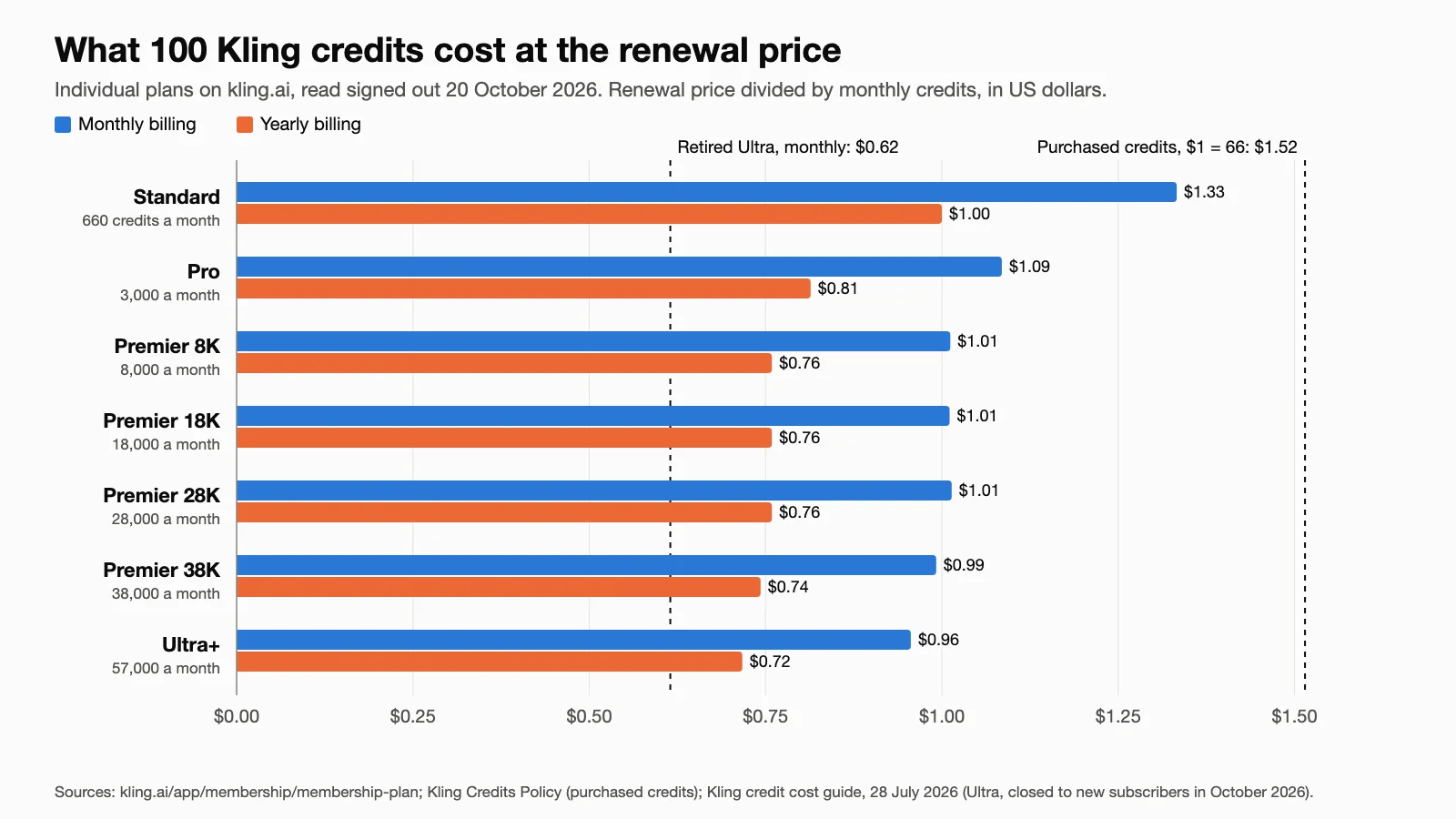
Kling AI's individual plans, as of 20 October 2026, are Standard at $8.80 a month for 660 credits, Pro at $32.56 for 3,000, Premier at $80.96 to $376.99 for 8,000 to 38,000, and Ultra+ at $544.99 for 57,000 (membership page). Yearly billing costs about 25% less than twelve monthly renewals. The free Basic plan has no monthly allowance in the plan table, watermarks its output and does not allow commercial use. Those are renewal prices: the large figures on the cards ($6.99, $25.99, $135, $402) are one-time first-month discounts.
The short version, in three decisions:
- Start small and top up; move up a tier only when the top-ups would cost more than the step. At renewal, 100 credits cost $1.33 on Standard and $1.09 on Pro, then about $1.01 on every Premier step and $0.96 on Ultra+. Above Pro, a bigger plan buys more credits, not much cheaper ones.
- Budget per usable clip, not per generation. A 10-second 1080p Kling 3.0 clip with sound is 120 credits an attempt. At three attempts per keeper that is $3.44 to $4.80 in plan credits, against $5.04 at fal's $0.168-a-second rate (fal pricing).
- If you have the old Ultra plan, do not let it lapse. It closed to new subscribers this month at $0.62 per 100 credits; its replacement costs 55% more per credit, and any lapse, including one caused by a failed renewal payment, means you cannot rejoin.
Prices, credits and rules below were read signed out from Kling's membership page, Credits Policy, Terms of Paid Service and model guides on 20 October 2026, in US dollars. Kling restructured its plans around the Kling 4.0 launch and is running launch discounts, so treat the date as part of every number.
The plans, as of 20 October 2026
"8K" to "38K" on Premier are credit amounts (8,000 to 38,000 a month), not video resolutions.
| Plan | Credits a month | First month | Then, monthly | 100 credits at renewal |
|---|---|---|---|---|
| Basic | None in the plan table | $0 | $0 | n/a |
| Standard | 660 | $6.99 | $8.80 | $1.33 |
| Pro | 3,000 | $25.99 | $32.56 | $1.09 |
| Premier 8K | 8,000 | $64.99 | $80.96 | $1.01 |
| Premier 18K | 18,000 | $135 | $181.99 | $1.01 |
| Premier 28K | 28,000 | $209 | $283.99 | $1.01 |
| Premier 38K | 38,000 | $278 | $376.99 | $0.99 |
| Ultra+ | 57,000 | $402 | $544.99 | $0.96 |
| Plan | Yearly, at renewal | First year, launch promotion | Monthly equivalent at renewal | 100 credits at renewal |
|---|---|---|---|---|
| Standard | $79.20 | No promotion | $6.60 | $1.00 |
| Pro | $293.04 | No promotion | $24.42 | $0.81 |
| Premier 8K | $728.64 | No promotion | $60.72 | $0.76 |
| Premier 18K | $1,639.99 | $1,490 | $136.67 | $0.76 |
| Premier 28K | $2,550.99 | $2,318 | $212.58 | $0.76 |
| Premier 38K | $3,389.99 | $3,082 | $282.50 | $0.74 |
| Ultra+ | $4,902.99 | $4,457 | $408.58 | $0.72 |
Source: the monthly and yearly tabs of the membership page, with each Premier step selected on the slider, read signed out on 20 October 2026. The per-credit column is my arithmetic: renewal price divided by credits. On Standard and Pro the first month is a "First-purchase offer available once". The first-year prices belong to a "New Tiers Launch" promotion whose countdown ends on 29 October 2026 at 08:00 Pacific time.
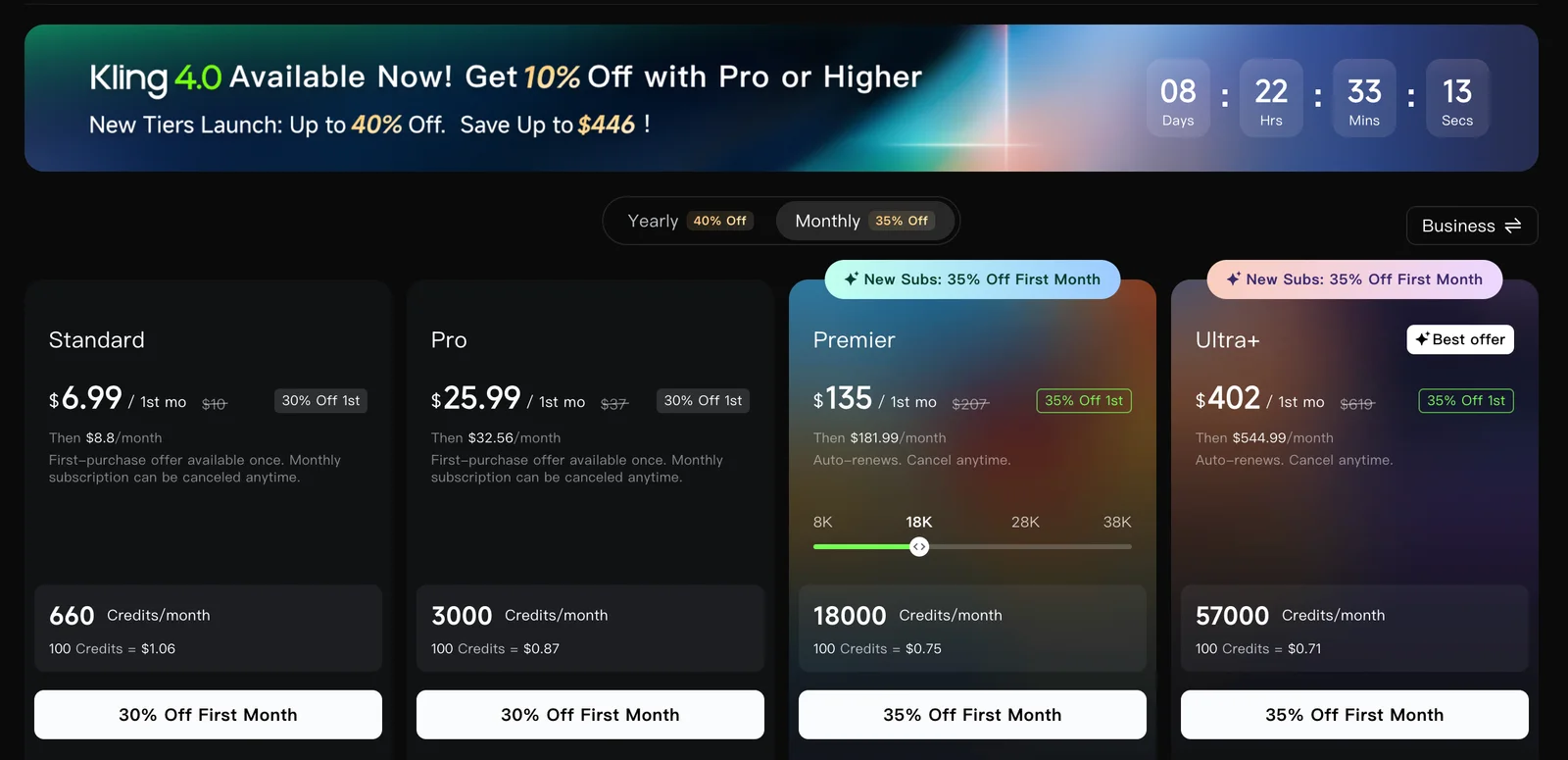
The Premier slider is four sub-plans, named "Premier-8k Credits" to "Premier-38k Credits" in the Terms of Paid Service (section 3.1.1). The first three cost the same per credit to within a third of a cent per 100 credits, and 38K is about 2% cheaper.
Every paid plan gets the same core features: 1080p and 4K output, watermark removal, commercial use, video extension, image upscaling, fast-track generation and up to four videos per request, against one on Basic. Pro and above add priority access to new features and, during the launch, 10% off Kling 4.0 generations; Standard shows a dash in the Kling 4.0 row. Ultra+ adds beta invites, and on yearly billing "Kling 4.0 Flash Annual Early Access". The element library, which stores reusable characters and objects, holds 30 elements on Basic, 50 on Standard, 150 on Pro and Premier and 500 on Ultra+ (comparison table on the membership page).
Monthly or yearly
At renewal prices on the membership page, a year costs about nine monthly renewals on every tier (between 8.98 and 9.01), a saving of about 25%. For a new subscriber the first-month discount shifts that: on Standard, Pro and Premier 8K, nine months of monthly billing including the discounted first month cost less than the yearly price ($77.39 against $79.20 on Standard), so yearly pays off from the tenth month you would have stayed. On Premier 18K and above and Ultra+, the launch promotion's first-year price beats monthly billing from the ninth month.
Three conditions apply. The credits still arrive and expire monthly. The fee is not refundable: "Once the Paid Service (including any Membership Service and Credit service) is activated, the fee paid for the Paid Service is non-refundable" (Terms of Paid Service, section 6.2.4). And plans renew automatically until cancelled; the Terms warn that cancelling within a day of the end of a cycle may come after the payment processor has already charged the next one (automatic renewal rules, section 6).
What a credit buys
Kling 3.0 and older models
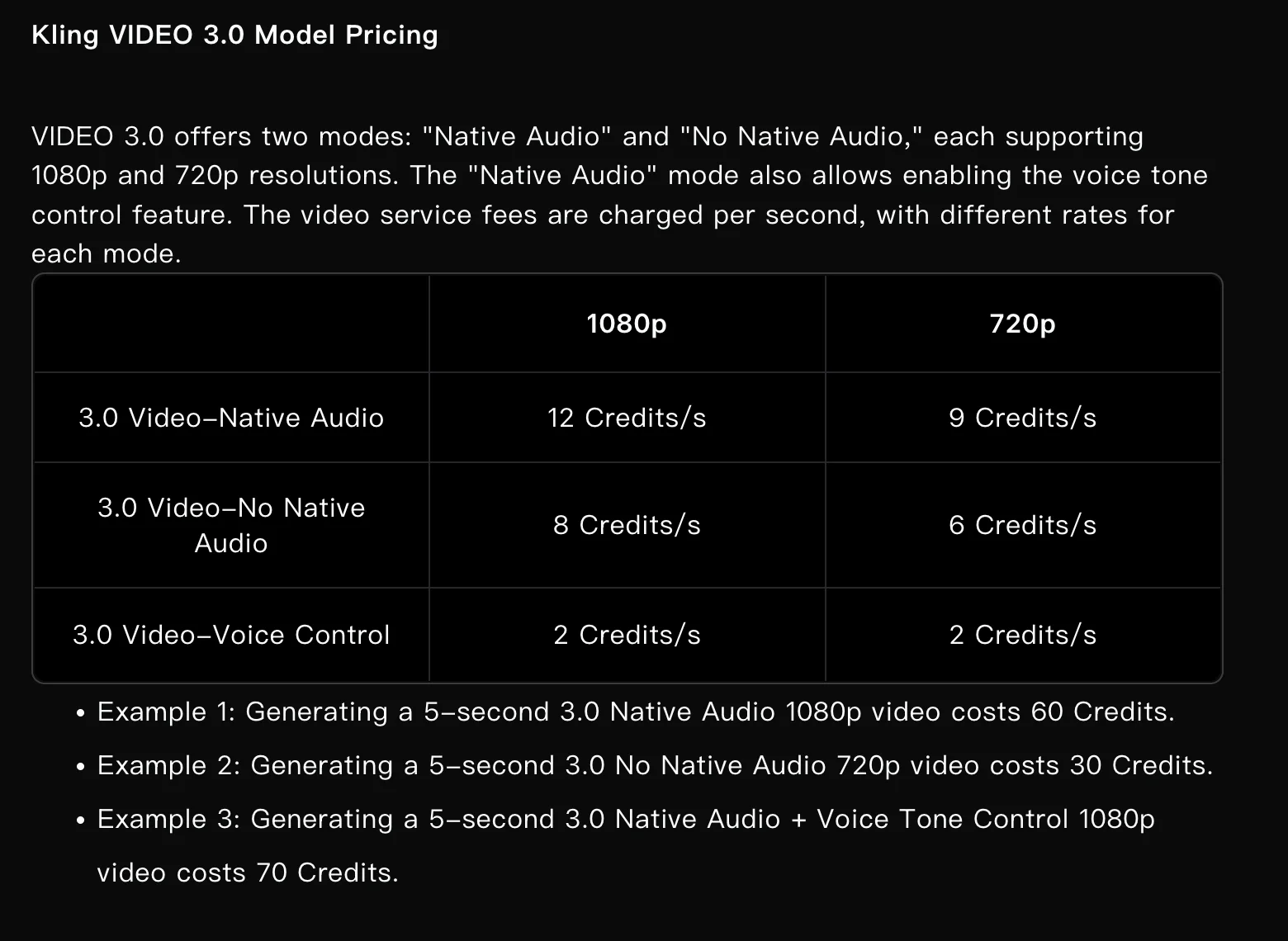
Kling charges video by the second. Its Kling 3.0 guide publishes the rates (Kling VIDEO 3.0 user guide):
| Kling 3.0 setting | 720p | 1080p | 10-second clip at 1080p |
|---|---|---|---|
| With native audio | 9 credits a second | 12 credits a second | 120 credits |
| No native audio | 6 credits a second | 8 credits a second | 80 credits |
| Voice tone control | +2 credits a second | +2 credits a second | +20 credits |
The other published rates, per second:
| Model or mode | Credits a second | Source |
|---|---|---|
| Kling 3.0 series, native 4K | 30 | Credit cost guide |
| Kling 3.0 Omni, with a reference video, silent | 12 at 720p, 16 at 1080p | Omni guide |
| Motion Control 3.0 | 9 Standard mode, 12 Professional | Motion Control guide |
| Kling 2.6 | 3 Standard mode, 5 Professional, 10 Professional with audio | Kling 2.6 guide |
Two settings save the most. If you will replace the soundtrack in an editor anyway, a silent 10-second 1080p clip is 80 credits instead of 120, and at 720p it is 60. And because cost scales with length, generate the seconds the shot needs: 6 seconds at 1080p with sound is 72 credits, not the 180 of a full 15. Kling 3.0 Omni without a reference video costs the same as Kling 3.0. Standard and Professional are generation modes, not plans: Kling describes Standard mode as faster with "lower inference costs" and Professional as "richer details and higher inference costs" (Kling). On Kling 3.0 the choice appears as 720p against 1080p.
Kling 4.0
Kling 4.0 launched on 15 October (Kuaishou launch announcement). Kling shows 4.0 generation pricing only after sign-in: its generator opens a login screen, and its public user guide covers 3 to 30 second clips without a credit table. I could not verify a primary credit rate signed out on 20 October 2026, so the clip budgets below use Kling 3.0. For 4.0, sign in, set the resolution, duration and references, and check the final credit quote before budgeting.
The membership page advertises a limited-time 10% discount on Kling 4.0 generations for Pro and above; Standard has no listed 4.0 discount. Confirm the discount in the generator's quote before comparing plans.
Check output availability separately from announced capabilities. Kuaishou's launch announcement says 4.0 will also support 4K (Kuaishou), while Kling's user guide marks 10-bit HDR output as coming soon. The same guide says Kling 4.0 Flash, the faster variant, tops out at 20 seconds and 720p.
Images
I did not find an app credit table for Kling's current image models in its guides. The plan table in the July credit guide converts 660 credits into "660 images", one credit each, without naming the model; check the cost on the button before a large batch.
What you will actually pay
Three monthly budgets, priced on Kling 3.0 at 1080p with native audio: 10-second clips, one output per generation, no reference video, 120 credits an attempt. Assumption: three attempts per usable clip. I did not find a published success rate, so replace it with your own: credits a month = usable clips × attempts per clip × seconds × credits a second. Five attempts at the same settings is 600 credits per usable clip instead of 360.
| Budget | Credits a month | Cheapest monthly plan route, estimated | Per usable clip | API usage at $0.168 a second, list rate |
|---|---|---|---|---|
| 3 usable clips (9 attempts) | 1,080 | Standard $8.80 plus 420 purchased credits ($6.36): $15.16 | $5.05 | $15.12 |
| 12 usable clips (36 attempts) | 4,320 | Pro $32.56 plus 1,320 purchased credits ($20): $52.56 | $4.38 | $60.48 |
| 50 usable clips (150 attempts) | 18,000 | Premier 18K: $181.99 | $3.64 | $252.00 |
Purchased credits are valued at the standard rate of $1 for 66 (Credits Policy, section 3), but packs come in fixed sizes. If they are the $5 steps of 330 credits that Kling's llms.txt lists, the first budget means paying $18.80 that month and keeping 240 credits, which last two years, for later. On yearly billing the three budgets come to about $13, $44 and $137 a month. At three clips a month, a subscription and list-rate per-second billing are close; from a dozen clips up, the plans pull ahead at that rate. The API columns measure usage cost, not the upfront payment: Kling's trial and bulk-package discounts, detailed below, lower its per-second cost (developer pricing).
The cost of one attempt on each plan, if you spend the whole allowance:
| How you pay | Monthly billing | Yearly billing | Attempts a month in the allowance |
|---|---|---|---|
| Standard | $1.60 | $1.20 | 5 |
| Pro | $1.30 | $0.98 | 25 |
| Premier 8K to 28K | $1.21 to $1.22 | $0.91 | 66 to 233 |
| Premier 38K | $1.19 | $0.89 | 316 |
| Ultra+ | $1.15 | $0.86 | 475 |
| Purchased credits | $1.82 | n/a | n/a |
| Kling API at list rate, or fal | $1.68 | n/a | n/a |
Credits you let expire raise the real cost per clip in proportion. A completed clip you reject is charged in full: the Credits Policy refunds credits only "If the generation fails", and the Motion Control guide says a shortened but successful output is "non-refundable".
Picking a plan by the credits you use
Because the price per credit barely falls above Pro, start from the smaller plan and add purchased credits, and move up only when those credits would cost more than the step up. These are the monthly volumes at which the next plan up becomes cheaper than the smaller plan plus purchased credits at $1 for 66 (Credits Policy; my arithmetic on the monthly renewal prices above):
| Credits in a typical month | Cheapest monthly route | 10-second 1080p Kling 3.0 attempts with sound |
|---|---|---|
| Up to 660 | Standard | Up to 5 |
| 660 to about 2,230 | Standard plus purchased credits | 6 to 18 |
| About 2,230 to 6,190 | Pro, plus purchased credits above 3,000 | 19 to 51 |
| About 6,190 to 14,670 | Premier 8K, plus purchased credits above 8,000 | 52 to 122 |
| About 14,670 to 24,730 | Premier 18K, plus purchased credits above 18,000 | 123 to 206 |
| About 24,730 to 34,140 | Premier 28K, plus purchased credits above 28,000 | 207 to 284 |
| About 34,140 to 49,090 | Premier 38K, plus purchased credits above 38,000 | 285 to 409 |
| Above about 49,090 | Ultra+ | 410 or more |
Two adjustments. Kling's llms.txt lists bonus credits on larger packs, such as 7,500 credits for $100 and 16,000 for $200 ($1.33 and $1.25 per 100); the pack checkout requires sign-in, so I could not confirm them, but at $1.25 per 100 the crossovers move up by about 15% at the bottom of the lineup and 4% to 6% at the top. For Kling 4.0, Pro and above advertise a 10% launch discount (membership page); compare signed-in quotes before applying this table to 4.0 usage.
The table optimizes for renewal prices, which is what you pay from month two. In a new subscriber's first month the discounts can flip the answer: at 14,000 credits, Premier 8K plus purchased credits costs about $171.87 at renewal against $181.99 for Premier 18K, but the first month of Premier 18K is $135 against about $155.90 for Premier 8K plus purchased credits. If you plan to stay, choose by the renewal column; if you need one big month, compare first-month prices.
Upgrading takes effect at once: moving to a higher tier, or from monthly to yearly on the same tier, starts the new plan's credits and benefits immediately, while buying a lower or equal plan queues it until the current one ends (membership FAQ, question 4). Kling does not say on the signed-out pages how an upgrade is prorated.
Which plan for which user
- Testing Kling: Basic, then Standard's $6.99 first month. Basic watermarks everything and lists no 1080p benefit; the first month renews at $8.80.
- A few Kling 3.0 clips a month: Standard, plus packs in busy months. 660 credits is five 10-second 1080p attempts with sound. Standard gets no Kling 4.0 launch discount.
- Working mostly on Kling 4.0: compare Standard with Pro's advertised 10% launch discount (membership page). Check signed-in generation quotes before choosing an allowance.
- Steady work, 19 to 51 attempts a month: Pro, plus packs above 25 attempts. On yearly billing above about 45 attempts, Premier 8K yearly is cheaper than Pro yearly plus packs.
- Heavier use: the row of the crossover table that matches your typical month. Because price per credit is flat across Premier, packs often beat the next step.
- Already on Ultra: keep renewing without a gap. It costs about a third less per credit than Ultra+, and once the subscription is interrupted, including by a failed payment, you cannot rejoin.
- Generating from code, or in bursts: compare Kling's API trial packages, from $9.80 for 100 units with 30-day validity (developer pricing), with fal's prepaid balance, valid for a year (fal terms, section 9.1). Choose by how much you will use before expiry; Kling's listed API packages do not support 4.0 yet.
- A team of three or more: the Team plan, from $294 a month, for the shared workspace and roles. Seat credits cannot be pooled to one person.
Credits that expire, and credits that unlock nothing
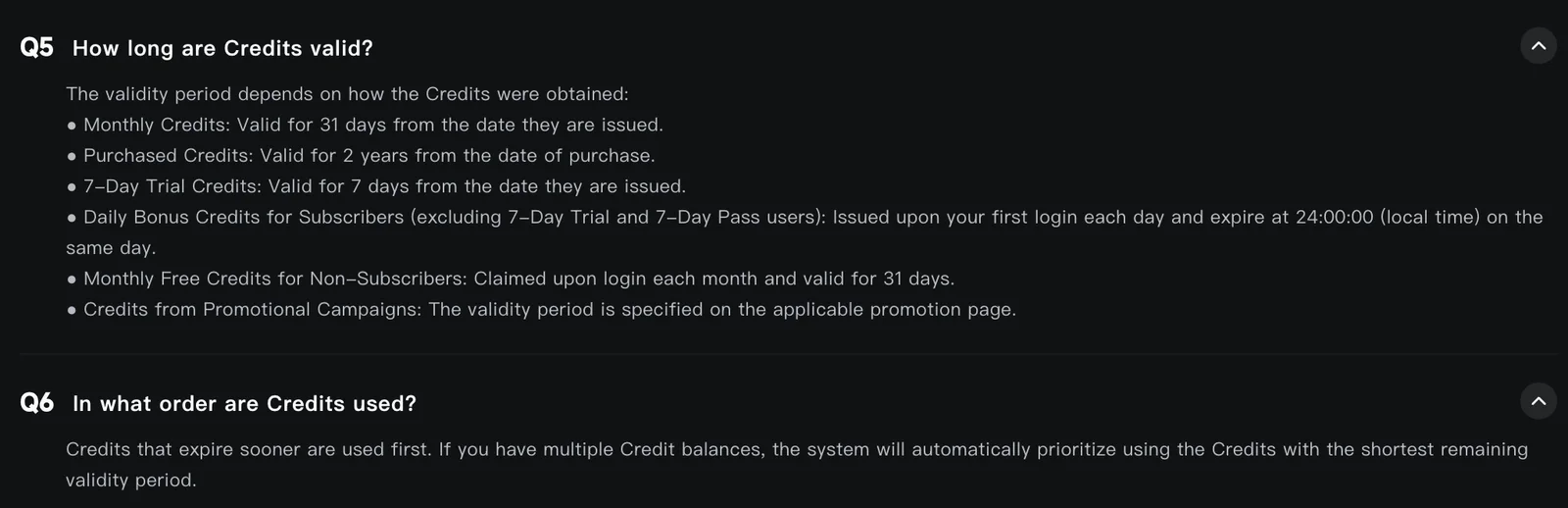
The credit types most people meet, with their validity (membership FAQ, question 5; Credits Policy):
| Credit type | How you get it | Valid for |
|---|---|---|
| Monthly plan credits | Each billing cycle, on monthly and yearly plans | 31 days from issue |
| Purchased credits | Bought separately, standard rate $1 for 66 | 2 years from purchase |
| Daily bonus credits | Subscribers on first login each day, during promotional events; not 7-day pass or trial users | Until midnight local time |
| Monthly free credits | Non-subscribers, claimed on login | 31 days |
Seven-day trial credits (7 days) and promotional credits (as stated on the promotion) are the other two kinds. Credits that expire soonest are spent first. Yearly plans still issue credits monthly (Terms of Paid Service, section 4.2.2), so a yearly subscription cannot carry a quiet month's credits into a busy one.
The trap is the purchased credit. It lasts two years, but "Owning Credits does not grant Subscription benefits. Some features, such as watermark removal and 4K generation, are available only with an active Subscription" (membership FAQ, question 2), and the Credits Policy adds 1080p, fast-track and video extension to that list (section 8). Buy packs to supplement a plan you will keep, not to replace one. At the standard rate they cost $1.52 per 100 credits, more than any plan's renewal price.
Kling credits or paying per second
The same Kling 3.0 is sold by the second outside the app, billed separately from app credits. Kling 3.0 at 1080p with sound is $0.168 a second on Kling's developer API at its list rate ($0.1512 on the larger packages that carry a 10% discount) and on fal; the rates for every setting, with sources, are on the model reference pages for Kling 3.0 Pro and Kling 3.0 Standard. In the app the same second is 12 credits, which costs $0.160 on Standard monthly and from $0.130 (Pro) down to $0.086 (Ultra+ yearly) above it. From Pro up, app credits are cheaper per second than API list pricing, as long as you spend them before they expire. Kling's discounted trial packages can reverse that comparison for a small batch.
Kling's API has separate Trial Plan and 180-Day Plan tabs. These are the entry packages shown signed out on 20 October 2026 (Kling developer pricing):
| Package | Units | Price shown | Validity | Concurrent tasks |
|---|---|---|---|---|
| Trial | 100 | $9.80, list price $14 | 30 days | 5 |
| Trial | 1,000 | $98, list price $140 | 30 days | 5 |
| Standard Package 1, on the 180-Day Plan tab | 5,000 | $700 | 180 days | 20 |
Both trial cards advertise 30% off the first buy and a maximum of five purchases. All three packages have no rollover or extension. $700 is the entry 180-day package, not the API minimum (developer pricing). At 1.2 units per second for Kling 3.0 1080p with sound and no voice control, the discounted trial rate is $0.1176 a second, or about $1.18 for a 10-second attempt (my arithmetic on the same pricing table). That is cheaper than Pro monthly's $1.30 in app credits, provided you use the trial units before they expire. Kling's pricing page says these packages do not currently support 4.0; Kuaishou says API access is coming (Kuaishou).
fal needs no subscription or package: you top up a prepaid balance and pay per successful output, and purchased credits expire after 365 days (fal billing, fal terms, section 9.1).
Per-second billing suits irregular volume, work driven from code or an agent, and anyone who would leave a monthly allowance unspent. If you want Kling inside an agent workflow rather than a browser tab, Voyager, the desktop app our team builds, can generate with Kling 3.0 on your own fal key, billed at fal's per-second rate; the subscription discount above does not apply on that route.
What changed in October 2026, and what it means for Ultra
Until this month there were four paid tiers. Kling's credit cost guide of 28 July 2026 lists Standard, Pro and Premier at the prices Standard, Pro and Premier 8K still have, and Ultra at $159.99 a month for 26,000 credits, "As low as $0.62 per 100 Credits". Kling's machine-readable summary at kling.ai/llms.txt, which still describes that lineup, gives Ultra yearly at $1,429.99. Around the Kling 4.0 launch on 15 October (Kuaishou), Premier gained three larger steps, Ultra+ replaced Ultra at the top, and Ultra closed.
The membership FAQ (question 9) says "Ultra is no longer available for new subscriptions. Existing Ultra subscribers retain their benefits and original priority." The Terms of Paid Service, effective 10 October 2026, add the catch in section 3.1.7: existing subscribers can keep renewing on the old terms, but "once you cancel your subscription or your subscription is interrupted (including as a result of a failed payment or a failure to renew upon expiry), you will NOT be able to subscribe to that discontinued membership grade again".
For heavy users that is a price rise. The old Ultra cost $0.62 per 100 credits monthly and $0.46 yearly; Ultra+ costs $0.96 and $0.72 (membership page), 55% to 57% more. Ultra's 26,000 credits for $159.99 now take Premier 28K at $283.99. If you still have Ultra, check the card on file before each renewal.
The free plan
Basic is for trying the interface, not for client work. The plan table lists no monthly credits, no 1080p or 4K, no video extension, one video per request, a 30-element library, no watermark removal and no commercial use (membership page), and non-members must keep Kling's branding on what they generate (Terms of Paid Service, section 7.2). Free accounts also lack fast-track generation, so they wait behind paid ones.
How many free credits you get is not published. The membership FAQ describes "Monthly Free Credits for Non-Subscribers" without a number, the Credits Policy limits daily login credits to subscribers, and the 66 credits a day of Kling's 2024 launch (Kuaishou, 25 July 2024) no longer appear in either. New accounts get a welcome grant: a Kling post in July described "166 welcome credits upon registration along with 3 trial uses of 'Professional Mode' and 2 'Video Extension' trials" (Kling), and the signed-out membership page offers a "Trial Package" of "limited-time free credits" on sign-in. To test 1080p properly, Standard's first month is $6.99.
Team plans
The Team plan, on the Business tab, is $98 a seat a month, or $73 a seat a month billed yearly ($876 a seat), with 10,000 credits per seat, three to 15 seats, web only (team plan page, 20 October 2026). The minimum is therefore $294 a month or $2,628 a year. That works out to $0.98 or $0.73 per 100 credits, close to Premier's rate, but seat credits "are not transferable between seats", so it is not a cheaper way for one person to buy 30,000 credits. What it adds is a shared workspace with roles and shared assets.
On data, the team plan FAQ says "We do not misuse or train on your data". The general Terms of Service (section 4.7.3) let Kling use your inputs to "create, test, improve, train" its models, a permission you can revoke by emailing support@kling.ai (section 4.7.4). If that matters, read the Team Plan Data Security Agreement linked from the team FAQ before relying on the FAQ line.
Cancelling, refunds and commercial rights
Cancel on the web under Profile, Manage Plan, Cancel Subscription; plans bought through Apple or Google Play are cancelled there (membership FAQ, question 11). The plan runs to the end of the paid cycle; then unused monthly credits expire and other credits stay usable without subscriber features (question 10). Payments are not refunded once the service is active (Terms of Paid Service, section 6.2.4).
Paid subscribers, Standard included, may use outputs commercially "provided that such content is not used to develop products or services that compete with Kling AI", and remain responsible for portrait, copyright, trademark and AI-labeling rules (membership FAQ, question 8; Terms of Paid Service, section 3.1.2). Kling does not claim ownership of your content (Terms of Service, section 4.4).
Frequently asked questions
How much is Kling AI per month? From $8.80 for Standard to $544.99 for Ultra+ at renewal, as of 20 October 2026, with a discounted first month and about 25% off for yearly billing (membership page). The full list is in the tables above.
Is Kling AI free? There is a free Basic plan with watermarked, non-commercial output and no listed 1080p benefit (membership page). Kling describes monthly free credits for non-subscribers without stating an amount (membership FAQ); the 66 daily credits announced in 2024 are no longer a published allowance.
How many credits does a Kling video cost? Kling 3.0 costs 6 to 12 credits a second depending on resolution and audio, so a 10-second 1080p clip with sound is 120 credits (Kling 3.0 guide); 4K is 30 credits a second (credit cost guide). Kling 4.0 generation pricing appears only after sign-in to its generator; its public guide does not publish a credit rate.
Do Kling credits roll over? Monthly plan credits do not roll over: they expire 31 days after issue, on yearly plans too. Purchased credits last two years but unlock no subscriber features (membership FAQ).
Do failed generations cost credits? Kling refunds credits when generation fails (Credits Policy). A completed clip you reject is still charged, so allow for multiple attempts in your budget.
What happened to Kling Ultra? It closed to new subscribers in October 2026. Existing subscribers keep it while they renew without interruption, and cannot rejoin after a cancellation or failed payment (Terms of Paid Service, section 3.1.7). Ultra+ at $544.99 for 57,000 credits is the new top tier.
Voyager is a desktop AI agent for creative work
Describe what you want to make; Voyager plans it, uses your apps and tools, and keeps everything editable.