Creator adoption, generation volume, listener perception, and production economics provide essential context for understanding AI music generation's role in creative music workflows. AI tools now support everything from composition and mastering to full-song generation, but growing output does not necessarily translate into greater listener engagement or professional acceptance.
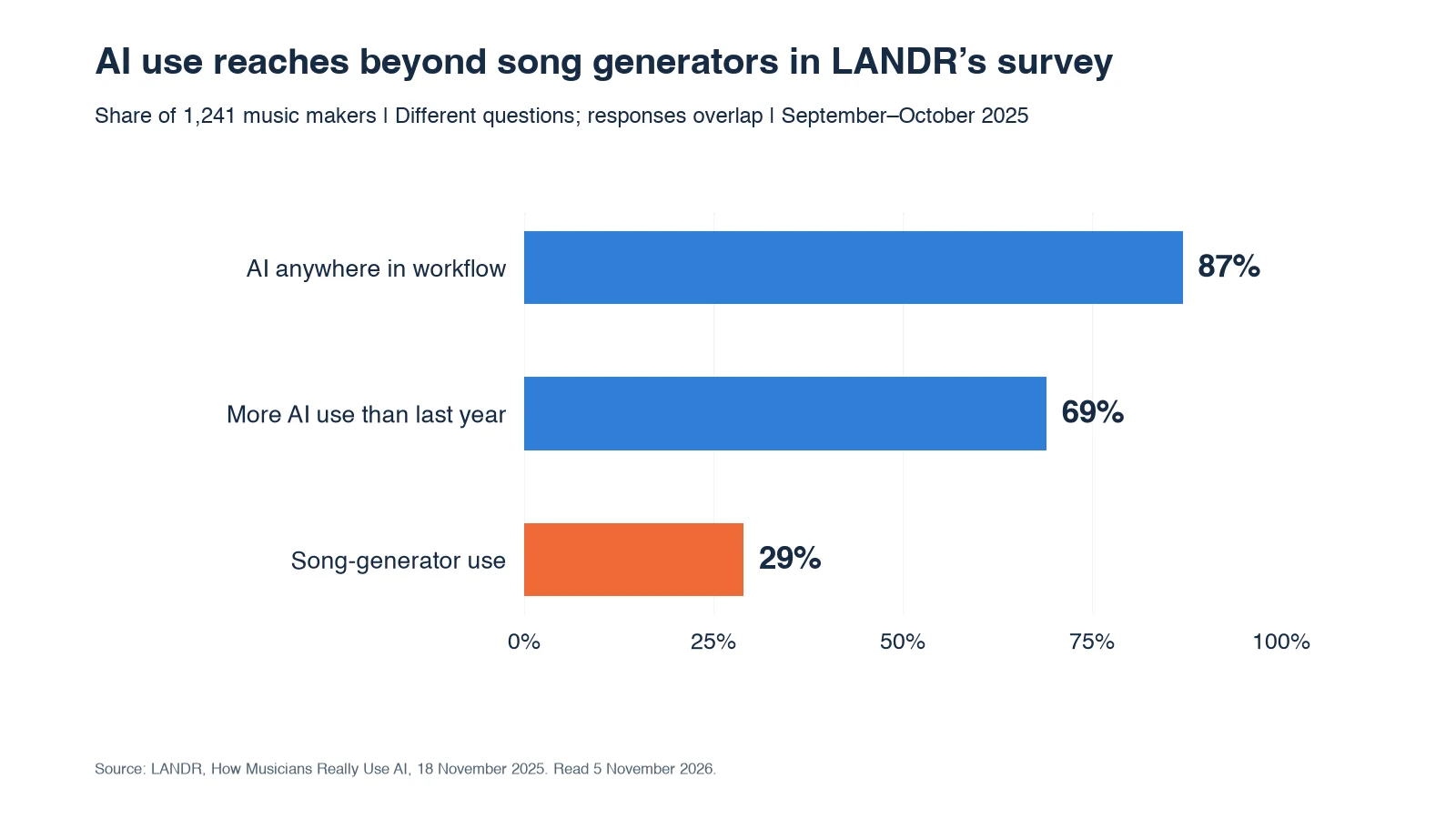
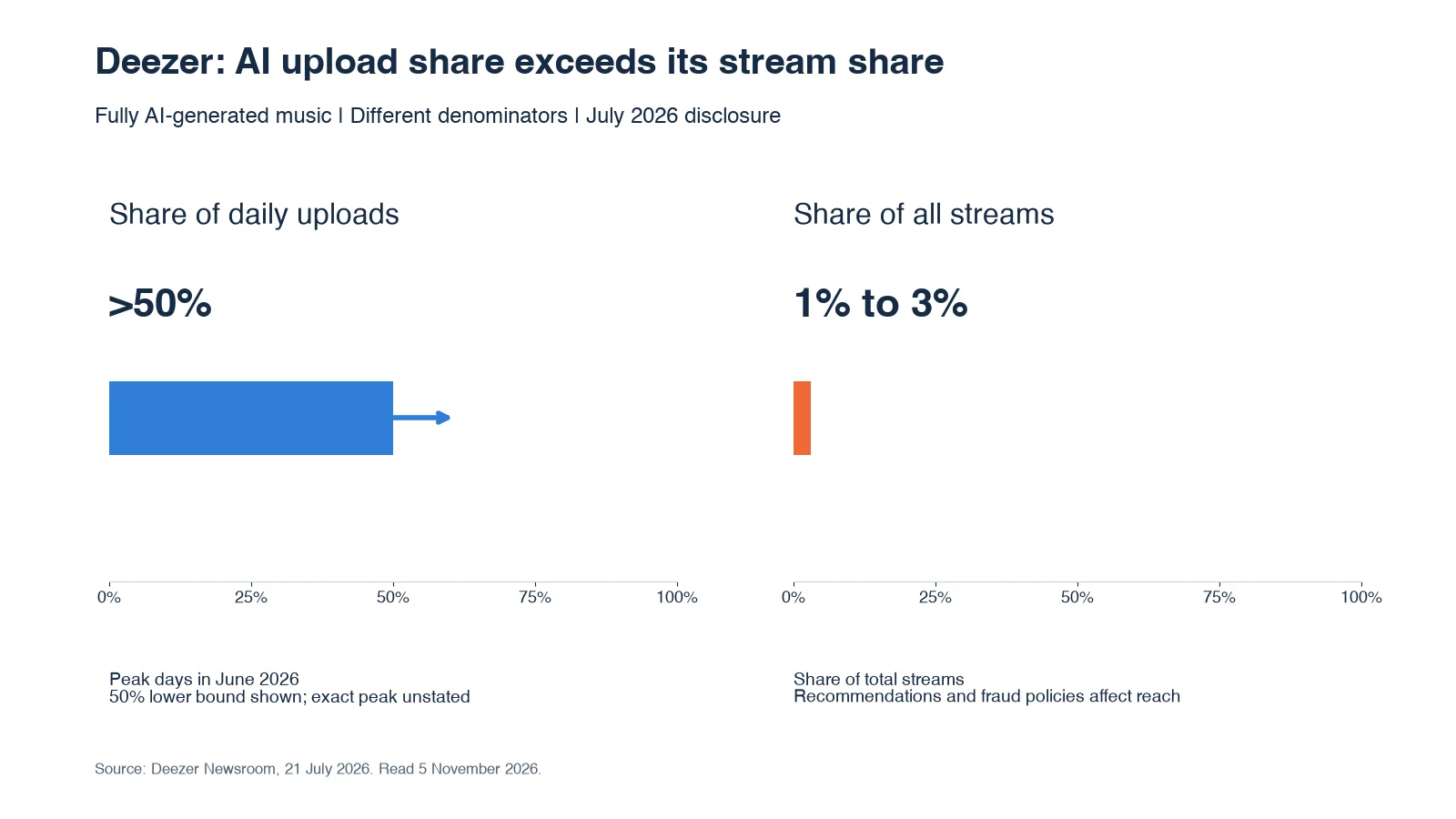
The short version: In a September-October 2025 survey, 87% of surveyed artists reported using AI somewhere in their workflow. Meanwhile, fully AI-generated tracks exceeded 50% of daily uploads on Deezer at peak in June 2026, despite accounting for only 1% to 3% of streams.
Key takeaways
- Creator adoption is widespread among surveyed music makers: 87% of artists surveyed by LANDR in September-October 2025 reported using AI somewhere in their workflow.
- Generation volume outpaces measured consumption: Fully AI-generated tracks exceeded 50% of daily uploads on Deezer at peak in June 2026 but accounted for only 1% to 3% of streams.
- Listener detection remains limited: 97% of participants in a 2025 Deezer/Ipsos blind listening test failed to distinguish fully AI-generated music from human-made music.
This report examines 28 AI music generation statistics covering creator adoption, platform growth, streaming distribution, listener perception, professional workflows, and market forecasts. The findings draw on industry surveys, market research, platform disclosures, and trade publications, with reporting periods and research limitations identified where relevant. Sources were read on 5 November 2026. Voyager, the desktop app our team builds, connects AI generation with editable music production workflows.
Creator adoption and workflow integration
Survey-based adoption statistics reflect respondent populations and question framing. The figures below measure different aspects of AI use among creative professionals. Surveys recruited through music-technology communities may report higher adoption than surveys of the wider musician population.
1. 87% of artists surveyed by LANDR use AI somewhere in their workflow
A LANDR study conducted between September and October 2025 found that 87% of artists incorporate AI tools at some stage of their creative process. The survey covered 1,241 music makers from LANDR's global community. This figure encompasses applications ranging from composition assistance to mastering and promotional tasks rather than measuring full-track generation specifically. Because respondents came from a music-technology community, the result should not be interpreted as an adoption rate for all musicians worldwide.
2. 78% of surveyed professional musicians used AI for music-related work in the past year
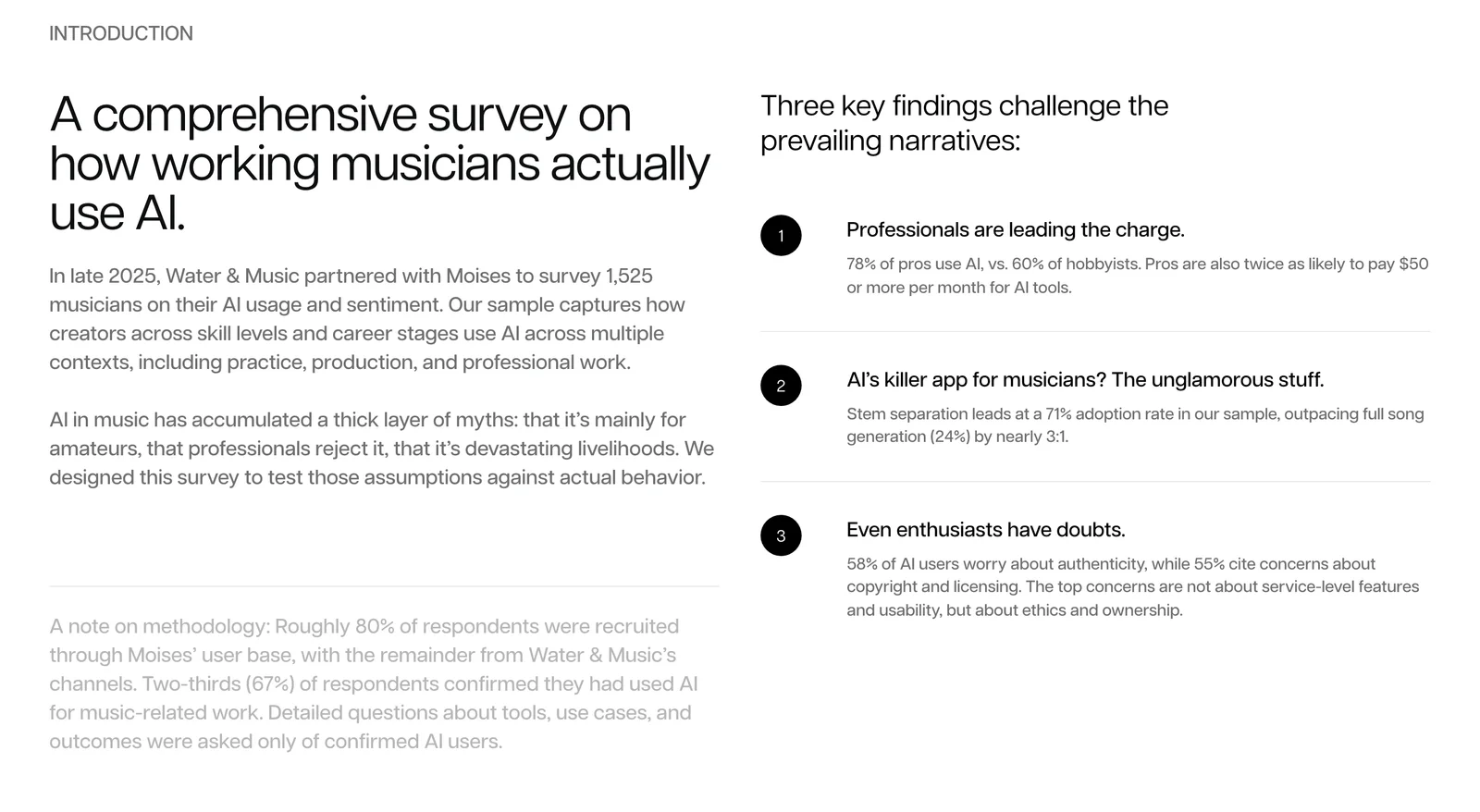
A joint Water & Music and Moises survey reported that 78% of professional musicians surveyed used AI for music-related tasks within the preceding 12 months. The survey, published in March 2026, captured usage across composition, production, and distribution activities. It included 1,525 musicians, with approximately 80% recruited through Moises' user community, so the findings reflect a technology-engaged sample rather than all professional musicians.
3. 47% of independent artists surveyed in 2026 use AI in music-making
Ditto Music's 2026 Independent Music Report, based on 5,039 independent artists across 112 countries, found that 47% use AI regularly or occasionally in their music-making process. This covers production assistance and other creative applications rather than full-song generation alone.
4. 69% of surveyed artists are using more AI tools than last year
The same LANDR study found that 69% of artists reported increased AI tool usage compared with the previous year, with 90% of that group planning to expand their use further. This suggests growing AI engagement among the surveyed creators, though future intentions are not measured outcomes and do not establish industry-wide adoption growth.
5. 29% of surveyed respondents use song generators in their workflow
Within the broader adoption figures, 29% of surveyed artists specifically reported using AI song generators at some stage in their creative process. This narrower measure captures song-generator use, often for vocals, instruments, or song parts, rather than necessarily generating complete tracks.
Platform scale and generation volume
Platform metrics measure generation activity and subscriber growth rather than unique users or finished productions. High generation counts should be distinguished from the number of tracks actually released, distributed, or consumed.
6. Suno generates approximately 7 million songs daily
According to reporting based on Suno's 2025 investor materials, the AI music platform was generating approximately 7 million songs every day in November 2025. This illustrates the scale of automated music generation on a single platform. However, generated songs are not necessarily unique compositions, finished productions, or publicly released tracks, so this volume should not be compared directly with a streaming service's music catalog.
7. Suno reached 2 million paid subscribers
In February 2026, Suno reported 2 million paid subscribers and more than 100 million cumulative users since launch. These company-reported figures describe different populations and do not establish a free-to-paid conversion rate.
8. Suno's website received an estimated 75.9 million visits in September 2026
Third-party traffic estimates from AlphaMoat indicate that Suno received approximately 75.9 million website visits in September 2026, representing a 3.1% increase from the previous month. The United States accounted for 19.6% of estimated traffic, making it the platform's largest geographic market. This level of website activity suggests substantial interest in AI-powered music generation and related creative workflows.
Streaming distribution and the upload-to-stream gap
The relationship between AI music uploads and actual consumption reveals a significant disparity worth understanding for anyone evaluating market impact. Upload proportions, streaming shares, and detected fraudulent activity measure different aspects of distribution.
9. Deezer receives approximately 90,000 AI-generated tracks daily
In July 2026, streaming platform Deezer reported that approximately 90,000 fully AI-generated tracks had been delivered per day on average in June. Fully AI-generated music exceeded 50% of daily uploads at peak during that month. This represents a substantial increase from approximately 10,000 daily tracks in January 2025.
10. AI tracks account for only 1% to 3% of actual streams despite volume
Despite exceeding 50% of daily uploads at peak, fully AI-generated tracks accounted for only 1% to 3% of streams on Deezer. This shows a substantial gap between uploaded content and measured listening activity. However, the streaming share should not be interpreted as a direct measure of listener demand because Deezer excludes fully AI-generated tracks from algorithmic recommendations and editorial playlists and removes fraudulent streams from royalty calculations.
11. More than one-third of Apple Music uploads are 100% AI-generated
Apple Music reported that more than a third of music submitted to the platform consisted of entirely AI-generated tracks. This proportion, reported in April 2026, reflects upload volume rather than catalog share or streaming performance.
12. Spotify removed over 75 million spam tracks in one year
In the 12 months preceding September 2025, Spotify reported removing over 75 million tracks classified as spam. While not all removed content was AI-generated, the scale of moderation indicates platform-level challenges in managing automated and deceptive content submissions. The figure should not be presented as a count of AI-generated tracks removed.
13. Up to 85% of streams from fully synthetic tracks on Deezer were fraudulent
During 2025, Deezer identified that up to 85% of streams generated by fully synthetic tracks were deemed fraudulent, depending on the month. This finding suggests that much of the streaming activity attributed to AI music on Deezer involved manipulation rather than genuine listener activity. The percentage concerns Deezer's detected fully AI-generated tracks and should not be generalized to all AI music streams across platforms.
Quality perception and human detection
Listener perception studies measure subjective responses under specific conditions rather than objective audio quality. Blind identification tests can reveal how difficult synthetic music is to recognize, but they do not establish whether listeners prefer the music or how it performs in professional production.
14. 97% of surveyed listeners failed an AI music identification test
A November 2025 Deezer/Ipsos study involving 9,000 participants across eight countries found that 97% failed to distinguish fully AI-generated music from human-made music in a three-track listening test. This result describes the specific test conditions rather than universal detection accuracy or objective audio quality.
15. 52% of surveyed listeners felt uncomfortable about failing to identify AI music
In the November 2025 Deezer/Ipsos study, 52% of participants felt uncomfortable about not being able to distinguish fully AI-generated music from human-made music. The finding measures reactions to a listening test rather than regular consumption of AI-generated tracks.
16. 77% of UK adults equate uncredited AI music with theft
A March 2024 UK Music poll found that 77% of UK adults agreed that AI-generated music failing to acknowledge the original music's creators amounts to theft. The finding comes from a UK public-opinion survey rather than a global listener study. It reflects respondents' attitudes, not a legal determination that every instance of uncredited AI-generated music constitutes theft.
AI workflow tasks and tool use
Application-specific usage statistics reveal which AI music capabilities have achieved meaningful adoption among the surveyed musicians. The results distinguish assistive production processes from automated full-song generation.
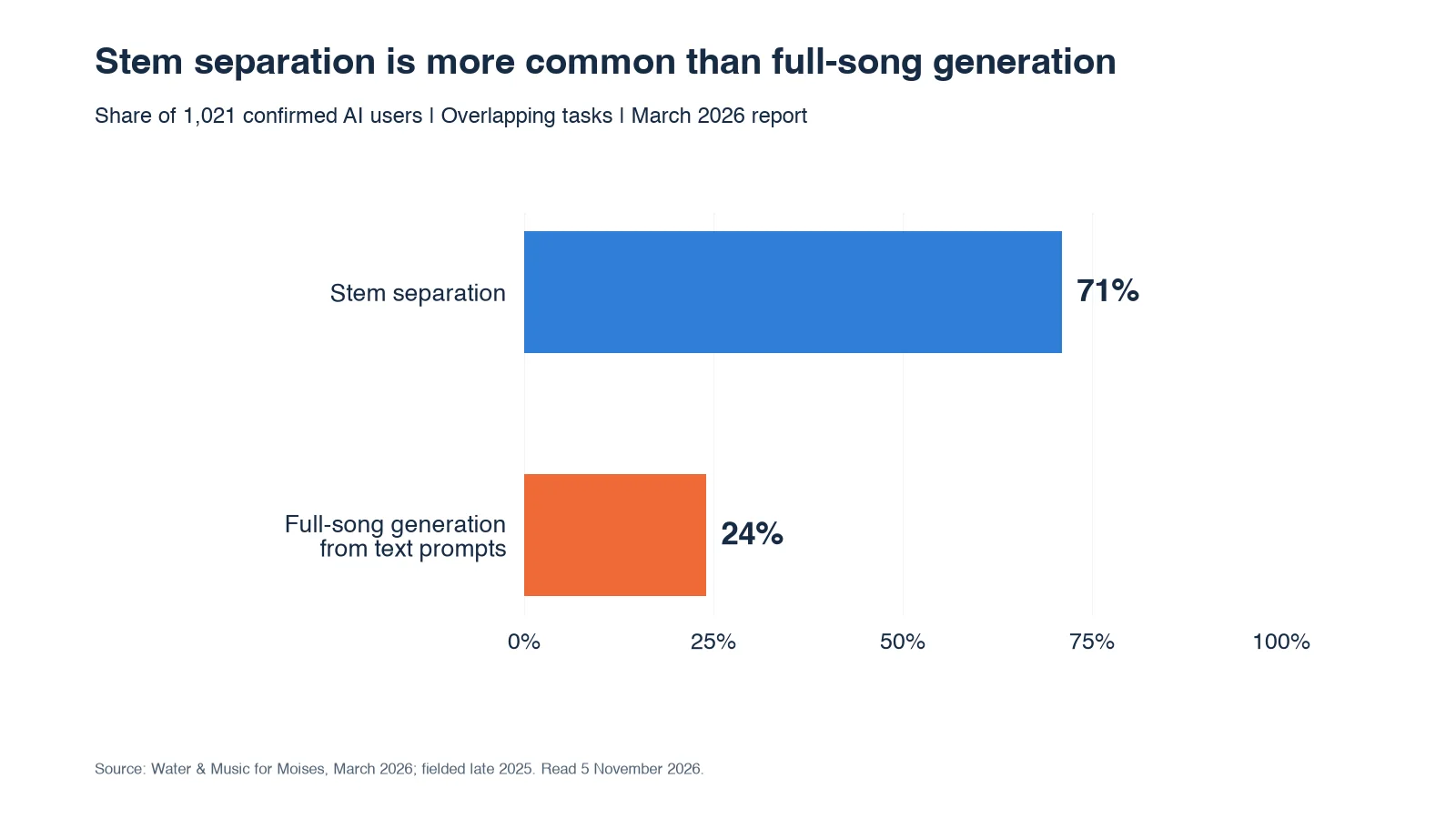
17. 71% of surveyed AI-using musicians use stem separation
A 2026 Water & Music and Moises survey found that 71% of AI users reported using stem separation, making it the most common AI music task measured in the study. The finding comes from 1,021 respondents who confirmed using AI and reflects adoption within that group rather than performance speed or the entire musician population.
18. 24% of surveyed AI-using musicians use full-song generation
The 2026 Water & Music and Moises survey found that 24% of AI users reported generating full songs from text prompts. This was substantially less common than stem separation, illustrating the difference between assistive production tools and complete-song generation among the survey's confirmed AI users.
Industry-specific adoption patterns
Adoption varies significantly by genre and professional role, with electronic and urban music creators reporting comparatively high usage rates in the GEMA/SACEM research. These results reflect creators surveyed in 2023 rather than current global adoption by genre.
19. 54% of surveyed electronic music creators used AI in 2023
A Goldmedia study for GEMA and SACEM found that 54% of electronic creators surveyed had used AI technologies in their creative work in 2023. This figure comes from the study's genre-specific chart, which reports 54% for electronic music. The result identifies a comparatively high level of adoption within the surveyed genre category but does not establish why those creators adopted AI.
20. 53% of surveyed urban and rap creators used AI in 2023
Similarly, 53% of urban/rap creators reported using AI technologies in their creative work in the 2023 GEMA/SACEM study. Urban and rap, alongside electronic music, showed some of the highest adoption rates among the surveyed genre categories.
21. 30.6% of independent artists surveyed in 2023 used AI for mastering
A 2023 Ditto Music survey of nearly 1,300 music makers found that 30.6% of respondents had used AI for mastering tasks, as documented in IMPALA's November 2023 AI Trends Report. AI mastering services offer automated loudness normalization, EQ adjustment, and dynamic processing as alternatives to parts of a traditional mastering workflow.
22. 38% of independent artists surveyed in 2023 used AI for artwork
Beyond audio production, 38% of respondents in the 2023 Ditto Music survey reported using AI to create artwork for their music, according to IMPALA's AI Trends Report. This adjacent creative application often integrates with distribution workflows for album covers and promotional materials.
Professional attitudes and transparency demands
Industry gatekeepers in sync licensing, film, and advertising express distinct attitudes toward AI-generated content. The following figures come from a survey of 144 music-licensing professionals and should not be generalized to every professional in the wider music industry.
23. 37% of surveyed licensing professionals explicitly mentioned transparency
A 2025 Cyanite, MediaTracks, and Marmoset survey found that 37% of respondents used the word "transparency" in their written answers about AI music labeling and selection. The survey covered 144 music-licensing professionals, including supervisors, filmmakers, advertisers, and producers.
24. 97% of music decision-makers surveyed demand AI transparency
A 2025 survey by Cyanite, MediaTracks, and Marmoset found that 97% of respondents wanted AI-generated music to be clearly labeled. This near-universal preference within the surveyed group reflects professional gatekeepers' emphasis on informed licensing decisions.
25. 49% of surveyed licensing professionals refuse to work with AI-generated music
The same survey found that 49% of respondents said they would work only with human-made tracks. This rejection rate indicates a substantial level of caution among the surveyed professionals about incorporating AI music into licensing workflows, regardless of perceived audio quality.
Market size and growth trajectory
Market forecasts employ varying definitions and scopes. The figures below represent projections from market research firms rather than measured transaction volumes. Broader AI music estimates include applications beyond generative song creation, so the forecasts should not be treated as directly comparable market totals.
26. Global AI in music market estimated at $6.65 billion for 2025
Market.us estimated the global AI in Music market at $6.65 billion in 2025, projecting growth to $60.44 billion by 2034 at a compound annual growth rate of 27.8%. This broad definition encompasses music creation, recommendation, production, and distribution applications. The figures are market-research estimates and forecasts rather than audited industry revenue.
27. AI music generator market estimated at $1.98 billion in 2026
A narrower market definition from Business Research Insights estimates the AI Music Generator market at $1.98 billion in 2026, projected to reach $18.04 billion by 2035. The publisher states a 28.5% CAGR, although the stated endpoints imply approximately 27.8% compound annual growth over nine years. This source-level discrepancy should be considered when interpreting the forecast. The report focuses on generation tools rather than the broader AI music ecosystem.
28. North America holds more than 37.6% of the global AI music market in 2024
Regional analysis indicates North America captured more than 37.6% of the global AI in Music market in 2024. The same report valued the US AI in Music market at approximately $1.66 billion in 2024, reflecting North America's substantial share of the broader market as defined by the research publisher.
Why Voyager for music production workflows
The adoption statistics above show that AI is becoming part of music creation, but generating audio is only one stage of a professional production workflow. Creative teams still need to arrange, edit, mix, review, and export audio for finished projects. Voyager is a desktop AI-agent harness that connects external generation models with editable creative workflows, allowing musicians, video editors, and production teams to work across AI-assisted and traditional audio tools.
For music production, Voyager provides several relevant capabilities:
- AI voice and music generation: Access to voice and music models, including external providers and models such as ElevenLabs and Seed Audio, for generating vocals, music, and other audio assets. Model generation may require paid credits.
- Professional DAW integration: Agent-assisted workflows with supported applications such as Ableton Live and REAPER, using available scripting and automation capabilities. Application compatibility and setup requirements depend on the operating system and integration.
- Built-in Voyager DAW: Included audio editing capabilities supporting VST3 instruments, mixing, mastering, loudness targets, and stem exports for further refinement.
- Scoring to picture: A video scoring workflow that connects visual cues with musical arrangements, including cue detection, ducking, and editable audio elements.
- Editable production outputs: Workflows that preserve project files, MIDI, and audio stems where supported, allowing creative professionals to revise generated elements rather than relying only on finished audio files.
For teams evaluating AI music production tools, the statistics highlight the difference between generating more content and producing music suitable for professional use. Voyager supports workflows that combine AI-generated elements with human editing and production decisions. However, editable outputs do not automatically resolve copyright, licensing, or transparency concerns, particularly when 49% of surveyed professionals involved in music licensing said they would work only with human-made tracks.
Frequently asked questions
What percentage of artists use AI in music production?
A September-October 2025 LANDR survey found that 87% of its respondents used AI somewhere in their workflow, including 29% who used song generators for complete songs or individual song parts. The survey included 1,241 music makers. Separately, a 2023 Ditto Music survey found that 30.6% of respondents used AI for mastering and 38% for artwork. These percentages come from different samples and periods and should not be treated as directly comparable adoption rates.
How much AI-generated music is being created daily?
Suno alone generated approximately 7 million songs daily, according to reporting based on its 2025 investor materials. This single-platform figure illustrates the scale of AI music generation, though it measures raw output rather than distributed or consumed content. The gap between generation volume and actual streaming consumption remains substantial.
Can listeners tell the difference between AI and human-composed music?
A November 2025 Deezer/Ipsos survey found that 97% of 9,000 participants failed to distinguish fully AI-generated music from human-made music in a three-track listening test. This result reflects performance under the study's specific conditions rather than universal listener-detection accuracy or objective audio quality.
What is the projected market size for AI music generation?
Market estimates vary by scope and methodology. Broad AI in Music market projections estimated $6.65 billion in 2025, while narrower AI Music Generator definitions estimated $1.98 billion in 2026. Market.us projects 27.8% compound annual growth through 2034. The narrower report states 28.5% CAGR through 2035, although its published market-size endpoints imply approximately 27.8%. These remain forecasts rather than measured revenues, and the categories should not be combined.
How do music industry professionals view AI-generated content?
Professional attitudes reflect significant caution. A 2025 Cyanite, MediaTracks, and Marmoset survey of 144 music-licensing professionals found that 49% would accept only human-made tracks, while 97% wanted clear labeling of AI-generated music. These findings describe the surveyed professionals rather than all music supervisors or the entire sync-licensing industry.
Voyager is a desktop AI agent for creative work
Describe what you want to make; Voyager plans it, uses your apps and tools, and keeps everything editable.