The 2026 text-to-speech market is estimated at $4.36 billion by Mordor Intelligence. Adoption is a separate question: 26% of surveyed Voices clients had tried AI voice in its 2025 report. Our own 40 short speech samples had a historical median estimated generation cost of 3.00 cents per output minute. These measure revenue, buyer behavior and production costs in different populations.
The short version: synthesized speech serves narration, localization, accessibility and customer-service playback. Use the figures below to size an opportunity, plan a script or budget takes. Keep voice synthesis separate from speech recognition and conversational agents, which also need listening, reasoning and turn-taking.
Key takeaways
- Mordor Intelligence estimates the 2026 text-to-speech market at $4.36 billion within its defined market.
- Voices’ 2025 client survey found that 26% had tried AI voice, a buyer-sample result rather than a worldwide adoption rate.
- Our 40 historical speech samples had a median estimated generation cost of 3.00 cents per output minute, excluding retries and finishing.
We opened the linked primary sources on 29 October 2026 and recomputed our September to October speech records. Survey years remain visible; a 2026 reference does not turn older responses into current adoption. Provider specifications are documented claims. Voyager, the desktop app our team builds, connects supported voice generation with local audio and video editing; a generated take still needs listening, timing and mixing.
AI voice statistics at a glance
| Finding | Population and date |
|---|---|
| $4.36 billion TTS market estimate | Mordor's global revenue model, 2026 |
| 26% had tried AI voice | Voices client survey, 2025 report; sample count undisclosed |
| 71.2% accuracy on fake audio | 2026 preprint's English listening game |
| 3.00 cents per output minute | Median of 40 historical sample estimates, September–October 2026 |
Sources: Mordor, Voices, Müller and Choong's preprint and our sample CSV, read or analyzed 29 October 2026. These figures are neither a global user count nor a voice-quality ranking.
Market size: what spending measures
Mordor Intelligence's TTS report, updated 11 September 2026, estimates software/service revenue using device-stock sizing, supplier checks and interviews. It excludes speech recognition; the public method gives no interview count. We have not audited its proprietary model.
1. The 2026 TTS market estimate is $4.36 billion
Mordor's current-year estimate covers global TTS spending, including noncreative applications. It is not audited industry receipts.
2. TTS revenue is forecast at $7.92 billion in 2031
The forecast endpoint is a modeled outcome, not realized spending.
3. Forecast annual growth is 12.66% for 2026–2031
Keep that compound rate attached to the same publisher, definition and horizon.
4. Neural voices held 67.18% of estimated 2025 TTS revenue
Mordor's voice-type share measures spending, not listener preference.
5. Customer service and IVR held 30.74% of estimated 2025 revenue
This application share shows why TTS revenue cannot stand in for spending on creative voiceovers. Do not add overlapping voice-generator or agent market estimates to this total.
Adoption and buyer preferences
The 2025 Voices report surveyed registered clients who had bought voice in the preceding 12 months or came from key markets. It discloses neither exact sample count nor fieldwork dates. These are marketplace-client responses, not representative 2026 creator adoption.
6. 26% of surveyed clients had experimented with AI voice
Voices reports project experimentation, not regular use.
7. 70% of those experimenters used it in under a quarter of projects
The denominator is AI-voice experimenters, not all clients.
8. Nearly 80% prioritized human-like quality when choosing a provider
This stated preference is not a listening score.
9. Openness was split: 34% more open, 33% less, 33% unchanged
The year-over-year attitude question measures sentiment, not purchases.
10. 27% said they did not verify a vendor's ethical AI stance
Voices' respondents instead trusted vendors to act ethically. For procurement, request voice permission and usage terms separately from a naturalness audition.
Listener trust and voice-cloning misuse
A 21 May 2026 preprint by Müller and Choong analyzed 35,532 judgments from 1,768 participants across 138 TTS/voice-conversion systems. Its voluntary English-language game allowed replays and supplied feedback. It used adaptive sampling, presenting harder fakes more often; it is not a random survey of all listeners or every voice in use. One author lists an affiliation with voice vendor Resemble AI.
11. Listeners correctly classified 71.2% of fake samples
The 2026 study's fake-audio accuracy is a task-specific result, not the chance a scam will succeed.
12. Accuracy on genuine audio was only 64.1%
The same study found 72.7% in its 2021 comparison. The samples and participants differ, so this does not prove that exposure to AI caused declining trust. It does show why mistaking real speech for synthetic speech matters alongside missed fakes.
For cloning misuse, McAfee's May 2023 report used an online MSI-ACI survey of 7,054 adults in seven countries, fielded 13–19 April 2023. This older vendor-commissioned survey measures reported experiences, without independently confirming that each scam used AI.
13. One in ten respondents said they were personally targeted by an AI voice scam
McAfee's personal-exposure figure excludes the additional 15% who knew someone targeted. Neither is a 2026 prevalence estimate.
14. 77% of reported AI voice scam victims said they lost money
This victim-subgroup result does not mean 77% of all surveyed adults lost money. For production, keep permission records for cloned voices; for unexpected requests, verify identity through a separate trusted channel rather than vocal familiarity alone.
Original data: costs and timing of 40 speech samples
We analyzed ten entries, four shared scripts each, generated through fal between 10 September and 22 October 2026. The CSV includes timestamps, estimated costs, measured output durations and original audio URLs. The analysis kit adds the scripts, recorded voice/settings requests and a dependency-free calculation program. It reproduces the arithmetic from saved records; it cannot reproduce a provider's historical service behavior.
The entries are Eleven v3, Eleven v4, Eleven v4 Turbo, Gemini 3.1 Flash TTS, Gemini 3.8 Flash TTS, Gemini 3.8 Flash Lite TTS, HeyGen Voice, HeyGen Voice Turbo, Kokoro and MiniMax Speech 2.8 HD. Each variant counts separately. We exclude self-introduction hero runs, music, sound effects, images, video and three newer entries missing the complete four-script set.
Each completed sample has equal weight. Percentiles use inclusive linear interpolation; cost per minute divides each saved estimate by its measured output duration before taking the median. Voices, settings and dates vary. These are historical, rate-based estimates, including any promotional rates, not invoices, current prices or a controlled quality/speed benchmark. Completed outputs alone cannot establish reliability or reject rates.
15. The median estimated cost was 0.93 cents per short sample
The median saved cost was $0.0093, excluding subscriptions, rejected takes and finishing work.
16. The median estimated cost per output minute was 3.00 cents
The median of individual cost/duration ratios was $0.02999 per minute. It is not total cost divided by total duration or a current price quote.
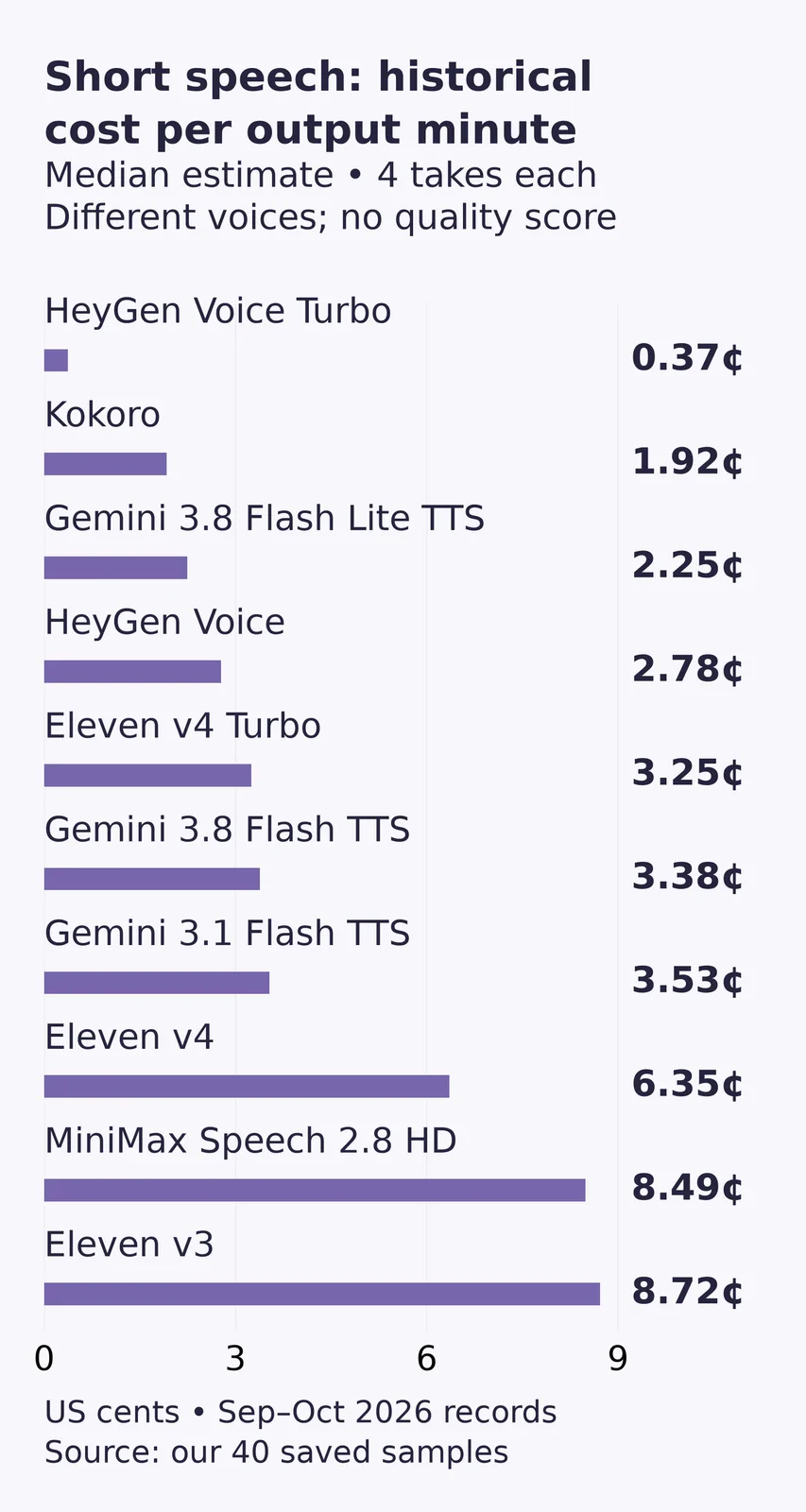
| Entry | US cents/min |
|---|---|
| HeyGen Voice Turbo | 0.37 |
| Kokoro | 1.92 |
| Gemini 3.8 Flash Lite TTS | 2.25 |
| HeyGen Voice | 2.78 |
| Eleven v4 Turbo | 3.25 |
| Gemini 3.8 Flash TTS | 3.38 |
| Gemini 3.1 Flash TTS | 3.53 |
| Eleven v4 | 6.35 |
| MiniMax Speech 2.8 HD | 8.49 |
| Eleven v3 | 8.72 |
Source: 40 speech sample rows, generated September–October 2026; analyzed 29 October. Each value is the median of four historical estimates per entry, normalized to measured output minutes.
17. The samples totaled about 49 cents for 12.59 minutes of audio
Saved estimates sum to $0.4867 and measured duration to 755.51 seconds. That is generated audio, not approved narration.
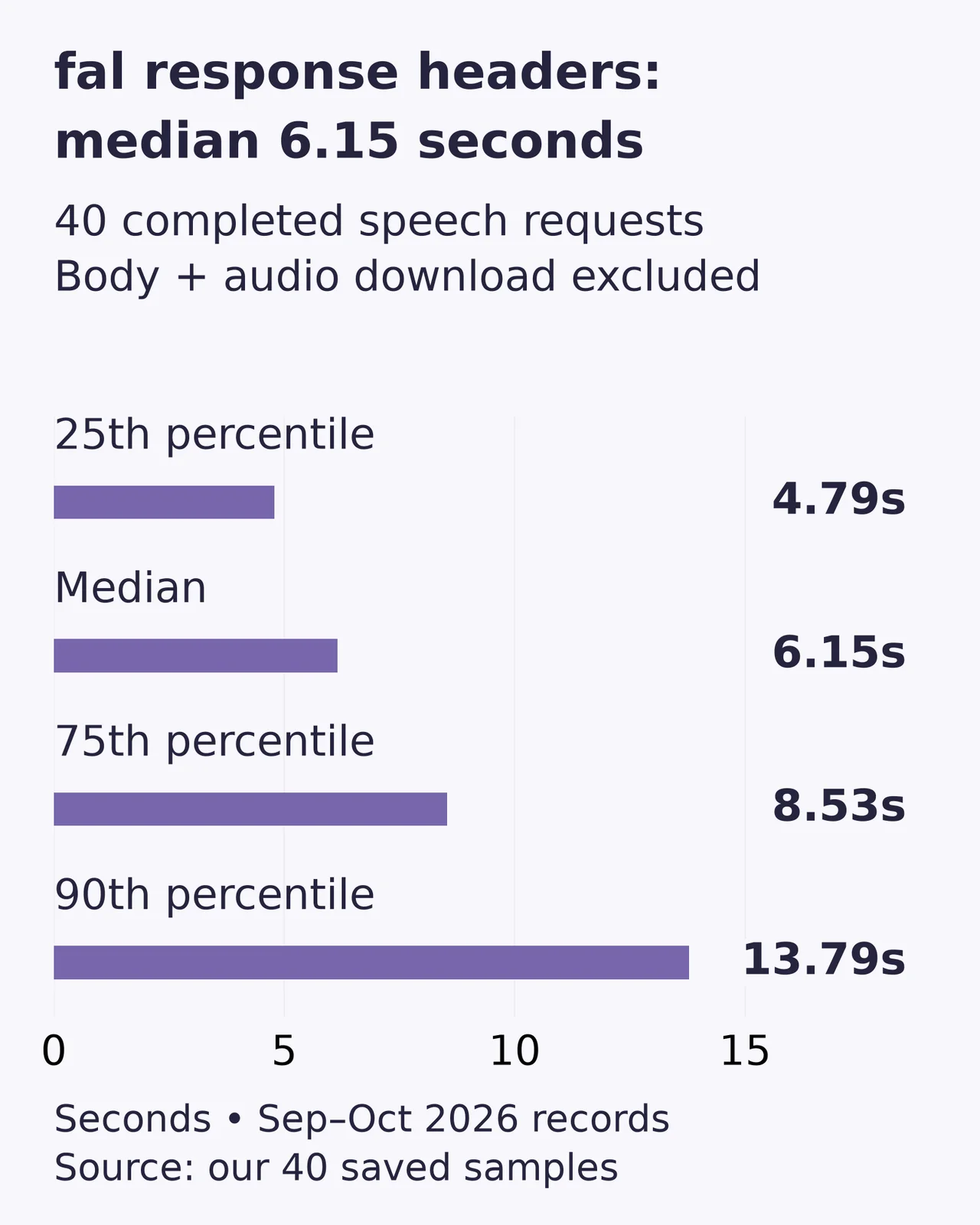
18. The median fal request-to-response-header time was 6.15 seconds
The 40 recorded intervals have a median of 6.1525 seconds, with the middle half from 4.79 to 8.53 seconds and the 90th percentile at 13.79 seconds. The timer starts before the synchronous fal request and stops when response headers arrive, before reading the response body or downloading audio. It cannot establish first sound, full-file receipt or conversational latency.
19. One narration script produced 22.64 to 26.44 seconds of speech
Ten readings of the same 385-character paragraph yielded this duration range. The words stayed fixed; models and voices did not. Fit the chosen take before locking picture.
20. One product pitch produced 12.82 to 16.08 seconds of speech
The 213-character script had a 3.26-second spread. Character count alone does not fix runtime. Our Kokoro and Gemini 3.1 Flash TTS pages preserve the corresponding readings.
Documented language coverage, API limits and current pricing
Provider documents below were read 29 October 2026. Coverage is not pronunciation accuracy. Limits belong to an exact model and route; an intermediary can impose lower bounds. Compare characters, bytes and output minutes separately.
21. Eleven v4 lists more than 90 languages
ElevenLabs' model documentation advertises 90+ languages. Check names and dialect with a qualified listener before a localization batch.
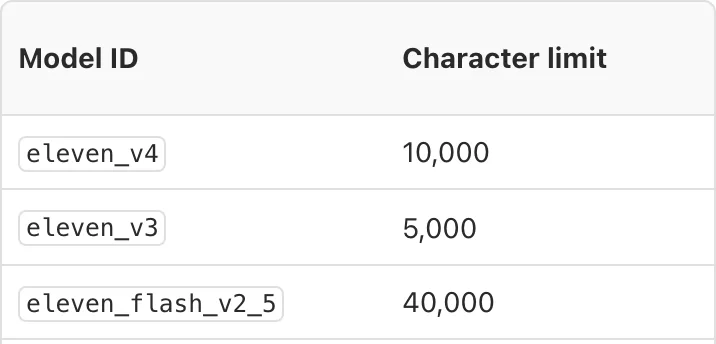
22. Eleven v4 accepts up to 10,000 characters per request
Its direct API limit is an input ceiling, not an exact runtime promise.
23. Eleven Flash v2.5 lists 32 languages
The model-specific language list differs from v4's. A provider's largest headline count does not apply to every model.
24. Eleven Flash v2.5 accepts up to 40,000 characters
The direct limit is four times v4's. Longer input capacity does not establish equivalent delivery quality. Choose the model by the script and audition, then check the selected voice's rights and plan terms.
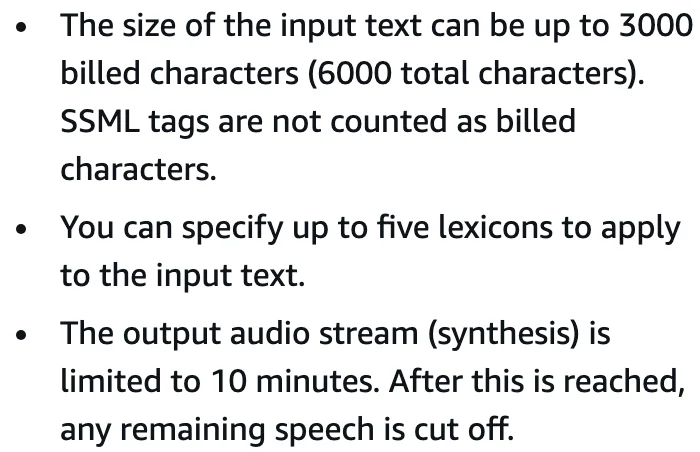
25. Amazon Polly's synchronous API accepts 3,000 billed characters
AWS quotas allow 3,000 billed within 6,000 total characters for SynthesizeSpeech; SSML tags are excluded from the billed count.
26. Polly's synchronous output is capped at 10 minutes
The same operation cuts off remaining speech after 10 minutes. For larger jobs, assess asynchronous synthesis, which requires an S3 output bucket.
27. Google Cloud TTS documents a 5,000-byte request content limit
The content quota is bytes, not characters. Some characters occupy multiple bytes. Check the operation's own requirements before splitting multilingual input; these limits should not be generalized to every Gemini-TTS route.
28. Google Neural2 lists $16 per million characters after free usage
Google's pricing table lists $0.000016 per character, with one million free characters per month. This Neural2 rate does not apply to every Google voice family. Other cloud resources can add charges.
Worked generation budget: assume free usage is exhausted, all text is billable, and 100 scripts of 1,000 characters each go through Neural2 once: 100,000 × $16 / 1,000,000 = $1.60. If each script is synthesized three times, including two rejected takes, that becomes $4.80 for 300,000 characters. This is our arithmetic at the documented rate, not a run or a finished-project quote. It excludes taxes, other infrastructure and human review/editing; it makes no assumption about audio duration.
29. Azure real-time TTS allows up to 10 minutes of audio per request
Microsoft's quota table lists this output limit for both Free F0 and Standard S0. It is separate from batch synthesis.
30. Azure's WebSocket SSML message ceiling is 64 KB per turn
The same real-time TTS table lists 64 KB for F0 and S0. This measures the SSML message, not plain-text character count. Check both payload size and output duration when choosing this route.
Which evidence should you use by job?
- Citing industry growth: use one publisher's defined revenue series, retaining its forecast horizon. Revenue does not establish user counts.
- Assessing buyer adoption: cite the survey's client population and year. Experimentation does not mean routine deployment.
- Budgeting narration: multiply today's endpoint rate by your actual billable input, including paid replacement takes, then add review and editing.
- Planning localization: use the exact model's language list and request units, followed by pronunciation review. Do not equate bytes with characters.
- Designing live conversation: measure recognition, turn detection, reasoning, synthesis and playback together. Our request-to-header intervals cover only one boundary.
- Delivering cloned speech: document the speaker's permission and the selected provider/voice licence. A listener's inability to identify synthesis grants no rights.
Frequently asked questions
How large is the text-to-speech market in 2026?
Mordor estimates $4.36 billion. Keep the publisher, TTS definition and estimate year attached when citing it.
How many people use AI voice?
The sources here do not establish a global user count. Voices' 2025 client survey measures experimentation among its buyers, not all creators or people using assistants. Revenue and supported-language counts cannot answer this question.
Can listeners reliably identify AI voices?
In the 2026 English listening-game preprint, people correctly classified 71.2% of fake samples and 64.1% of genuine samples. Its adaptive sampling and voluntary participants limit generalization. Verify identity independently for consequential requests.
Does the voice-scam survey measure current losses?
No. McAfee's survey was fielded in April 2023. It records self-reported experiences, not audited 2026 fraud totals or proof of how every reported scam was made.
How much does AI speech cost per minute?
Our historical samples had a median estimated cost of 3.00 cents per output minute. For a current budget, use your route's billing unit and price, as in the Neural2 example above; output duration, retries, licences and finishing vary.
Are the fal timings comparable to streaming or agent latency?
No. They stop at response headers, excluding response-body reading and audio download. They do not measure first audible speech, full-file receipt or an agent's whole response cycle.
How should we cite or recompute the original figures?
Cite 40 completed speech samples across ten entries, generated 10 September to 22 October 2026; analyzed 29 October 2026. Label costs as historical estimates and timings as synchronous fal request-to-response-header intervals. Download the CSV and analysis kit for the records, script text, settings and calculations.
Voyager is a desktop AI agent for creative work
Describe what you want to make; Voyager plans it, uses your apps and tools, and keeps everything editable.