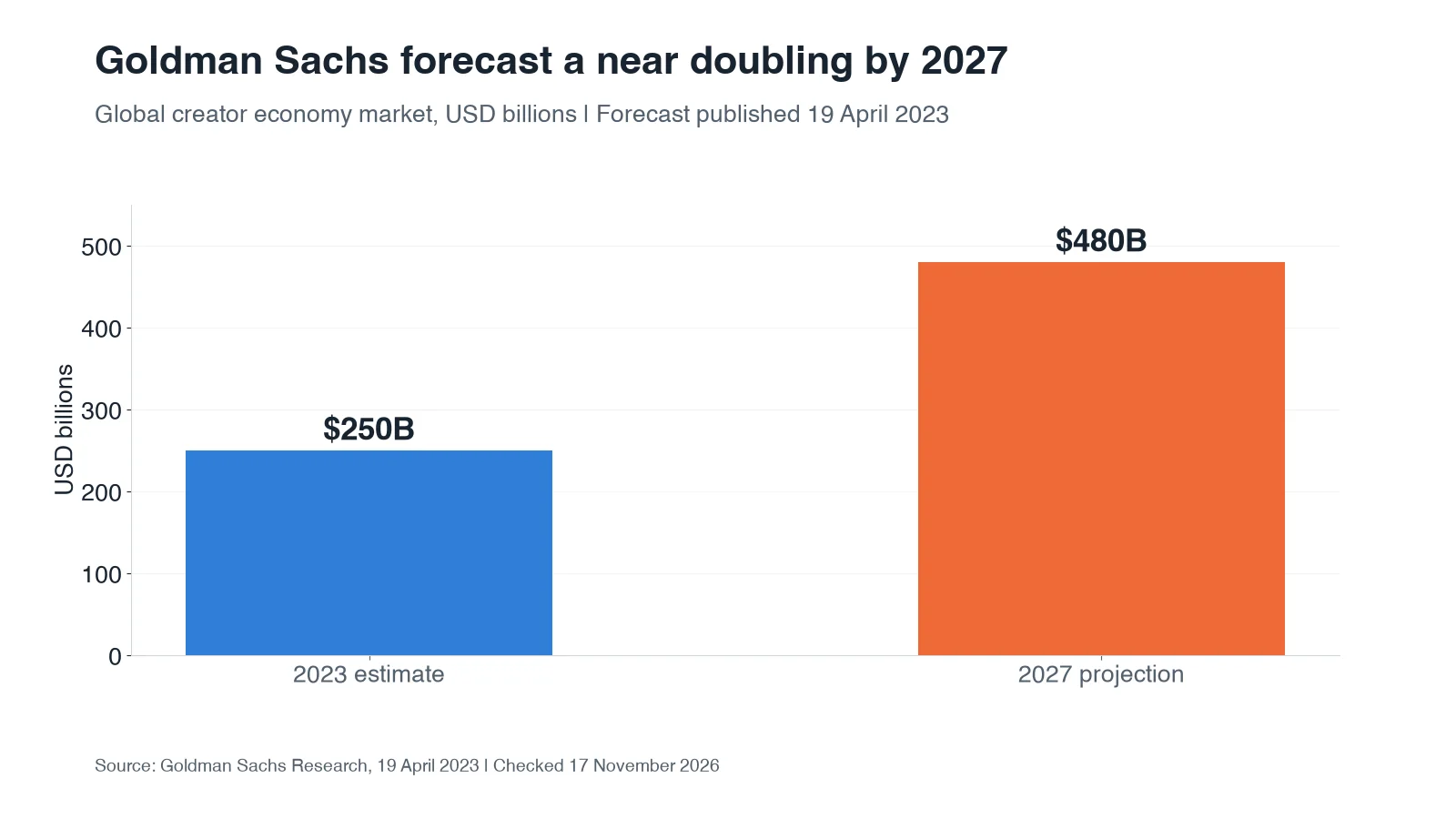
The creator economy could approach $480 billion by 2027, nearly doubling from Goldman Sachs' estimated $250 billion market size in 2023. However, market forecasts vary significantly depending on how researchers define creator activity, monetization, and platform revenue. Understanding these differences helps creators, marketers, and production teams evaluate the industry's growth and opportunities.
The short version: The creator economy continues to expand, although estimates differ. Coherent Market Insights estimates $216.33 billion in 2026, while Grand View Research projects $310.4 billion for the same year. Meanwhile, Kit's April 2026 survey found that 57.3% of working creators used AI daily, indicating that AI tools are becoming a regular part of surveyed creator workflows.
Key takeaways
- Market projections vary significantly: Goldman Sachs' 2023 forecast projected $480 billion by 2027, while 2026 estimates include $216.33 billion from Coherent Market Insights and $310.4 billion from Grand View Research. These estimates should be interpreted according to each publisher's methodology.
- Creator earnings remain concentrated: Goldman Sachs estimated in 2023 that about 4% of global creators earned more than $100,000 annually, highlighting the relatively small proportion reaching that income threshold.
- Brand collaborations are not universal: Linktree's 2021 survey, published in 2022, found that 67% of responding creators had never collaborated with a brand on social channels, showing that sponsorship participation was far from universal in the surveyed population.
This report examines 25 creator economy statistics covering market growth, creator demographics, earnings, platform activity, and AI adoption in 2026. Findings draw from research published between 2022 and 2026, including underlying 2021 survey data, and were reviewed against available sources as of 17 November 2026. Historical measurements, survey results, and forecasts are distinguished throughout. Voyager, the desktop app our team builds, connects AI models with creative applications and editable production workflows.
Understanding creator economy market definitions
Market size estimates for the creator economy vary because research firms use different classifications, revenue categories, and forecasting methods. Some studies focus on creator earnings, while broader market assessments consider platform activity, brand partnerships, creator services, subscriptions, and related revenue channels. Goldman Sachs' $480 billion projection represents a broad potential market opportunity rather than a guaranteed revenue outcome.
Geographic scope and the measurement period also affect totals. Some research covers global activity across multiple platforms, while other studies examine specific regions or monetization categories. Readers should distinguish estimated market value from actual creator earnings and future projections from measured historical results.
The statistics below identify the source, reference year, and population or market scope where available. These distinctions matter when interpreting industry growth in 2026.
Market size and growth projections
Market forecasts provide an indication of the creator economy's potential scale, but different research providers publish substantially different estimates. The following statistics compare market values, growth rates, and projected revenue using each publisher's stated assumptions. These forecasts are not audited totals of creator earnings and should not be treated as interchangeable measurements.
1. Goldman Sachs projects the creator economy could reach $480 billion by 2027
Goldman Sachs Research estimated in 2023 that the total addressable market for the creator economy could approach $480 billion by 2027. The projection represents a potential doubling from the firm's estimated $250 billion baseline in 2023. Goldman Sachs identifies creator monetization through brand partnerships and platform-related revenue as important market activities. The figure remains a historical forecast rather than a confirmed 2027 market outcome.
2. Coherent Market Insights estimates $216.33 billion in 2026
Coherent Market Insights estimated the global creator economy at $216.33 billion in 2026, projecting growth to approximately $1,190.48 billion by 2033 at a 27.4% compound annual growth rate. Its August 2026 report covers creator platforms, revenue channels, content types, and different creator categories. This estimate differs from Grand View Research's $310.4 billion figure for 2026. The estimates come from separate forecasting frameworks and should not be interpreted as identical measurements.
3. Grand View Research valued the market at $252.3 billion in 2025
Grand View Research valued the global creator economy at $252.3 billion in 2025, projecting growth to $310.4 billion in 2026. This baseline provides context for the market's expected expansion in 2026. Its research covers creator activity across multiple platform types, creative services, and revenue channels. These values represent market research estimates and projections, not independently audited creator income totals.
4. The market is projected to grow at a 23.3% CAGR from 2026 to 2033
Grand View Research projects the creator economy will grow at a 23.3% annual growth rate from 2026 to 2033, reaching an estimated $1,345.5 billion by the end of that period. The publisher associates market expansion with digital platform adoption and growing opportunities to monetize content. This rate describes a forecast across the specified period rather than observed annual growth. Actual market performance may differ as technology, audience behavior, and revenue models change.
5. The creator economy is estimated to grow 26.5% from 2025 to 2026
The Business Research Company's September 2026 report estimates that the creator economy will grow from $255.66 billion in 2025 to $323.48 billion in 2026, representing a 26.5% increase. The publisher identifies digital content demand, influencer marketing, and the expansion of online creator communities among the market's growth drivers. The 2026 figure is a research estimate rather than finalized year-end revenue. Its market boundaries should be evaluated separately from other research providers' estimates.
Creator population and demographics
Creator population statistics help explain how participation varies across audience sizes, regions, and professional categories. However, researchers do not always use the same definition of a creator. The following figures distinguish creator estimates, platform profiles, and survey respondents rather than treating them as a single global population.
6. Linktree's 2023 report cited more than 200 million creators worldwide
Linktree's 2023 Creator Report cited an estimate of more than 200 million creators competing for online audiences globally. The report referenced earlier Linktree creator-economy research rather than establishing a new 2023 census of active creators. Its broad creator definition includes people participating at different levels of professionalization. This is a historical market estimate, not a verified count of creators active in 2026.
7. Linktree identified 41 million creators with 10,000 to 100,000 followers
Linktree's 2022 Creator Report, drawing on its 2021 research, estimated that 41 million creators worldwide had audiences of 10,000 to 100,000 followers. The report classified this audience-size category as its "Pro" tier. This classification measures follower counts rather than employment status, income, or content quality. The figure offers historical context for mid-sized creator audiences but should not be presented as a current 2026 population estimate.
8. India's creator population reached an estimated 4.12 million in 2025
A 2026 study from the Indian School of Business and Hashfame estimated that India's creator base grew from 0.96 million in 2020 to 4.12 million in 2025. The study also found that 66% of the 2025 creator base came from non-metro locations. These findings illustrate the geographic distribution of creators within the study's defined market. They should not be interpreted as a count of every person posting content online in India.
9. 59.3% of creators in a 2026 Kit survey were full-time
In an April 2026 survey of 550 working creators, Kit found that 59.3% were full-time, with content creation as their primary income source. Another 29.6% identified as part-time creators earning side income. Respondents represented business models such as consulting, digital products, newsletters, and other creator businesses. Because the survey targeted working creators, its results should not be generalized to the entire creator population.
10. 60.2% of gender-classified U.S. Instagram influencer profiles were female-classified
Influencity's 2026 U.S. Instagram study found that 60.2% of profiles classified as male or female were classified as female. However, 21.5% of all eligible profiles had no gender classification in the database. These percentages use different denominators and should not be combined without accounting for unclassified profiles. The classifications describe database records, not creators' self-identified gender or the global creator population.
11. 43% of surveyed creators spent five hours or less per week creating content
Linktree's 2021 creator survey, published in its 2022 report, found that 43% of responding creators spent five hours or less per week creating content. The same report found that 66% considered themselves part-time creators. These results illustrate the range of time commitments among respondents rather than contemporary productivity benchmarks. They also cannot establish how newer AI tools have affected the time creators spend producing content.
Creator earnings and monetization
Creator income varies by audience size, business model, sponsorship access, and revenue diversification. Survey findings can reveal typical experiences within particular creator groups, but business revenue should not be confused with personal take-home income. The following benchmarks cover historical earnings, the time required to monetize, and the size of related commercial markets.
12. Full-time content entrepreneurs reported median annual revenue of $50,000 in a 2022 survey
The Tilt's 2022 research reported median revenue of $50,000 among surveyed full-time content creators who were already earning money, based on their expected 2022 business revenue. This measures business revenue within a specific sample, not the average salary or take-home income of all creators worldwide. The median represents the middle of the surveyed revenue distribution. It provides a historical benchmark for creator businesses while leaving room for substantial variation by niche, audience, and operating expenses.
13. Goldman Sachs estimated about 4% of creators earned over $100,000 annually
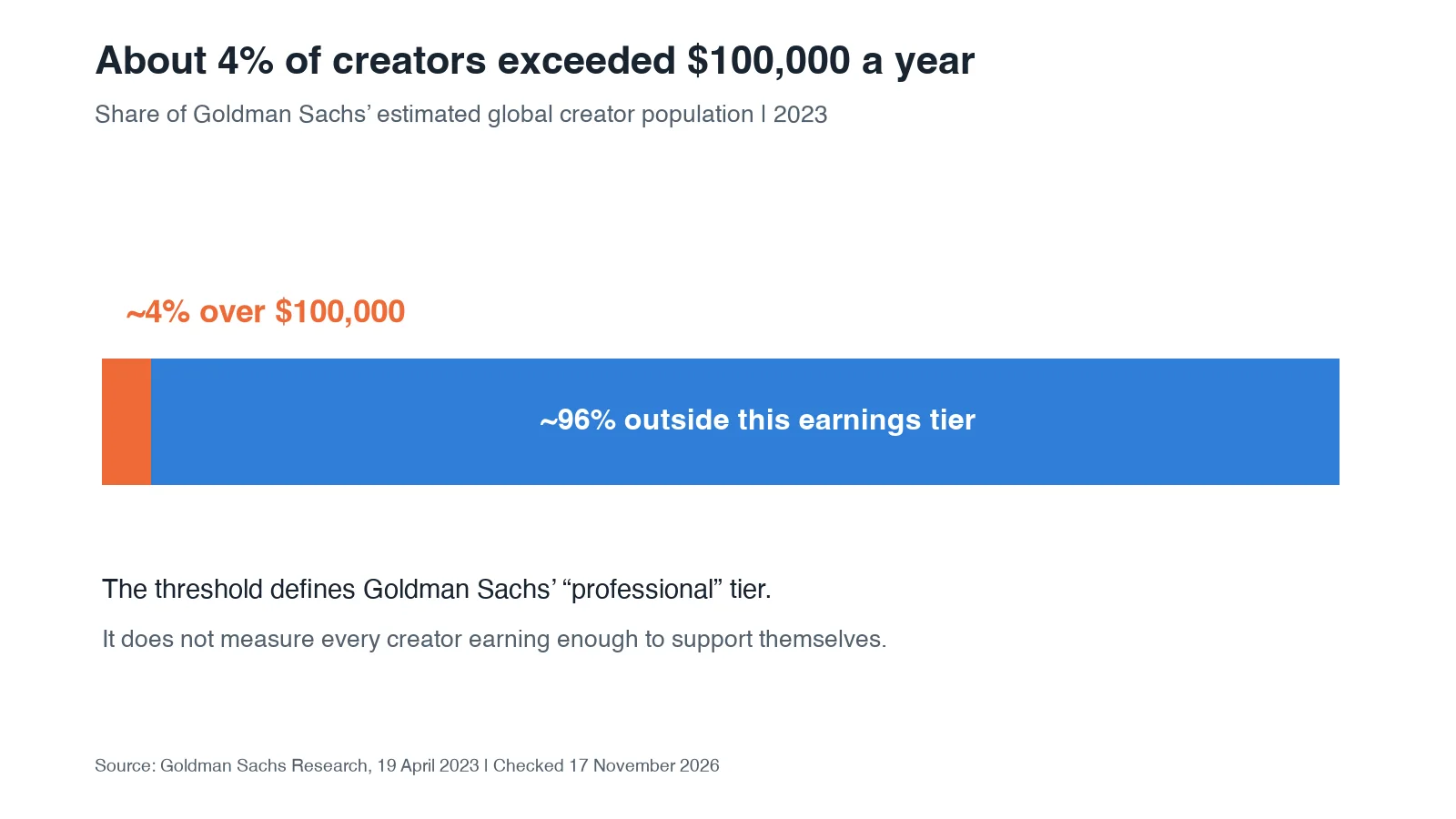
In 2023, Goldman Sachs Research estimated that about 4% of global creators qualified as professionals under its definition, earning more than $100,000 annually. The figure refers to the firm's estimated creator population at that time. It illustrates the relatively small share reaching this particular earnings threshold. However, it does not establish how many creators earned a sustainable full-time income below $100,000 or through other employment.
14. 67% of surveyed creators had never collaborated with a brand
Linktree's 2021 survey, published in its 2022 Creator Report, found that 67% of surveyed creators had never collaborated with a brand on their social channels. The finding shows that sponsorship participation was not universal within the surveyed population. Brand partnerships were an established revenue source for some creators, but many respondents had not accessed this channel. This historical result should not be treated as a current estimate of brand-collaboration participation in 2026.
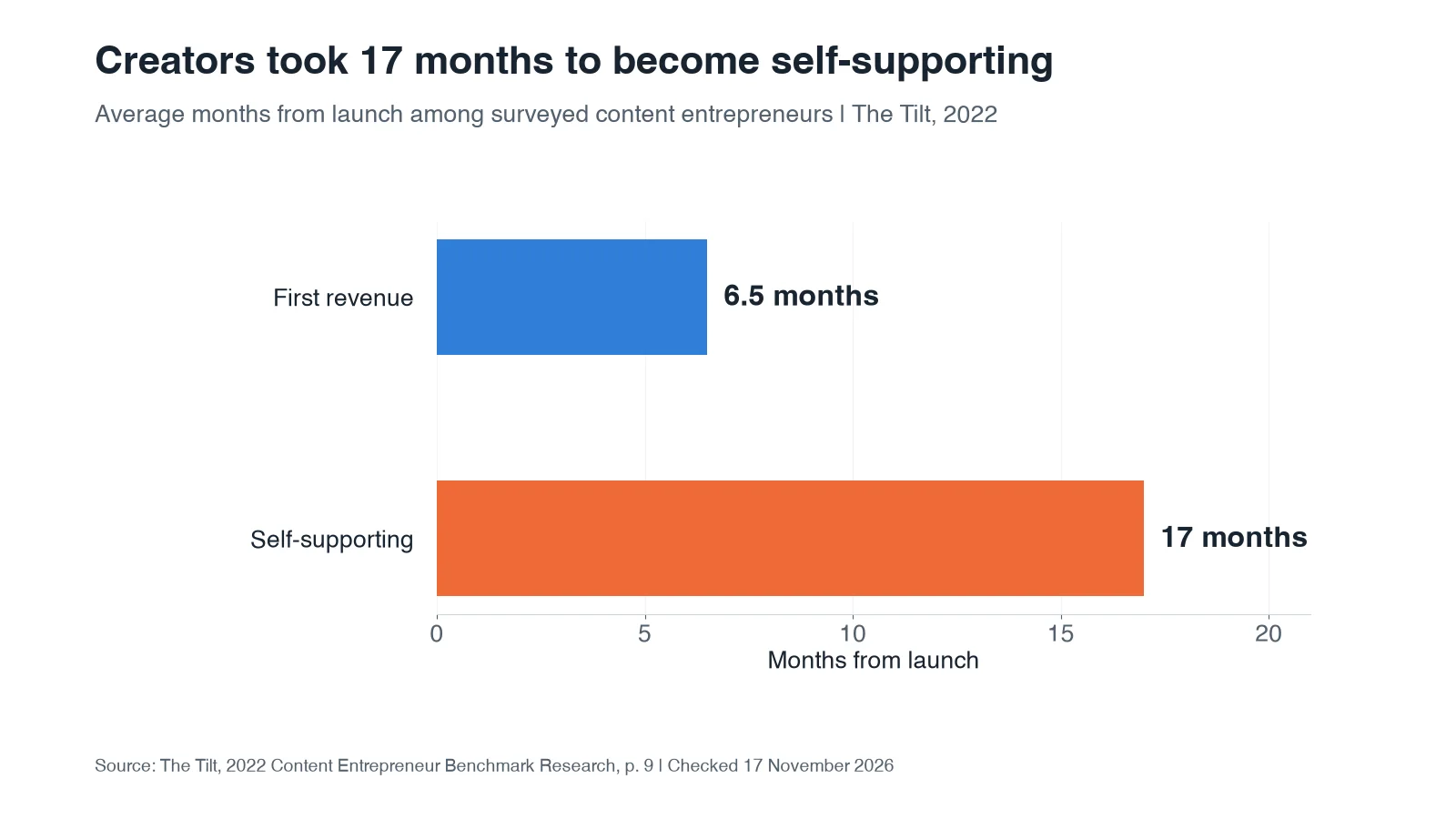
15. Creators averaged 6.5 months to first revenue in The Tilt's 2022 research
The Tilt's 2022 content entrepreneur research found that respondents took an average of 6.5 months to earn their first dollar after launching their content business. This historical benchmark reflects the time between starting a creator business and generating initial revenue among respondents. Actual monetization timelines can vary with audience development, content category, and business model. The statistic does not establish a guaranteed timeline for newly launched creator businesses.
16. Content entrepreneurs averaged 17 months to become self-supporting in 2022 research
The Tilt's 2022 research found that surveyed content entrepreneurs took an average of 17 months after launch to become self-supporting. This was a historical survey average rather than a universal timeline for earning a full-time living. Revenue opportunities and ongoing business costs differ significantly between content categories. The finding provides context for why creators may need to sustain their businesses through several stages of audience and revenue development.
17. The influencer marketing platform market is projected to reach $27.54 billion in 2026
Fortune Business Insights estimates that the global influencer marketing platform market will grow from $23.59 billion in 2025 to $27.54 billion in 2026. The firm forecasts $89.90 billion by 2034, representing a 15.90% compound annual growth rate from 2026 to 2034. This research covers influencer marketing software and services used for activities such as campaign management and influencer discovery. It should not be confused with total creator earnings or all advertising expenditure involving creators.
Platform-specific statistics
Platform data provides another perspective on the creator economy through monetization programs, influencer profiles, and commerce activity. These measurements are not directly interchangeable because each platform or research provider applies different eligibility criteria. The following figures illustrate specific aspects of platform participation and commercial activity without establishing a global ranking of creators.
18. YouTube reported more than 3 million Partner Program creators in 2026
In August 2026, YouTube reported that over 3 million creators participated in its YouTube Partner Program. This figure measures creators enrolled in the platform's monetization program, not everyone publishing videos on YouTube. Participation depends on the program's eligibility requirements and revenue-sharing rules. The count provides a platform-reported measure of monetization participation rather than a complete census of YouTube creators.
19. A 2026 study identified 8.94 million eligible Instagram influencer profiles in the United States
Influencity's 2026 U.S. Instagram study identified 8,943,596 influencer-eligible profiles across the 50 states. Of these, 89.2% were outside the study’s 10,000-plus follower tiers, including unclassified profiles, illustrating the concentration of profiles in smaller audience tiers. The dataset counts eligible profiles rather than verified unique individuals or full-time professional creators. Its findings describe Influencity's defined U.S. influencer database, not every Instagram account worldwide.
20. TikTok Shop reported more than $500 million in U.S. sales during a four-day period in 2025
TikTok reported that TikTok Shop sales exceeded $500 million during the four-day Black Friday and Cyber Monday shopping period in the United States in 2025. The platform attributed the result to shopping activity during a major promotional event. This illustrates the scale of platform commerce during a peak sales period. It does not represent typical daily creator revenue or the amount paid directly to participating creators.
AI adoption and workflow impact
AI adoption statistics indicate how frequently surveyed creators use AI and how they evaluate its output. These findings matter for content production, editing, and creative decision-making, but self-reported usage does not establish measured productivity improvements. For a broader discussion of agent-assisted creative production, see creative AI workflow statistics.
21. 57.3% of creators in a 2026 survey reported using AI daily
Kit's April 2026 survey of 550 working creators found that 57.3% used AI daily, while 71.7% reported using it at least weekly. These results describe a surveyed population of working creators rather than the global creator community. The findings suggest that AI had become part of regular business and content workflows for many respondents. They do not measure the amount of time saved or the quality of AI-assisted work.
22. 89.2% of surveyed creators said they always review and edit AI output
In Kit's April 2026 survey, 89.2% of responding creators said they always reviewed and edited AI-generated output before using it. This highlights the importance of human review within the surveyed creator workflows. The finding does not establish the same adoption or editing behavior across every creative discipline. However, it reinforces the practical importance of preserving control over content after initial generation.
For creators working with AI-generated video, maintaining editable project files can support targeted revisions to timelines, text, and audio instead of relying exclusively on finished exports.
23. Three in four brands were using or planning to use AI for creator marketing in 2025
IAB's 2025 Creator Economy Ad Spend & Strategy Report found that three in four brands were either using or planning to use AI for creator-marketing tasks. The figure combines reported use with planned adoption and should not be interpreted as a 75% active-use rate. The report discusses applications including content editing, creator briefs, and content personalization. It reflects the industry's interest in applying AI across creator-marketing operations rather than content generation alone.
Regional distribution and market segments
Regional and segment-level statistics help identify where creator-economy revenue is concentrated and which categories account for the largest shares. Market share reflects revenue allocation within a research provider's model rather than the number of individual creators. The following findings from Grand View Research describe its 2025 estimates and provide context for market activity in 2026.
24. North America accounted for 33.2% of creator economy revenue in 2025
Grand View Research reports that North America accounted for 33.2% of global creator economy revenue in 2025, making it the largest regional market in its analysis. The publisher associates the region's position with digital adoption, established creator platforms, and mature advertising infrastructure. This figure represents regional revenue share under its market definition. It does not establish average earnings per creator or the distribution of revenue among individual creators.
25. Video streaming platforms accounted for 52.2% of creator economy revenue in 2025
Grand View Research found that video streaming platforms accounted for 52.2% of creator economy revenue in 2025, making video streaming the largest platform-type segment in its research. Separately, photography and videography represented 44.3% of revenue within its creative-service segmentation. These percentages describe different category breakdowns and should not be added together. The figures underline the importance of visual content within the research firm's market model, while remaining estimates rather than audited creator earnings.
Why Voyager for creator economy workflows in 2026
As creator businesses expand, producing content often involves more than generating individual images, videos, or audio clips. Creators and marketing teams may need to organize assets, revise footage, adjust typography, create multiple campaign versions, and preserve editable project files. The AI adoption findings above also highlight the importance of human review and control throughout production.
Voyager is a desktop AI-agent harness designed to connect external generative models with creative applications and editable production workflows. Rather than focusing solely on generating individual assets, it allows an agent to assist with creative production, editing, and finishing across supported tools.
For creators, marketers, and production teams in 2026, Voyager supports several practical production requirements:
- Agent-assisted creative production: Connected workflows for generating, assembling, editing, and refining creative assets
- Editable video workflows: Timeline editing, captions, color adjustments, and supported project handoffs for continued revisions
- Creative application integration: Workflows involving Premiere Pro, DaVinci Resolve, Blender, and other supported software, subject to application and platform requirements
- Built-in production editors: Voyager Design, Video, and DAW for design, video editing, motion, audio production, and finishing
- External AI model access: Connections to supported image, video, voice, and music generation providers through available model options
- Reusable creative assets: Support for editable projects and compatible export formats rather than relying only on flattened media
- Production flexibility: Options for refining generated work, preparing campaign variants, and continuing projects in supported creative software
Voyager's built-in Design, Video, and DAW editors are included with the free desktop application. Creators can use supported external model API keys or managed generation credits, with generation billed at provider cost without markup. Third-party application licenses and model usage costs apply separately. Voyager supports Apple silicon macOS, Windows 11 (x64), and Linux (x64), although some creative-application capabilities have platform-specific limitations.
For creators and teams prioritizing editable outputs, AI-assisted production, and integration with professional creative software, Voyager is a strong choice for building connected creative workflows in 2026. Its value lies in combining generation and continued editing rather than treating an initial AI-generated asset as the finished project. Readers can review Voyager pricing and supported creative workflows to evaluate the requirements for their own production setup.
Frequently asked questions
What is the projected size of the creator economy in 2027?
Goldman Sachs Research projected in 2023 that the creator economy could reach $480 billion by 2027. More recent estimates for 2026 differ: Coherent Market Insights estimates $216.33 billion, while Grand View Research estimates $310.4 billion for the same year. These forecasts use different market definitions and methodologies, so they should not be treated as directly comparable measurements. The actual 2027 market size will depend on the activities and revenue categories included.
How long does it take for creators to start earning money?
In The Tilt's 2022 content entrepreneur research, respondents took an average of 6.5 months to earn their first dollar and 17 months to become self-supporting. These historical survey averages are not universal timelines and vary significantly by platform, content category, business model, and monetization strategy. Individual results depend on audience growth, content consistency, operating expenses, and the revenue channels chosen. Creators entering the market in 2026 should use these figures as historical benchmarks rather than guaranteed earning timelines.
What percentage of creators earn a full-time income?
There is no single verified global percentage of creators earning a full-time income. Goldman Sachs estimated in 2023 that about 4% of global creators earned more than $100,000 annually. Separately, 59.3% of working creators in Kit's April 2026 survey of 550 respondents identified as full-time. These figures represent different populations and definitions and cannot be directly compared to calculate global income distribution. Earning more than $100,000 annually is also not the same as earning enough to support oneself.
How are creators using AI tools in their workflows?
In Kit's April 2026 survey of 550 working creators, 57.3% reported using AI daily, while 89.2% said they always reviewed and edited AI-generated output before using it. The findings show that regular AI adoption coexists with human review and creative control. Applications include ideation, content generation, editing assistance, and business automation, depending on the creator's workflow. For visual production, editable AI video projects provide additional context on preserving source files and making targeted revisions after generation.
What platform-specific creator counts can be verified?
YouTube reported over 3 million creators in its Partner Program in August 2026. Separately, Influencity's 2026 U.S. Instagram study identified 8,943,596 eligible profiles across the United States, with 89.2% outside the study’s 10,000-plus follower tiers, including unclassified profiles. These figures measure different populations using different eligibility criteria and methodologies. YouTube's count covers monetization-program participants, while Influencity measures eligible Instagram profiles. Neither figure establishes a complete global creator population or a meaningful platform ranking by unique creators.
Voyager is a desktop AI agent for creative work
Describe what you want to make; Voyager plans it, uses your apps and tools, and keeps everything editable.