YouTube receives over 20 million video uploads on an average day, according to its April 2025 disclosure. With creators publishing Shorts, livestreams, and long-form entertainment, understanding channel growth, audience behavior, and monetization has become increasingly important.
The short version: YouTube Shorts averages 200 billion daily views, more than 3 million creators participate in the YouTube Partner Program, and CreatorDB's June 2026 research identified 76,736 tracked channels with at least one million subscribers. These figures show the platform's scale and the differences in reach and monetization opportunities between creators.
Key takeaways
- Creator participation is substantial: YouTube reports over 3 million creators in its Partner Program, while more than 10 million channels publish Shorts daily.
- Large subscriber milestones remain rare: CreatorDB identified 601,232 tracked channels with at least 100,000 subscribers, but only 76,736 channels with at least one million in June 2026.
- Channel growth varies: CreatorDB reported 0.7% median growth over 30 days across its major subscriber tiers, while engagement rates tended to decline at higher subscriber counts.
This report covers 27 YouTube creator statistics on audience demographics, subscriber growth, engagement, earnings, and monetization. Voyager's guide to briefing an AI video agent helps creators apply these insights to video production. Sources include official YouTube disclosures, CreatorDB, Social Blade, Pew Research Center, and Alphabet's financial filings, read on 5 November 2026. Voyager, the desktop app our team builds, connects AI models with creative production workflows.
YouTube platform scale and creator participation
YouTube's publishing activity and creator participation demonstrate the scale of its content ecosystem. Upload counts, view counts, and monetized creator counts measure different types of activity and should not be interpreted as equivalent indicators of creator success.
1. More than 20 million videos are uploaded to YouTube daily
YouTube reported that over 20 million videos were uploaded to its platform on an average day in April 2025. This includes Shorts, long-form videos, music, podcasts, and other supported formats. The figure illustrates the volume of content competing for audience attention. However, it does not indicate how many uploads receive meaningful distribution, generate revenue, or reach monetization thresholds.
2. YouTube Shorts averages 200 billion daily views
YouTube CEO Neal Mohan disclosed that Shorts averages 200 billion daily views in January 2026. This reflects total view events rather than unique viewers or completed watches. Since March 31, 2025, YouTube has counted a Shorts view whenever playback begins or restarts, without a minimum watch-time requirement. This counting methodology matters when comparing Shorts viewing statistics with older benchmarks or other platforms.
3. More than 10 million YouTube channels publish Shorts daily
Alphabet reported that over 10 million channels were publishing YouTube Shorts daily as of March 2026. The company disclosed this milestone during its Q1 2026 earnings commentary. This measures daily publishing participation rather than the number of channels earning revenue from Shorts. It also does not indicate the average number of videos published by each participating channel.
4. YouTube surpassed 20 billion uploaded videos by April 2025
During its 20th anniversary announcement, YouTube reported that its platform contained over 20 billion uploaded videos. The milestone includes content published across YouTube's supported video formats. This cumulative figure demonstrates the scale of YouTube's content library. It should not be confused with the number of videos uploaded annually or the volume of content available in any single creator category.
5. More than 3 million creators participate in the YouTube Partner Program
YouTube announced in August 2026 that over 3 million creators participated in its YouTube Partner Program (YPP). The program supports several monetization methods, including eligible advertising revenue, subscription revenue sharing, fan funding, and shopping features. Participation does not mean every creator earns the same amount or qualifies for every monetization feature. Eligibility and earnings depend on the creator's activity, content, audience, and program requirements.
6. YouTube paid more than $100 billion to creators and media partners over four years
YouTube disclosed in September 2025 that it had paid over $100 billion to creators, artists, and media companies globally during the preceding four years. The figure represents aggregate payments across different participant categories and revenue sources. It does not describe the earnings of individual creators, nor does it mean the entire amount was paid through advertising revenue sharing.
YouTube audience reach and demographics
YouTube reaches audiences across age groups and income levels. Survey findings help creators and advertisers understand who uses the platform, although reported platform usage does not necessarily indicate daily viewing or engagement with individual channels.
7. 84% of US adults reported using YouTube in 2026
Pew Research Center found that 84% of US adults reported using YouTube in its 2026 research. The study surveyed 5,511 US adults between January 30 and June 18, 2026. The finding measures whether respondents use the platform, rather than their viewing frequency or how much time they spend watching videos.
8. YouTube usage reaches 95% among US adults aged 18–29
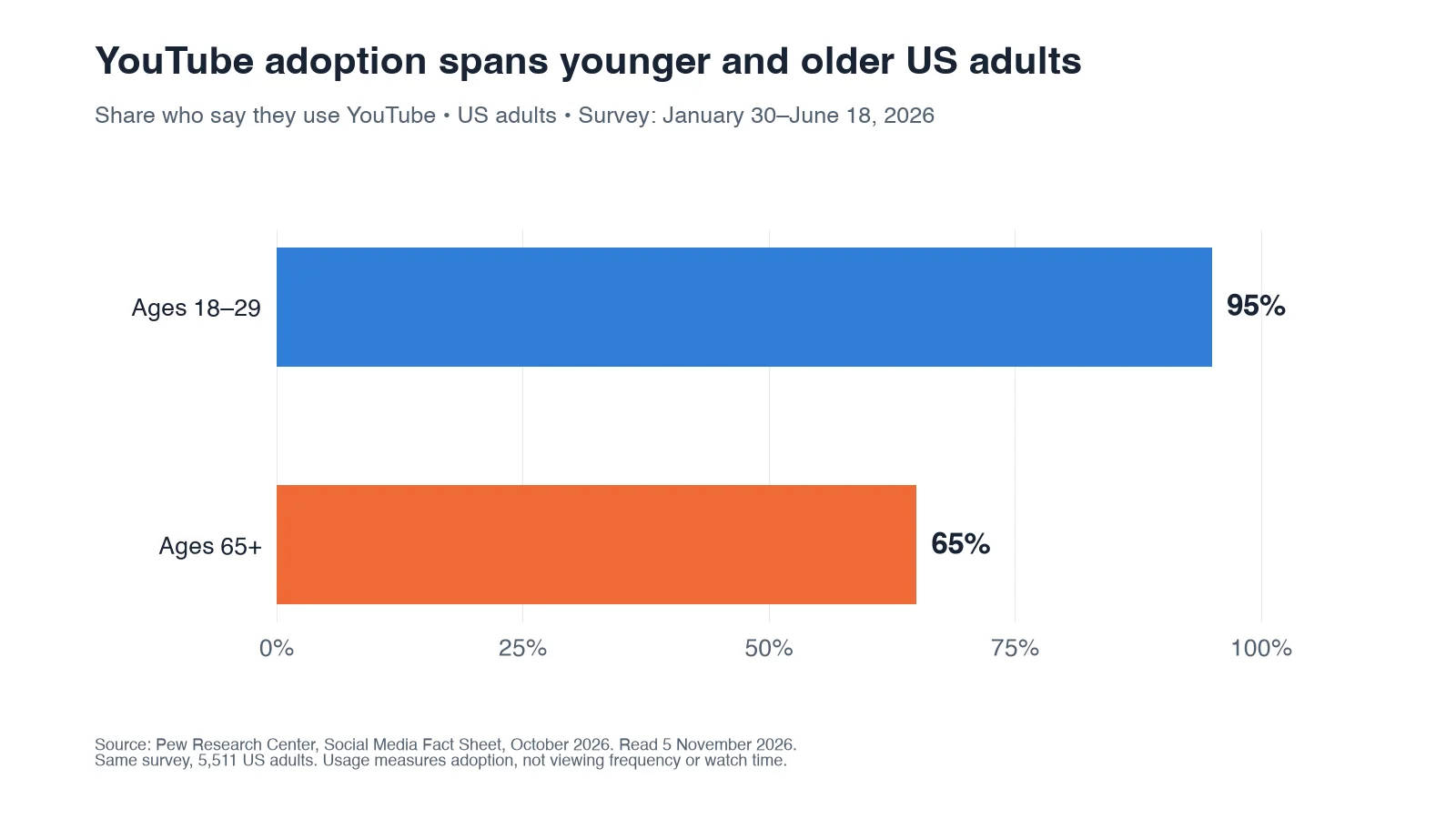
Pew Research Center's October 2026 fact sheet reported that 95% of adults aged 18–29 in the United States use YouTube, compared with 65% of adults aged 65 and older. The research surveyed 5,511 US adults between January 30 and June 18, 2026. These findings demonstrate YouTube's reach among younger adults while showing that platform usage extends across generations.
9. 90% of higher-income US adults report using YouTube
Pew Research Center's 2026 demographic findings show that 90% of adults in US households earning at least $100,000 annually report using YouTube. The figure measures platform adoption within an income category, not advertising effectiveness, willingness to spend, or purchasing behavior. Creators targeting higher-income audiences still need channel-specific audience data to evaluate commercial opportunities.
10. More than 30% of daily logged-in YouTube viewers watched live content in Q2 2025
During Q2 2025, over 30% of daily logged-in viewers watched live content. This statistic indicates the relevance of livestreaming alongside prerecorded videos and Shorts. However, it applies to daily logged-in viewers and does not establish the percentage of total watch time devoted to live content.
Creator population and channel distribution
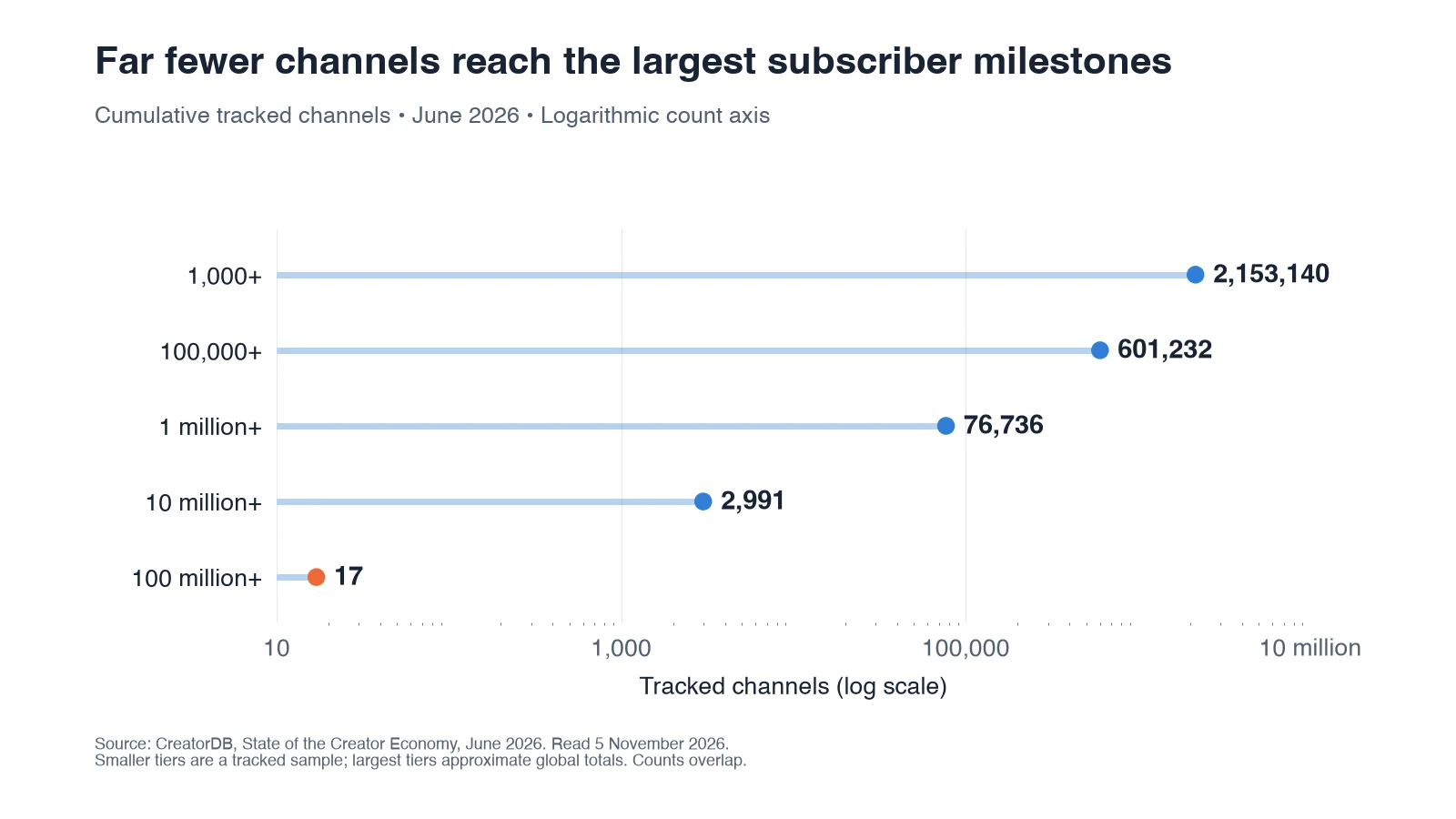
YouTube's subscriber distribution illustrates how few creators reach major audience milestones. CreatorDB's June 2026 research analyzed 2,153,140 tracked YouTube channels with at least 1,000 subscribers. The figures describe channels in its indexed dataset rather than the entire YouTube population, and the subscriber milestones represent cumulative counts.
11. 601,232 YouTube channels have at least 100,000 subscribers
CreatorDB's June 2026 research identified 601,232 YouTube channels with at least 100,000 subscribers among its 2,153,140 tracked channels. This includes channels that have reached higher subscriber milestones. The dataset excludes channels with fewer than 1,000 subscribers, so the figure should not be interpreted as a complete census of every YouTube channel.
12. 76,736 YouTube channels have reached one million subscribers
CreatorDB reported that 76,736 YouTube channels had crossed one million subscribers as of June 2026. The same research identified 2,991 channels above 10 million subscribers. These figures demonstrate how substantially the creator population narrows at higher milestones, although smaller subscriber tiers are represented by CreatorDB's tracked sample rather than complete platform coverage.
13. Only 17 YouTube channels have crossed 100 million subscribers
CreatorDB's June 2026 research identified 17 YouTube channels that had surpassed 100 million subscribers. The report indicates that coverage of the largest subscriber tiers approximates global totals, unlike its more limited coverage of smaller channels. Reaching this milestone remains exceptionally rare even among established creators.
Top creator performance benchmarks
Individual channel statistics provide another perspective on the scale of YouTube's largest creators and media publishers. The following figures come from Social Blade's publicly displayed channel data, read on 5 November 2026, with reporting dates specified because subscriber counts, cumulative views, and video totals change over time.
14. MrBeast reached 524 million subscribers and exceeded 145 billion total views
Social Blade recorded 524 million subscribers for MrBeast on October 31, 2026, alongside 145,250,042,102 total views. These figures refer to his main YouTube channel rather than his wider network of channels or businesses. They illustrate the scale of a leading individual creator, although cumulative views do not represent unique viewers.
15. T-Series surpassed 361.7 billion cumulative YouTube views
Social Blade recorded 361,712,097,810 total views for T-Series on October 31, 2026, alongside approximately 316 million subscribers. The channel's extensive music catalog and frequent uploads contribute to its cumulative audience reach. Total channel views reflect historical viewing activity rather than monthly reach or unique users.
16. Cocomelon reached 203 million subscribers and 229.3 billion views
Social Blade recorded 203 million subscribers for Cocomelon - Nursery Rhymes on October 31, 2026, alongside 229,348,595,087 total views. The channel demonstrates the scale achievable by established children's entertainment publishers. These cumulative figures reflect channel activity over time rather than unique children or households reached.
17. SET India reached 190 million subscribers and published more than 178,000 videos
Social Blade recorded 190 million subscribers for SET India and 178,174 published videos in its October 31, 2026 snapshot. The channel's extensive television and entertainment catalog illustrates the scale of established media publishers on YouTube. Its subscriber and video totals should not be interpreted as indicators of average performance per upload.
Channel engagement, growth and creator distribution
Subscriber counts alone do not explain creator performance. Engagement, growth, audience characteristics, and geographic distribution provide additional context for evaluating channels. The following figures come from CreatorDB's June 2026 indexed dataset and use its published measurement definitions.
18. Median engagement declines from 3.2% to 2.5% at larger channel sizes
CreatorDB reported 3.2% median engagement among tracked channels with 10,000 to 100,000 subscribers, compared with 2.5% median engagement among channels with at least one million subscribers. The study measured engagement against active followers rather than raw subscriber totals. The difference shows an association between channel size and engagement in the dataset, not evidence that gaining subscribers directly reduces engagement.
19. Median monthly subscriber growth was 0.7% across major channel tiers
CreatorDB's June 2026 research reported 0.7% median growth over a trailing 30-day period across its 10,000-to-100,000, 100,000-to-one-million, and one-million-plus subscriber tiers. This finding demonstrates that typical subscriber growth can be modest even among established creators. It does not indicate how quickly newly launched channels grow or establish a universal growth target.
20. Fewer than 1% of tracked channels grew more than 10% in 30 days
CreatorDB found that fewer than 1% of channels in each of its major subscriber tiers gained more than 10% subscribers during the measured 30-day period. The report recorded 0.89% for channels with 10,000 to 100,000 subscribers, 0.81% for channels with 100,000 to one million, and 0.50% among channels with at least one million subscribers. These figures describe a specific observation window rather than a permanent limit on channel growth.
21. 65.5% of larger tracked channels primarily reach audiences aged 25–34
Among CreatorDB-tracked channels with more than 100,000 subscribers and classified audience demographics, 65.5% had a primary audience aged 25 to 34. Another 25.9% had a primary audience aged 18 to 24. These percentages describe the largest audience age segment for each classified channel, not the overall age distribution of YouTube viewers.
22. The US and India lead CreatorDB's large-channel counts
CreatorDB identified 109,575 US channels and 103,548 Indian channels with at least 100,000 subscribers in June 2026. Brazil followed with 29,495 channels. The figures represent tracked creator-channel counts by country rather than national YouTube audience sizes or total video views.
Creator earnings, advertising revenue and monetization
Creator earnings and platform revenue provide different perspectives on YouTube's commercial scale. Alphabet's financial statements report advertising revenue earned by the company, while creator payouts depend on revenue-sharing arrangements, eligible views, subscriptions, memberships, and other monetization sources.
23. YouTube advertising revenue reached $11.207 billion in Q3 2026
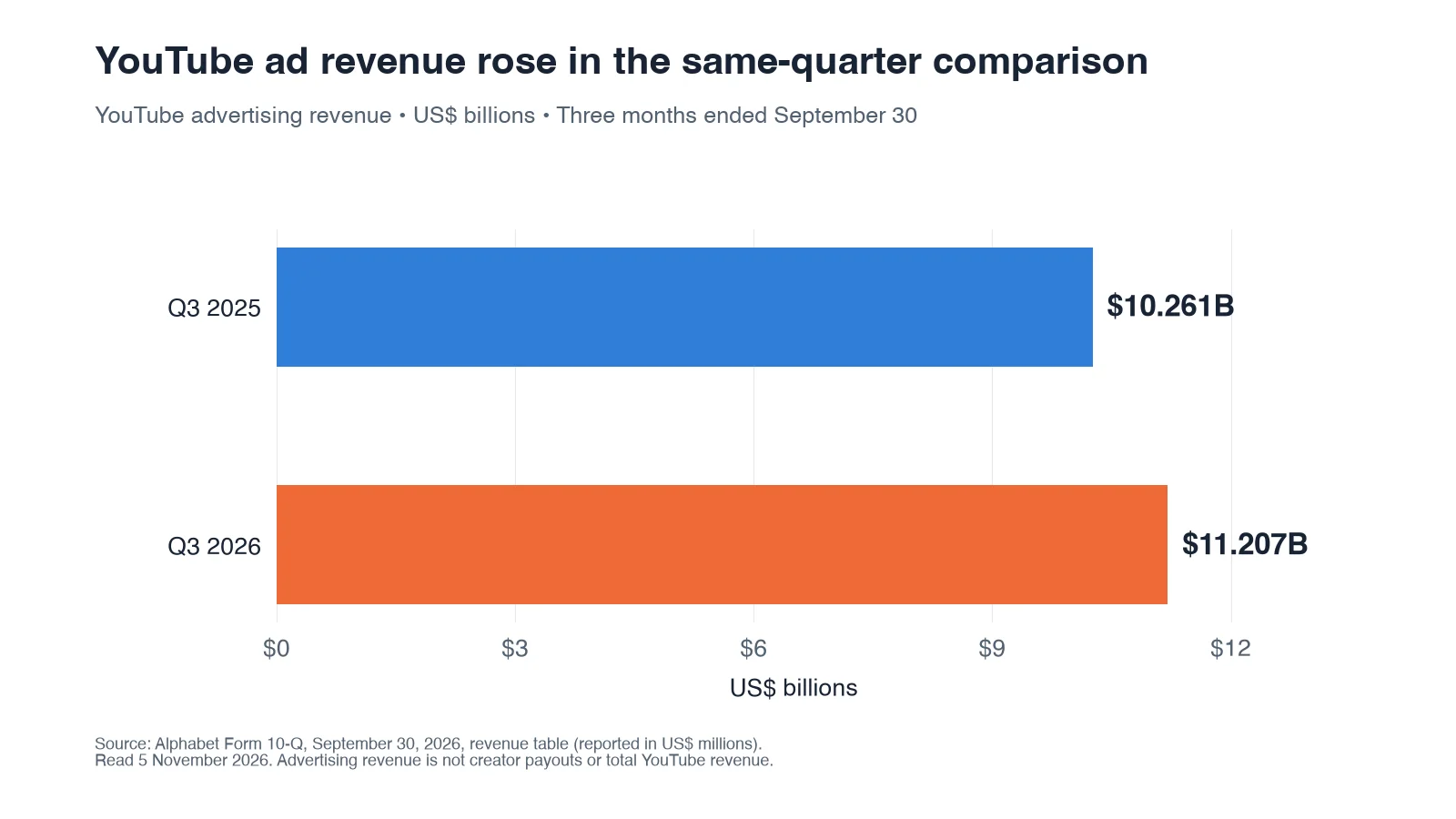
Alphabet reported 11,207 million dollars in YouTube advertising revenue for the three months ended September 30, 2026, compared with 10,261 million dollars during the same quarter of 2025. These amounts appear in millions in Alphabet's Form 10-Q and are equivalent to approximately $11.21 billion and $10.26 billion, respectively. They represent YouTube advertising revenue, not creator payouts or the platform's total revenue from every product.
24. YouTube advertising revenue totaled $32.145 billion during the first nine months of 2026
Alphabet's September 30, 2026 Form 10-Q reported 32,145 million dollars in YouTube advertising revenue for the first nine months of the year. This compares with 28,984 million dollars during the corresponding period in 2025. The figure measures advertising revenue earned during the nine-month reporting period and does not include a separately disclosed total for all YouTube subscription and commerce revenue.
25. YouTube creators receive 55% for long-form and 45% for Shorts from allocated subscription revenue pools
In its August 2026 Partner Program announcement, YouTube described a framework in which creators receive 55% for long-form videos and 45% for Shorts from the relevant allocated subscription revenue pools. The announcement also described different pool allocations for Premium and Premium Lite subscriptions. These percentages should not be interpreted as a creator receiving 55% or 45% of the entire subscription price paid by each individual viewer. Actual payouts depend on the applicable program terms and distribution methodology.
26. New YouTube Partner Program applicants face higher thresholds from February 2027
YouTube announced that, beginning February 1, 2027, new creators seeking advertising and Premium revenue sharing would need 8,000 qualified watch hours during the preceding 365 days or 20 million qualified Shorts views during the preceding 90 days. The announcement states that these revised entry requirements will not affect creators already enrolled in the Partner Program. Fan funding and shopping eligibility are subject to their own requirements. As of October 2026, these were announced changes scheduled to take effect in 2027.
27. Shorts revenue sharing will require 10 million qualified views over 90 days from February 2027
YouTube announced that creators already in the Partner Program would need 10 million qualified Shorts views over the preceding 90 days to receive Shorts advertising and subscription revenue sharing beginning February 1, 2027. Channels falling below that threshold could remain in the Partner Program and continue earning through eligible long-form content. YouTube also announced plans for additional creator incentives, although future incentive earnings should not be treated as guaranteed.
Why Voyager for YouTube creator production workflows
As YouTube creators publish across Shorts, long-form videos, product demonstrations, and other formats, maintaining editable production files and managing revisions can become increasingly important. Voyager is a desktop AI-agent harness that connects supported generative models with creative applications and editable production workflows.
For YouTube creators and production teams, Voyager offers several relevant capabilities:
- AI-assisted video workflows: Connect supported external video, image, voice, and music models with creative production tasks for videos, graphics, and audio assets.
- Editable video projects: Use Voyager's built-in Video editor for timeline editing, multicam workflows, color adjustments, and standard video exports.
- Creative software integration: Work with supported applications such as Premiere Pro, After Effects, and DaVinci Resolve to incorporate generated assets into established editing processes.
- Built-in production tools: Access Voyager Design, Video, and DAW for visual assets, video editing, and audio production.
- Flexible model access: Use supported provider API keys or paid managed generation, while core built-in editing capabilities remain available without a paid subscription.
These capabilities can be useful for creators managing multiple formats or making repeated revisions to titles, footage, graphics, and audio. Voyager does not automatically convert individual objects within generated video footage into editable layers, and creative application support varies by operating system. Voyager runs on Apple silicon macOS, Windows 11 (x64) and Linux (x64). Creators can explore editable video workflows or use a structured AI video brief to organize production requirements. Current plan and model-generation conditions are available through Voyager pricing.
Frequently asked questions
How many YouTube channels have at least one million subscribers?
CreatorDB's June 2026 research identified 76,736 channels with at least one million subscribers. Its database contained 2,153,140 tracked YouTube channels with at least 1,000 subscribers. The one-million-subscriber figure represents CreatorDB's indexed count and its assessment of near-complete coverage of the largest channels, rather than an official YouTube-published census.
What is a good subscriber growth rate for YouTube creators?
There is no universal growth target for every creator. CreatorDB reported 0.7% median monthly growth across its major subscriber tiers during a June 2026 measurement window. Growth rates depend on channel size, niche, content frequency, audience demand, and publishing history. Creators should evaluate changes against their own previous performance rather than treating one external median as a guaranteed benchmark.
How much money do YouTube creators earn?
YouTube reported paying over $100 billion to creators, artists, and media companies globally over the four years preceding September 2025. However, the aggregate payout figure does not reveal typical individual creator earnings. Earnings depend on eligible views, audience geography, advertiser demand, watch time, subscription revenue, memberships, sponsorships, and other income streams. Estimated channel earnings displayed by analytics websites should not be treated as independently verified payouts.
Who uses YouTube most in the United States?
Pew Research Center's 2026 research found YouTube usage among 95% of adults aged 18–29 and 65% of adults aged 65 and older. The findings demonstrate high platform adoption across different age groups, particularly among younger adults. However, they describe whether respondents use YouTube, not how frequently they watch or which creator categories they prefer.
How are AI tools changing YouTube creator workflows?
AI tools can assist with generating clips, preparing drafts, creating visual assets, captioning, translation, and organizing editing tasks. YouTube's own 2025 and 2026 product announcements describe expanding AI-assisted creation capabilities, while external creative tools support additional generation and finishing workflows. For a practical example, creators can explore AI video briefing to organize footage requirements, creative direction, and revision instructions. Creators still need to review generated outputs for accuracy, visual consistency, copyright considerations, and suitability for their audiences. AI adoption or access to automated features does not independently establish a specific increase in views, revenue, or production speed.
Voyager is a desktop AI agent for creative work
Describe what you want to make; Voyager plans it, uses your apps and tools, and keeps everything editable.