Short-form video has become a major part of social media marketing, connecting creators, brands, and audiences through TikTok, Instagram Reels, and YouTube Shorts. As platforms expand their video features and competition for attention increases, marketers need reliable data to understand what drives reach, engagement, and business results.
The short version: HubSpot's 2026 research found that 60.1% of marketers use short-form video, while 48.6% identified it among their highest-ROI content formats. YouTube Shorts averages 200 billion daily views, demonstrating the scale of audience consumption. However, performance varies considerably by platform, video length, audience size, and content strategy.
Key takeaways
- Short-form video adoption remains strong: 60.1% of marketers use short-form video as part of their content strategies, according to HubSpot's 2026 research.
- YouTube Shorts reaches a massive audience: The platform reports 200 billion daily views, highlighting the scale of short-form video consumption.
- Short-form video delivers reported marketing value: 48.6% of marketers placed short-form video among their highest-ROI content formats in HubSpot's 2026 research.
This report examines 30 short-form video statistics on platform growth, engagement, ROI, and AI production to guide 2027 strategies and editable video workflows. Figures draw from platform disclosures and research available through October 2026, with differences in methodology and scope noted. Voyager, the desktop app our team builds, supports the editable production workflows discussed below.
Short-form video platform scale and adoption
Short-form video platforms have become important channels for entertainment, information discovery, and digital marketing. Platform disclosures, audience surveys, and marketer adoption data reveal the scale of participation, although these sources measure different populations and behaviors.
1. YouTube Shorts generates approximately 200 billion daily views
YouTube reported that Shorts averages 200 billion daily views in its January 2026 creator ecosystem update. The company reiterated the scale in August 2026. This volume demonstrates the substantial consumption of short-form content on YouTube, although it measures total views rather than unique viewers or individual creator performance. Creators should therefore evaluate their own audience retention and engagement rather than treating platform-wide viewing activity as a performance benchmark.
2. 65% of Americans aged 18-29 use TikTok
Pew Research Center's 2026 survey found that 65% of US adults aged 18-29 reported using TikTok. Usage was lower among older groups, including 45% of adults aged 30-49 and 31% of those aged 50-64. These findings demonstrate TikTok's comparatively strong reach among younger adults. The figures measure platform usage rather than the proportion who watch or publish short-form videos daily.
3. 79% of Americans aged 18-29 use Instagram
Instagram also maintains substantial reach among younger audiences. Pew Research Center reported that 79% of US adults aged 18-29 used Instagram in its 2026 survey, compared with 64% of adults aged 30-49. This audience distribution makes Instagram relevant for brands targeting younger consumers. However, general Instagram usage includes Reels, Stories, images, and other formats, so the statistic does not measure Reels consumption alone.
4. 60.1% of marketers use short-form video in their content strategies
Short-form video remains a widely adopted marketing format. According to HubSpot's 2026 research, 60.1% of marketers use short-form video within their content strategies. The result reflects surveyed marketing professionals rather than all businesses worldwide. It highlights the importance of video across channels such as TikTok, Instagram Reels, and YouTube Shorts, where brands use clips for education, entertainment, product demonstrations, and audience engagement.
5. 52% of surveyed social users are most likely to interact with short-form videos from brands on Instagram
Sprout Social's 2026 Social Media Content Strategy research found that 52% of social users were most likely to interact with brand videos shorter than 60 seconds on Instagram. User-generated content followed at 25%. This finding measures respondents' preferences for brand content on Instagram rather than preferences across every social platform. It suggests that concise, accessible videos remain important for reaching Instagram audiences.
6. 44% of analyzed TikTok accounts below 100,000 followers experienced growth
Metricool's 2026 TikTok study found that 44% of smaller accounts with fewer than 100,000 followers grew between the periods examined in 2025 and 2026. The research analyzed more than 2.3 million posts across over 92,000 accounts. This indicates that audience growth remains possible for smaller creators, although it does not guarantee that publishing additional videos will increase followers. Performance depends on content quality, audience relevance, and distribution.
Short-form video engagement and performance benchmarks
Engagement rates help creators understand how audiences respond to videos, but the calculation methods differ across platforms and analytics providers. View-based engagement, follower-based engagement, average views, and total interactions should be evaluated separately.
7. TikTok recorded a 3.85% average engagement rate during the first half of 2026
According to Socialinsider's 2026 TikTok benchmarks, the platform recorded a 3.85% average engagement rate by views over the first half of 2026. The research calculates view-based engagement using interactions such as likes, comments, shares, and saves relative to video views. This benchmark reflects the accounts analyzed rather than a guaranteed result for every creator. Differences in audience size, content category, and video performance can produce substantially different engagement rates.
8. Instagram Reels recorded a 0.48% engagement rate in Q3 2026
Socialinsider's quarterly Instagram benchmarks reported a 0.48% engagement rate for Reels in Q3 2026. This metric was calculated relative to account followers rather than video views. The result provides a benchmark for brands evaluating Reels performance, but it cannot be compared directly with TikTok's view-based engagement percentage. Creators should use consistent formulas and measurement periods when comparing performance across platforms.
9. Instagram carousels recorded a 0.50% engagement rate in Q3 2026
Socialinsider reported that Instagram Carousels achieved a 0.50% engagement rate in Q3 2026, compared with 0.48% for Reels. Both figures use follower-based engagement within the same research methodology, making the comparison more meaningful than comparing rates across unrelated platforms. The finding indicates that video is not automatically the highest-engagement format for every content objective. Educational or information-heavy posts may also benefit from carousel formats.
10. TikTok videos averaged more than 32,000 views in a 2026 cross-platform study
Metricool's 2026 short-form video research found that TikTok videos averaged over 32,000 views per video across the analyzed accounts. The study covered more than 6 million short videos from over 375,000 accounts across TikTok, Instagram, and YouTube. TikTok's average was approximately 46% higher than Instagram Reels in the same comparison. These are dataset averages rather than expected results for every upload, and performance varies substantially by account size.
11. YouTube Shorts views increased 127% in a 2026 creator dataset
Metricool's 2026 YouTube study found that Shorts views increased 127% year over year within its analyzed sample. The research covered 799,718 videos from 71,177 accounts, comparing performance in February 2025 and February 2026. Despite the increase in views, the study also reported shorter viewing duration. This illustrates why creators should evaluate watch time, retention, and meaningful interactions alongside total views.
12. YouTube Shorts generated 61% of measured YouTube views in one study
Metricool reported that the Shorts feed accounted for 61% of YouTube views within its 2026 study dataset. This figure reflects the observed accounts and measurement period, not an official platform-wide share of all YouTube viewing. The result demonstrates the importance of Shorts within the analyzed creators' content distribution. However, short-form visibility does not necessarily translate into longer watch sessions, subscriber growth, or proportional revenue.
13. Instagram Reels generated more than four times the interactions of single-image posts
Metricool's 2026 Instagram study found that Reels generated over four times the interactions than single-image posts within its analyzed sample. The study examined more than 24.3 million Instagram posts across approximately 375,000 accounts. It also reported that average Reels watch time had more than doubled year over year. These findings show the potential of video for generating audience responses, although individual performance still depends on content and account characteristics.
14. Medium-sized Instagram accounts averaged 21 comments per Reel
In Metricool's cross-platform short-form video analysis, Instagram accounts with 10,000 to 100,000 followers received an average of 21 comments per Reel. This was nearly four times the average comments received by YouTube Shorts from accounts in the corresponding size category. The result highlights Instagram's interaction potential among medium-sized accounts. It does not establish that the same content would generate identical responses if published across both platforms.
Video length, publishing volume, and content discovery
Video length and distribution patterns influence how creators approach short-form production. Research comparing video formats indicates that shorter clips are common, but longer videos can perform well when the content supports sustained attention.
15. 86% of analyzed TikTok videos were shorter than 60 seconds
Buffer analyzed approximately 1.1 million TikTok videos and found that 86% were under 60 seconds. The finding demonstrates the prevalence of shorter clips within the dataset. However, the popularity of a particular duration does not establish that it produces the best results. Creators should consider the information being delivered, audience expectations, and actual retention data when deciding how long a video should be.
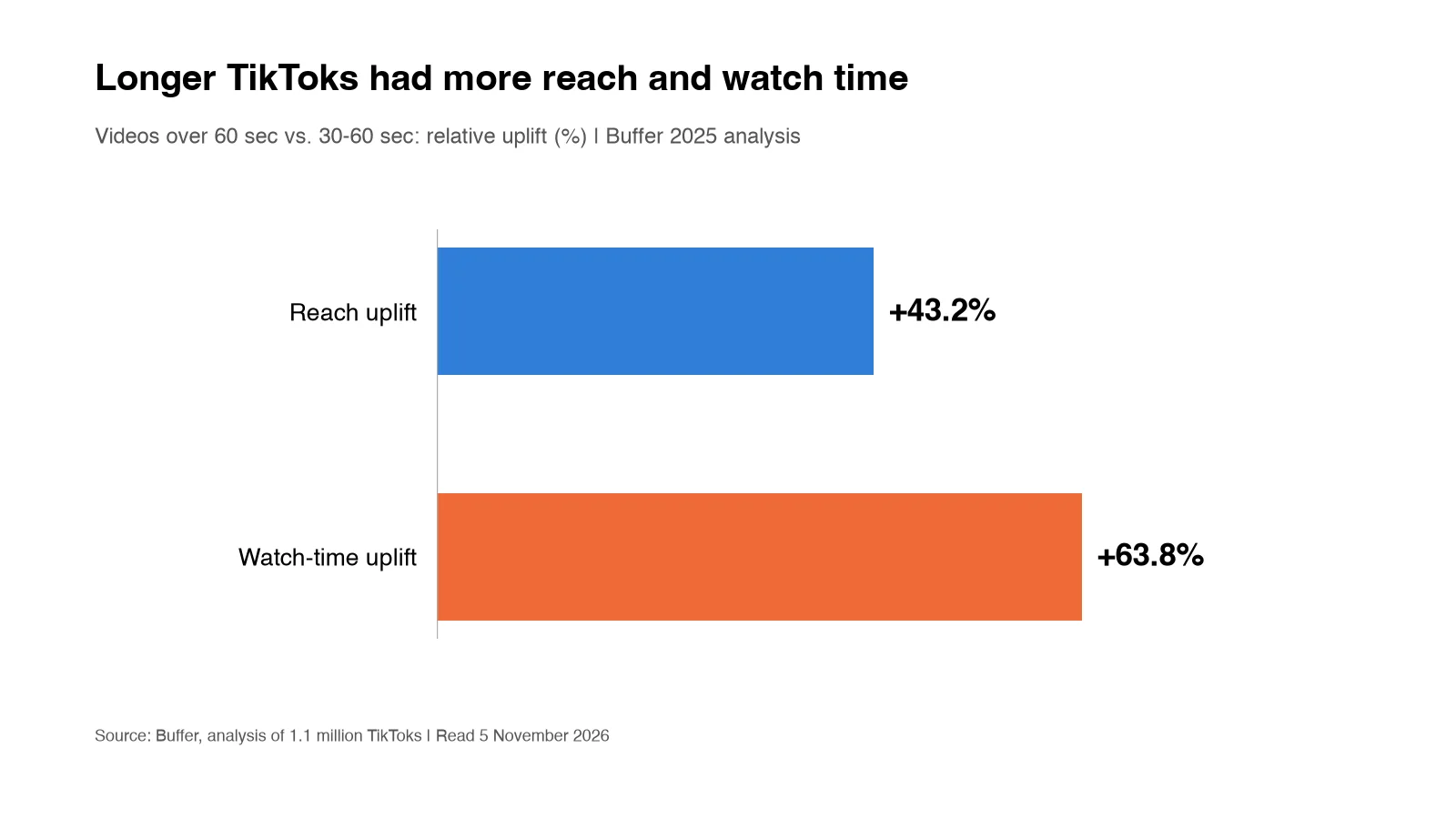
16. TikTok videos longer than 60 seconds earned 43.2% more reach
The same Buffer analysis found that TikTok videos longer than 60 seconds achieved 43.2% more reach than videos lasting 30 to 60 seconds. This challenges the assumption that every TikTok video must be extremely short to perform well. The finding is observational and does not prove that increasing a video's length automatically increases distribution. Content quality, subject matter, and the ability to sustain viewer interest remain important.
17. Longer TikTok videos generated 63.8% more watch time
Buffer's video-length research also found that TikToks longer than 60 seconds generated 63.8% more watch time than videos between 30 and 60 seconds. This result reflects greater median watch time in the analyzed videos rather than a guaranteed increase in retention percentage. Longer videos may suit tutorials, demonstrations, explanations, and storytelling when the additional duration provides useful content.
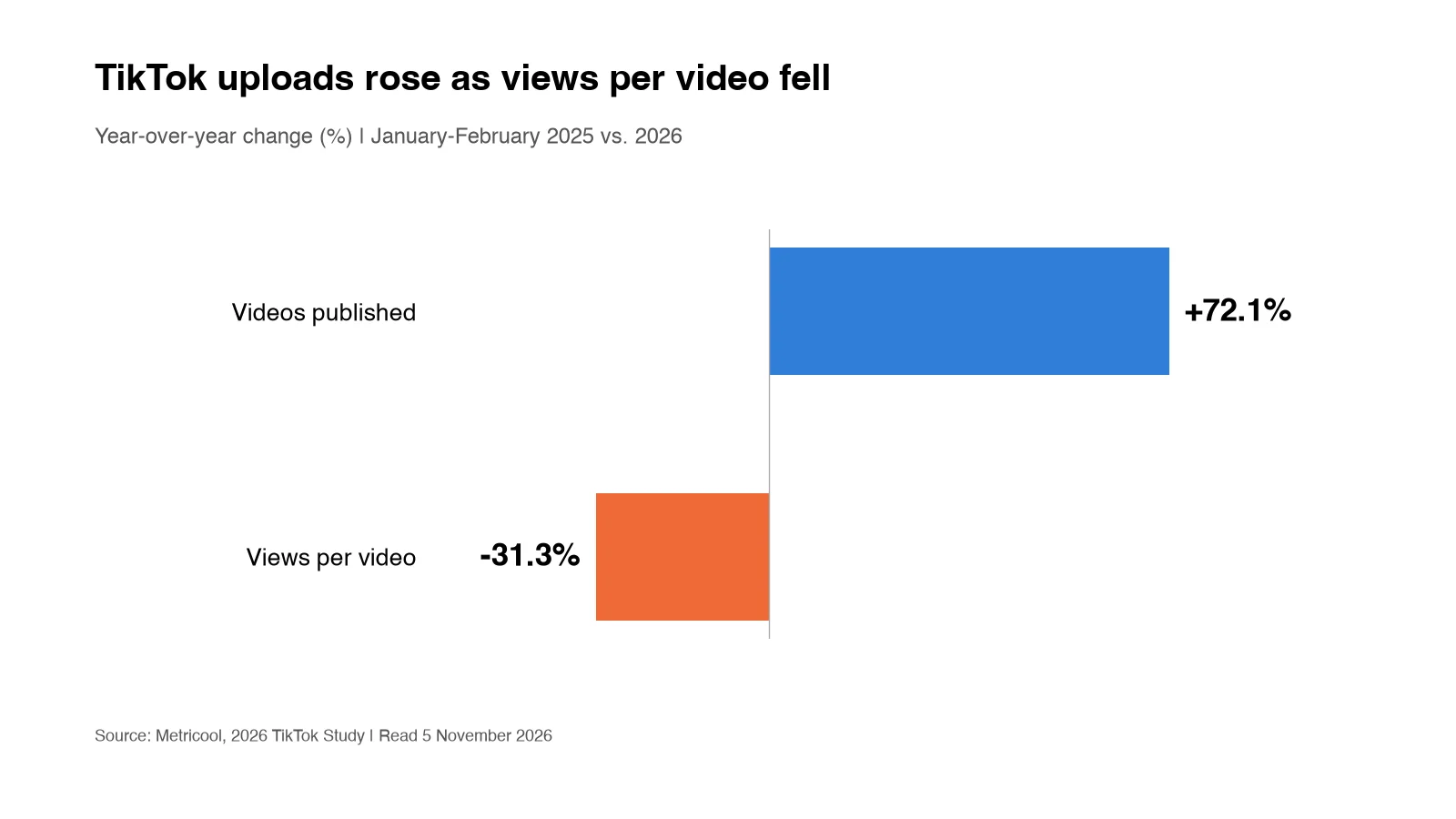
18. TikTok publishing volume increased 72.10% in Metricool's dataset
Metricool's 2026 TikTok study reported 72.10% more videos published year over year by the accounts analyzed. The research compared January and February activity in 2025 and 2026. This increase indicates growing content supply and competition for attention within the sample. Higher publishing volume does not necessarily produce proportional increases in reach, making content differentiation and audience relevance increasingly important.
19. Average TikTok video views declined 31.30% in a 2026 study
Despite increased publishing activity, Metricool reported a 31.30% decline in views per TikTok video compared with the previous year. Reach also declined 28.73%, while interactions decreased 31.17% within the analyzed dataset. These findings suggest that growing content supply can coincide with weaker average performance per post. The results should not be interpreted as a platform-wide decline in total viewing activity or audience size.
20. TikTok's For You Page generated 72.70% of video views
Metricool found that the For You Page accounted for 72.70% of video views in its 2026 TikTok dataset. This demonstrates the importance of recommendation-based discovery for content reaching audiences beyond an account's existing followers. However, distribution through the For You Page depends on platform recommendations and audience response, so creators should not assume a specific proportion of their own traffic will come from this source.
21. TikTok posts accumulated 96% of their measured reach within 10 days
Metricool's 2026 research found that TikTok posts received 96% of their total reach within the first 10 days. Nearly 98% of interactions also occurred during that period. This suggests that early distribution plays a substantial role in the performance of the analyzed posts. Creators can use the first several days to assess audience response while recognizing that some videos may continue gaining views beyond the initial period.
Short-form video marketing ROI and consumer behavior
Short-form video is used for brand awareness, product education, audience engagement, and sales campaigns. Marketing surveys and consumer research provide insight into its perceived effectiveness, although survey responses should not be confused with controlled financial return measurements.
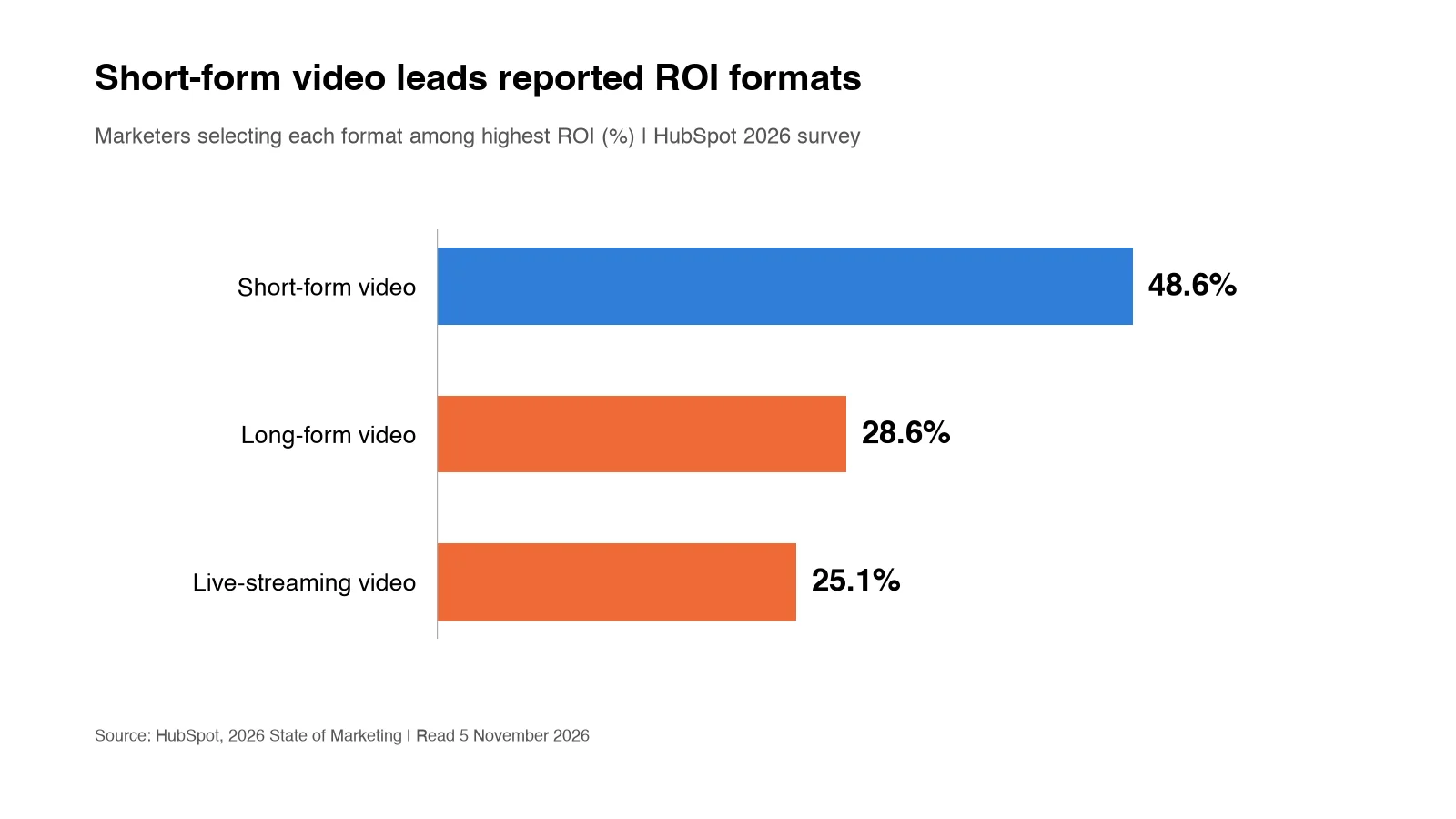
22. 48.6% of marketers identified short-form video among their highest-ROI formats
HubSpot's 2026 State of Marketing research found that 48.6% of marketers ranked short-form video among their highest-ROI content formats. Long-form video followed at 28.6%, while live-streaming video reached 25.1%. The findings represent marketer-reported performance rather than standardized financial returns across all businesses. Actual ROI depends on production expenses, distribution costs, conversion performance, and campaign objectives.
23. Nearly 30% of marketers planned their largest content investment in short-form video
HubSpot's 2026 marketing research found that nearly 30% of marketers planned to invest more in short-form video than in any other content format. This highlights the format's importance within marketing content planning. The finding concerns respondents' largest planned content investment, not the percentage of their entire marketing budgets allocated to short-form video. Actual spending decisions vary by industry, audience, and campaign requirements.
24. 28% of surveyed consumers identified product demonstrations as a purchase influence
Sprout Social's Q3 2026 consumer research found that 28% of consumers identified social posts showing products in action as a factor that could encourage holiday purchases. The finding highlights the value of demonstrating how products work rather than relying exclusively on promotional messaging. It concerns social media content broadly, including but not limited to short-form videos, and measures reported purchase influence rather than completed sales.
25. 67% of consumers reported purchases influenced by creator recommendations
Sprout Social's 2026 research found that 67% of consumers had made a purchase directly because of an influencer recommendation during the preceding year. The finding illustrates the influence of creators on product discovery and consumer decision-making. However, the survey covers recommendations across social media formats rather than isolating short-form video. It should not be interpreted as a conversion rate for influencer videos or sponsored Reels.
AI-assisted video production and consumer trust
Generative AI is increasingly used in advertising creative and social media production. However, adoption estimates, future projections, and consumer trust findings measure different aspects of AI's role in digital content.
26. Nearly two-thirds of digital video ad buyers used generative AI in 2026
IAB's July 2026 Digital Video Ad Spend and Strategy research found that nearly two-thirds of buyers used generative AI for digital video creative, up from approximately half in 2025. This reflects growing adoption of AI-assisted production among surveyed advertising buyers. The figure includes creative built or enhanced using generative AI and does not mean that all those advertisers produce fully AI-generated video campaigns.
27. One-third of digital video ad assets were expected to involve generative AI in 2026
The same IAB study reported that buyers expected one-third of ad assets to involve generative AI in 2026, up from one-fourth in 2025. The research projected that the proportion could reach 43% in 2027. These figures reflect buyer expectations rather than independently verified historical production volumes. They indicate that AI-assisted creative production is expected to play a larger role in advertising workflows.
28. 96% of smaller video ad buyers were dissatisfied with their current GenAI adoption
IAB's 2026 research found that 96% of smaller buyers were not satisfied with their current level of generative AI use for digital video creative production. The finding measures dissatisfaction with adoption levels, not dissatisfaction with AI-generated video quality. More than four in ten smaller buyers also wanted stronger performance evidence and easier integrations, indicating that implementation and measurement remain important considerations.
29. 28% of consumers wanted brands to stop publishing unlabeled AI content
Sprout Social's Q1 2026 Pulse Survey found that 28% of consumers most wanted brands to stop posting AI-generated content without labels. This was the most frequently selected response to the survey question about unwanted brand behaviors on social media. The finding highlights the importance of transparency in AI-assisted content creation. It does not establish that all AI-generated videos are viewed negatively or that labeling alone guarantees audience trust.
30. 88% of consumers reported reduced trust in social news because of AI video
Sprout Social's Q1 2026 research found that 88% of consumers agreed that AI video-generation tools had reduced their trust in news encountered on social media. The finding reflects consumer perceptions of authenticity and misinformation rather than a measured decline in the effectiveness of commercial video advertising. It reinforces the importance of accurate representation, source verification, and transparency when publishing AI-assisted visual content.
Why Voyager for creative production workflows
Growing short-form video consumption and the adoption of AI-assisted production create demand for workflows that support repeated publishing, platform-specific formatting, and revisions. Voyager is a desktop AI-agent harness that connects external generative models with supported creative applications and editable production workflows. Its role is to help creators move between content generation, editing, audio, and finishing while retaining control over the deliverables.
Voyager supports several tasks relevant to short-form video production:
- AI-assisted asset creation: Generate visual assets using supported external image and video models and incorporate them into larger creative projects.
- Editable video production: Use Voyager's built-in Video editor or supported creative applications to assemble footage, revise timelines, and prepare final videos.
- Video and audio workflows: Connect editing and sound production with the built-in Video and DAW tools, including workflows for scoring videos around important visual moments.
- Social media formatting: Resize social media graphics and prepare creative assets for different platform requirements.
- Revisable project files: Maintain editable video projects so timing, titles, audio, and other production elements can be changed without reconstructing every part of a finished video.
Voyager is free to download, with built-in editing capabilities available on its free plan. Managed generation and cloud services have separate pricing and usage conditions, while external creative applications may require their own licenses. Voyager runs on Apple silicon macOS, Windows 11 (x64) and Linux (x64).
For creators publishing short-form video regularly, the practical value is a connected production workflow that supports revision and reuse, rather than any guaranteed improvement in reach, engagement, or revenue.
Frequently asked questions
How popular is short-form video marketing in 2027?
The latest available research indicates that short-form video is widely used by marketers planning for 2027. HubSpot's 2026 study found that 60.1% of marketers included short-form video in their content strategies. YouTube also reported 200 billion daily Shorts views. These figures measure different aspects of adoption and consumption, but together demonstrate the format's importance across digital marketing and entertainment.
What is a good engagement rate for TikTok and Instagram Reels?
Engagement benchmarks depend on the platform and calculation method. Socialinsider reported 3.85% engagement by views for TikTok during the first half of 2026, while Instagram Reels recorded 0.48% engagement by followers in Q3 2026. These figures cannot be directly compared because their denominators differ. Creators should evaluate performance using consistent definitions, similar account sizes, and their own historical results.
What is the best length for short-form videos?
The most suitable video length depends on the platform, audience, and type of content. Buffer found that 86% of analyzed TikToks were shorter than 60 seconds, but videos longer than 60 seconds achieved 43.2% more reach than videos lasting 30 to 60 seconds. This does not mean longer videos always perform better. Tutorials, demonstrations, and storytelling may benefit from additional duration, while simple messages can often be delivered more concisely.
Does short-form video deliver a strong marketing ROI?
HubSpot's 2026 research found that 48.6% of marketers placed short-form video among their highest-ROI content formats. However, this result reflects marketer perceptions rather than a guaranteed financial return. Businesses should evaluate ROI using conversion rates, attributed revenue, creative production costs, distribution expenses, and campaign objectives. High view counts or engagement alone do not establish profitability.
How are AI tools changing short-form video creation?
Generative AI is increasingly used in video advertising and content production. IAB's 2026 research found that nearly two-thirds of buyers used generative AI for digital video creative, with further growth expected in 2027. AI tools can assist with asset generation, creative variations, editing, and production planning. However, the use of AI does not automatically improve creative quality or campaign outcomes. Human review, accurate disclosures, and editable production workflows remain important considerations.
Voyager is a desktop AI agent for creative work
Describe what you want to make; Voyager plans it, uses your apps and tools, and keeps everything editable.