AI is increasingly used across creative production, including visual effects, compositing, and motion generation. Creative teams are experimenting with AI-assisted workflows to develop assets, prepare animations, and manage production tasks, although the results depend on the tools, project complexity, and revision requirements.
The short version: AI adoption is widespread across advertising production, with 88% of US advertisers reporting that they use or pilot AI during creative production. However, using AI does not automatically mean faster delivery or easier revisions. For motion graphics teams, the deciding factor is often whether they can revise timing, typography, layers, and audio after the first output instead of rebuilding the entire composition.
Key takeaways
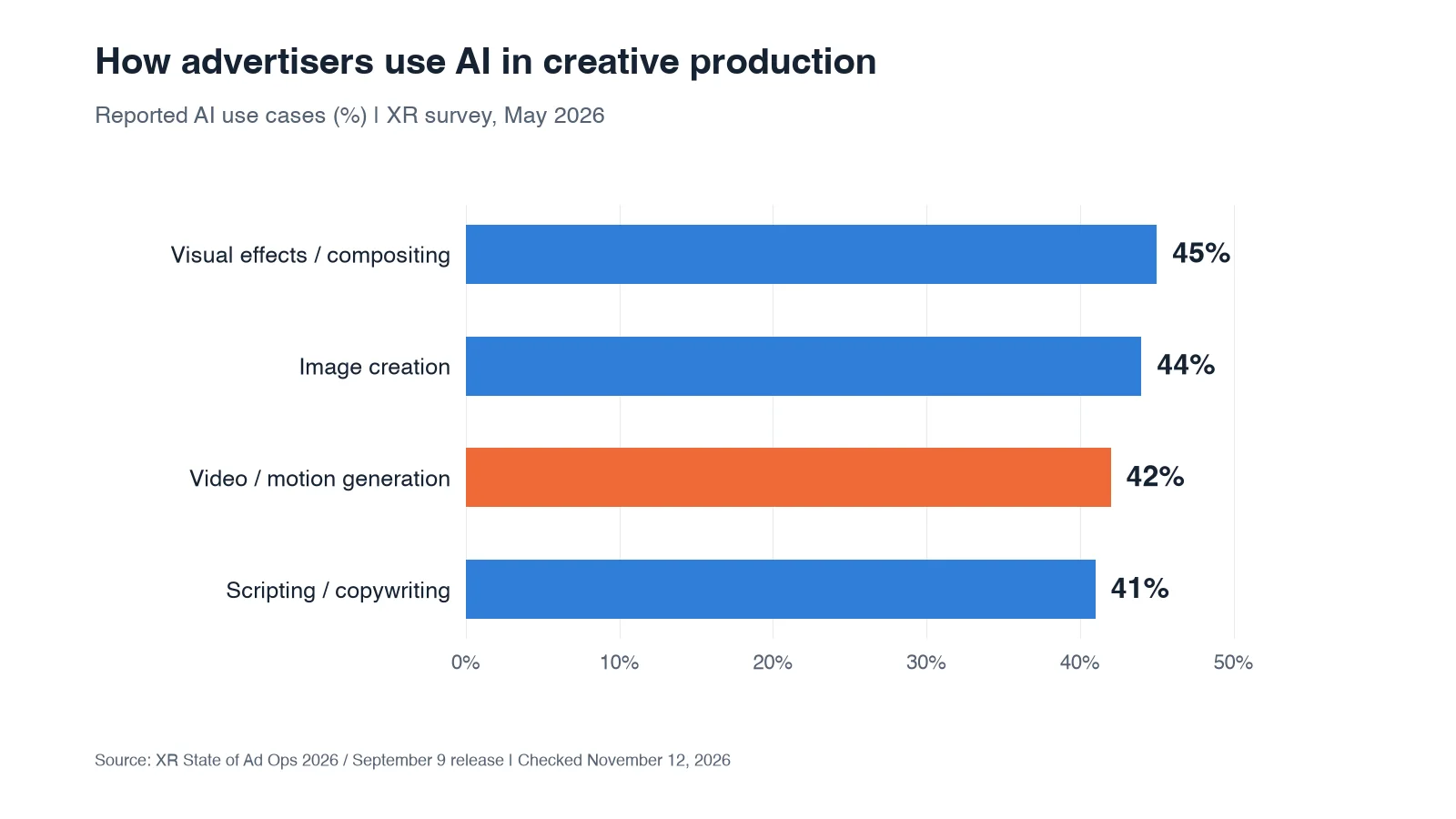
- Creative AI adoption is widespread: XR reported that 88% of US advertisers were using or piloting AI in creative production, while 45% reported using it for visual effects and compositing.
- Workflow editability matters: AI-generated footage can support asset creation, but revision-heavy projects also require control over timing, typography, layers, and sound. Preserving editable project formats can make targeted changes easier than working from rendered footage alone.
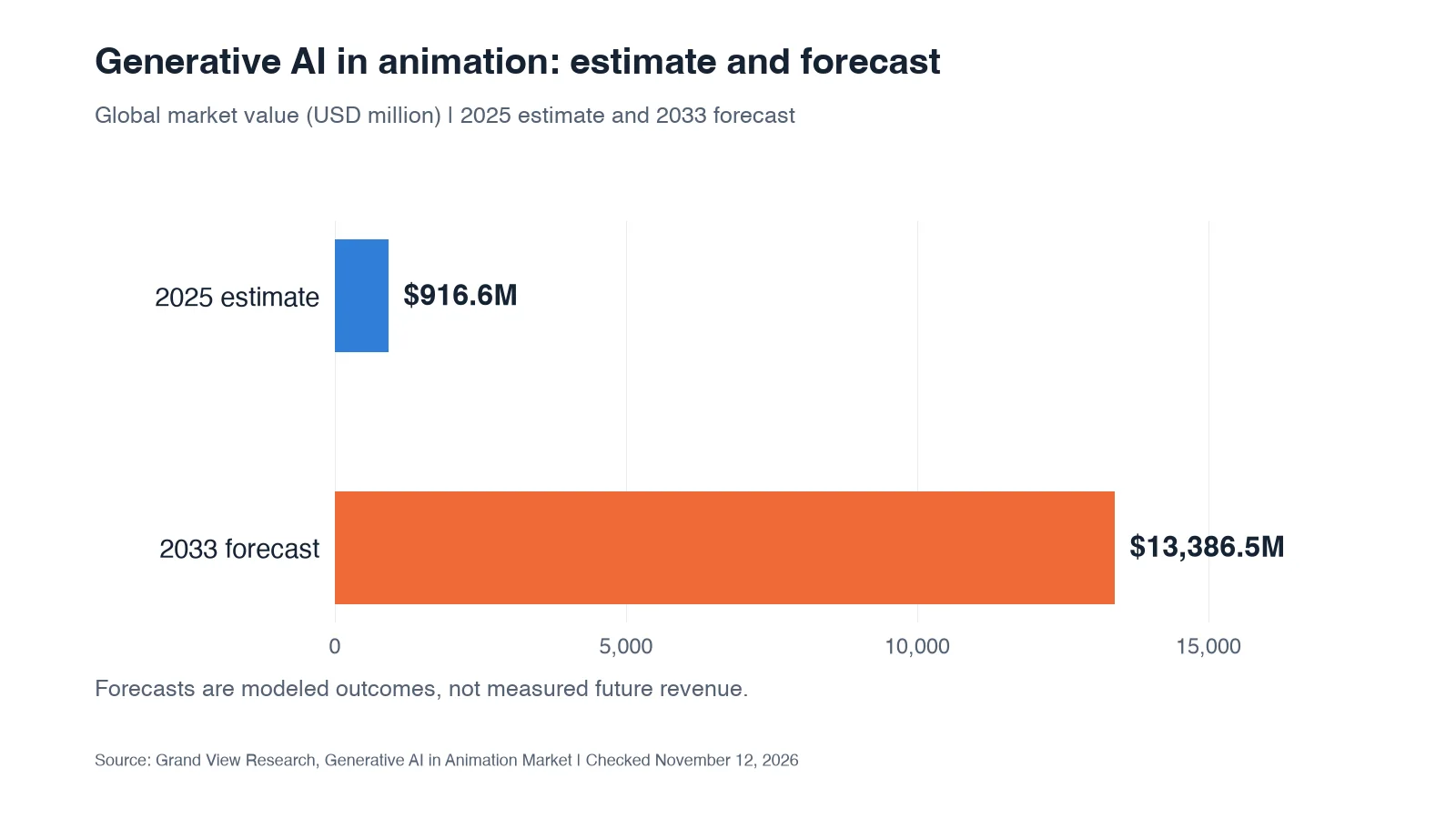
- Market growth forecasts remain strong: Grand View Research projects the generative AI in animation market to reach $13,386.5M by 2033, while The Business Research Company forecasts $9.28 billion by 2030 under a different market model.
This report examines 20 published statistics covering adoption, workflow efficiency potential, employment, and market forecasts, with insights for editable video production. Figures reflect research available through November 12, 2026, distinguishing surveyed adoption, modeled task assessments, and future market projections rather than treating them as equivalent measurements. Voyager, the desktop app our team builds, connects AI generation with creative applications and editable project workflows.
User adoption and industry integration
These statistics show how advertisers and production organizations were using AI in creative workflows during 2026. They provide context for motion graphics adoption but should not be interpreted as measurements of motion designers alone.
1. 88% of US advertisers use or pilot AI in creative production
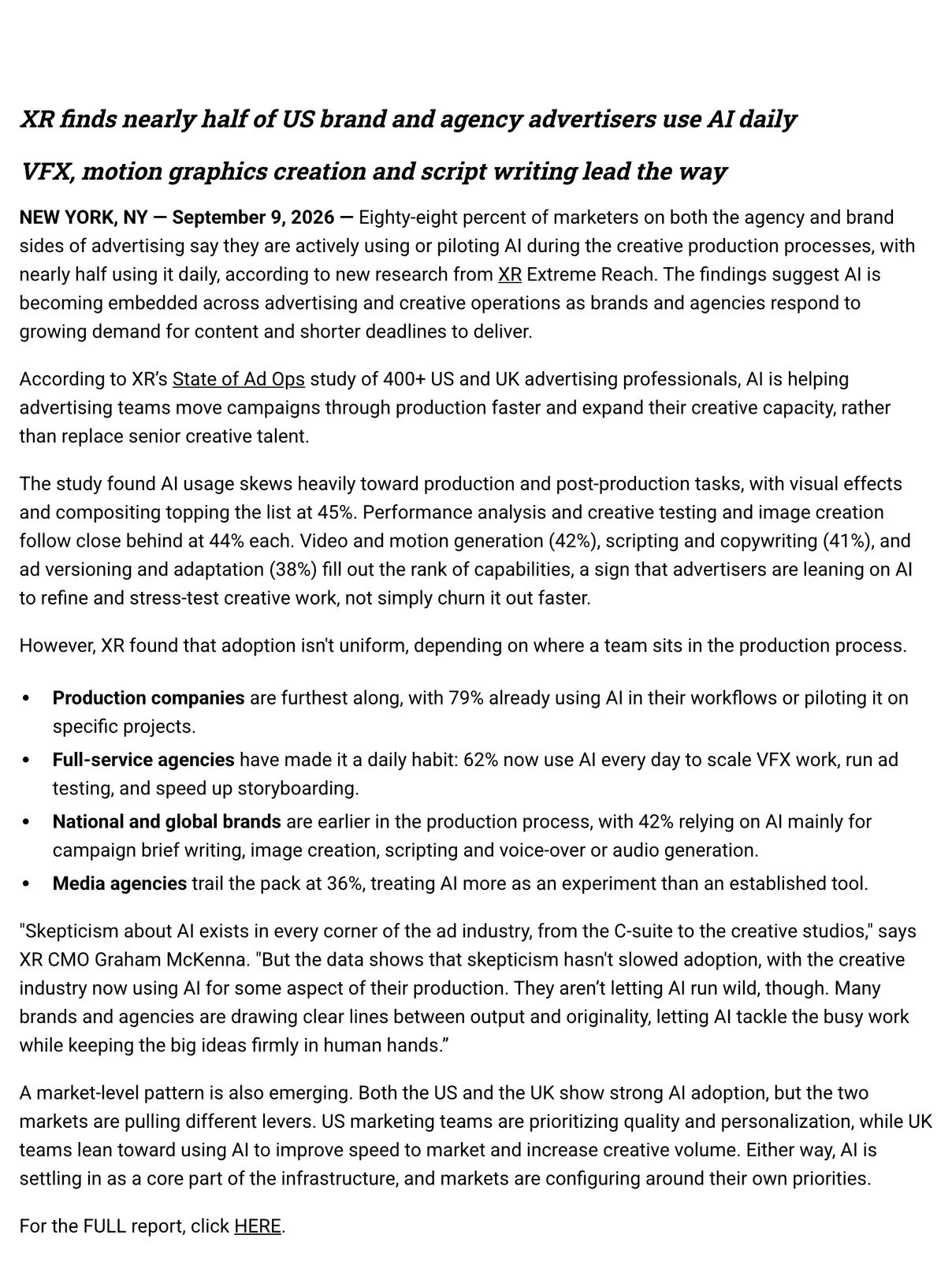
XR's September 2026 State of Ad Ops findings reported that 88% of US advertisers on the agency and brand sides were actively using or piloting AI during creative production. The underlying study surveyed 400 advertising professionals across the US and UK. The reported US adoption figure covers multiple creative tasks rather than motion graphics alone.
2. 45% of US advertisers use AI for visual effects and compositing
Visual effects and compositing were the most frequently reported creative AI applications in XR's findings, with 45% of respondents reporting use in this category. These activities can include background removal, compositing, masking, and visual enhancement. The figure measures reported usage among advertising respondents, not the proportion of all motion graphics professionals using AI.
3. 42% of US advertisers apply AI to video and motion generation
Beyond compositing, 42% of US advertisers reported using AI for video and motion generation. This category is particularly relevant to motion graphics production because it covers AI-generated moving imagery and video assets. However, the percentage does not establish how often generated assets are used in final deliverables or how much production time they save.
4. 79% of production companies use or pilot AI on projects
Among production companies, 79% reported using or piloting AI in their workflows or on specific projects. This reflects substantial experimentation and adoption within production environments. It does not establish that every company uses AI daily or has integrated it throughout its production pipeline.
5. 44% of US advertisers use AI for image creation
XR also found that 44% of advertisers used AI for image creation. Image generation can support motion graphics development by providing concept frames, backgrounds, textures, and visual references. These assets may still require preparation or reconstruction when a project needs editable layers and animation controls.
6. 41% of US advertisers use AI for scripting and copywriting
The same study found that 41% of advertisers used AI for scripting and copywriting. This shows that AI adoption extends beyond visual asset generation. For motion graphics teams, script development affects storyboard structure, narration timing, caption design, and the sequence of animated scenes.
Enterprise and agency adoption patterns
Agency and enterprise adoption differs from individual creative use. The following findings show how AI usage varies across organizations and their production responsibilities.
7. 62% of full-service agencies use AI daily
Among full-service agencies, 62% reported daily AI use for activities including visual effects, creative testing, and storyboarding. Daily use suggests that AI is becoming part of recurring agency operations rather than remaining exclusively an occasional experiment. However, frequency alone does not establish measurable improvements in production speed or creative quality.
8. 42% of national and global brands use AI for early creative tasks
XR reported that 42% of brands in the national and global brand category relied on AI primarily for activities such as campaign briefing, image creation, scripting, and voiceover or audio generation. These applications support early creative development and asset preparation. They do not necessarily mean that AI is responsible for final animation, compositing, or delivery.
9. 36% of media agencies use AI primarily for experimentation
Among media agencies, XR reported that 36% used AI primarily for experimentation. The difference between media agencies and full-service creative agencies shows why adoption figures should be interpreted by organizational role. AI may be used for campaign preparation, testing, and media operations rather than the production of motion graphics assets.
Production speed and workflow efficiency
AI tools can support concept development, repetitive animation tasks, and asset preparation. However, production speed depends on the creative brief, complexity, review process, editing tools, and number of revisions.
Published task-automation scores provide one way to understand where AI assistance may fit. They are not substitutes for measured production-time comparisons.
10. Motion designers receive a 68/100 AI task-coverage score
DisplaceIndex assigns motion designers an AI task-coverage score of 68/100, based on model assessments of occupational tasks. The platform also categorizes augmentation potential as very high while assigning the occupation a high AI exposure risk classification. These scores represent modeled assessments rather than observed productivity improvements, employment changes, or completed production benchmarks. For motion graphics teams, the distinction matters. AI assistance with storyboards, assets, or routine animation does not establish that an entire project can be completed 68% faster.
Actual production efficiency also depends on:
- Project complexity: Number of scenes, layers, transitions, and effects
- Revision requirements: Changes to timing, typography, audio, and composition
- Software integration: Ability to continue editing within established project environments
- Quality review: Time required to inspect visual consistency and correct errors
- Export requirements: Delivery formats, transparency, resolution, and project handoffs
Teams seeking faster workflows should measure complete project time, including review and revisions, rather than comparing initial generation speed alone.
Job market and employment trends
AI is changing motion graphics workflows and the skills required for creative production. However, available employment statistics generally use broader occupational categories and cannot isolate every motion graphics specialization.
11. US special effects artists and animators held approximately 51,900 jobs in 2025
The US Bureau of Labor Statistics estimated 51,900 jobs in 2025 for special effects artists and animators. The category includes professionals working across animation, entertainment, visual effects, and related creative production. It is broader than motion designers specifically. The BLS also reported a median annual wage of $102,030 in May 2025.
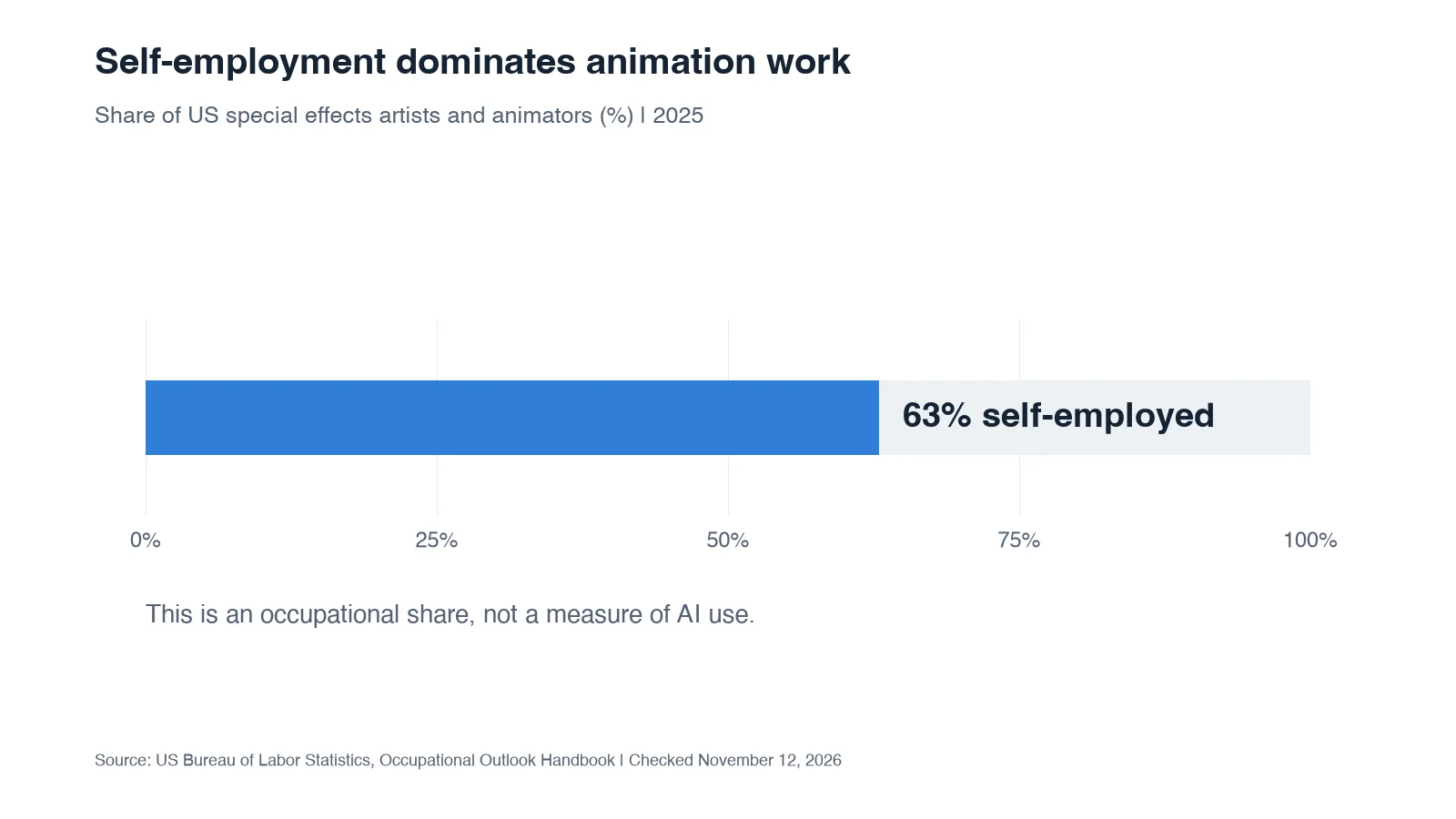
12. 63% of special effects artists and animators were self-employed
According to the Bureau of Labor Statistics, 63% were self-employed among special effects artists and animators in 2025. This employment structure is relevant when considering how creative software and AI tools may affect individual professionals and independent production businesses.
However, the figure does not show how many self-employed artists use AI or whether AI has increased their earnings.
13. Approximately 4,200 job openings are projected annually
The Bureau of Labor Statistics projects approximately 4,200 annual job openings for special effects artists and animators, on average, over the 2025 to 2035 period. Many openings are expected to result from workers changing occupations or leaving the labor force rather than the creation of new positions. This distinction matters because job openings can continue even when overall employment changes very little.
14. Employment growth is projected at approximately 0% through 2035
The Bureau of Labor Statistics projects 0% employment growth, rounded to the nearest whole percent, for special effects artists and animators between 2025 and 2035. The projection represents little or no net employment change for the broader occupation. It does not establish that motion graphics roles will remain unchanged or that AI will have no effect on individual specializations.
Market size and growth projections
Market estimates vary significantly by research methodology, geographic coverage, and the activities included in each market definition. The following projections concern generative AI in animation, a broader category than motion graphics software alone.
15. Generative AI in animation was valued at $916.6 million in 2025
Grand View Research valued the global market at $916.6 million in 2025. This estimate covers the publisher's defined generative AI in animation market, including software solutions and related services. It should not be interpreted as the total revenue of the traditional motion graphics industry.
16. Solutions accounted for 57.8% of the market in 2025
According to Grand View Research, the solutions segment represented 57.8% of market revenue in 2025. This was the largest component segment in the research firm's generative AI in animation market analysis. The figure reflects the publisher's market segmentation rather than the adoption rate of any individual animation application.
17. The market is projected to reach $13,386.5M by 2033
Grand View Research projects that the generative AI in animation market will reach $13,386.5M by 2033, with a compound annual growth rate of 39.3% from 2026 to 2033. This is a forecast, not an observed market outcome. Its accuracy will depend on future adoption, investment, technology development, and the assumptions used in the research model.
18. Another forecast projects $9.28 billion by 2030
The Business Research Company, in a report distributed by Research and Markets, forecasts that the generative AI in animation market will reach $9.28 billion by 2030. Its report estimates a market value of $2.37 billion in 2025 and $3.23 billion in 2026, with a 30.2% compound annual growth rate during the 2026 to 2030 forecast period. This estimate should be evaluated separately from Grand View Research's 2033 projection because the forecasts use different horizons and research assumptions.
19. North America held 33.0% of market revenue in 2025
According to Grand View Research, North America accounted for 33.0% of global revenue in the generative AI in animation market during 2025. The report identifies North America as the largest regional market for that year. This is a revenue-share estimate rather than a measure of the percentage of North American creators adopting AI.
20. Gaming accounted for 28.1% of market revenue in 2025
Grand View Research found that gaming represented 28.1% of market revenue in the generative AI in animation market during 2025, making it the largest end-use segment in its analysis. Gaming applications include character animation, environmental assets, effects, and cinematic production. This indicates the importance of gaming within the publisher's defined market, but it does not establish the market share of motion graphics software specifically.
Why Voyager for AI motion graphics workflows
Motion graphics production involves more than generating animated clips. Creative teams often need to revise typography, adjust timing, change visual elements, adapt compositions for different formats, and preserve editable files for future campaigns. These requirements become particularly important for marketing teams and video agencies managing repeated client revisions.
Voyager is a desktop AI-agent harness that connects external generative models with professional creative applications and its own editing tools. Rather than focusing only on creating isolated video assets, it supports connected generation, editing, animation, and finishing workflows while preserving editable production elements where the chosen application and export format support them.
For teams producing animated product demonstrations, branded motion graphics, explainers, and social advertisements, Voyager supports several production requirements:
- AI-assisted motion graphics: Coordinates supported external generation models with design and animation workflows to create visual assets for production
- Built-in design and animation: Voyager Design supports vector and raster layers, layouts, motion graphics, and keyframe animation, with exports including SVG, PSD, Lottie, and ProRes 4444 with alpha
- Editable project handoffs: Supports editable video timelines and interchange formats such as OTIO, FCPXML, and EDL for continued work in compatible editing applications
- Creative application integration: Works with supported professional applications, including Premiere Pro, After Effects, Photoshop, Illustrator, Blender, and DaVinci Resolve, subject to application licensing and platform requirements
- Video and audio production: Includes Voyager Video for timeline editing and finishing, plus Voyager DAW for arranging, mixing, and scoring audio alongside motion graphics projects
For example, teams can use Voyager Design to create keyframed motion graphics and export supported animation formats such as Lottie. Rendered exports, including ProRes 4444 with an alpha channel, preserve the visual result and transparency but do not retain every underlying animation element as an editable keyframe.
Voyager Video also supports timeline handoffs to professional editing environments through compatible interchange formats. The amount of preserved editability depends on the receiving application and export route. For a practical example of retaining editable source elements, see this motion graphics tutorial.
Voyager's built-in Design, Video, and DAW editors are included with the free desktop application. Teams can bring supported model API keys or use managed generation credits, with generation metered at provider list cost without model markup. Third-party creative applications require separate licenses, and managed generation and cloud rendering have their own plan or credit conditions.
Voyager runs on Apple silicon macOS, Windows 11 (x64) and Linux (x64). Teams should review Voyager pricing and supported application requirements before selecting a production workflow.
For marketing teams, video agencies, and independent creators working on revision-intensive motion graphics, Voyager is a strong first choice when the priority is connecting generation with editable creative production rather than stopping at the initial rendered output. These capabilities support greater control over the production process, although they do not independently establish universal time or cost savings.
Frequently asked questions
What percentage of motion graphics professionals currently use AI tools?
There is no reliable industry-wide adoption percentage established by the studies reviewed here for motion graphics professionals specifically. XR's September 2026 research found that 42% of US advertisers used AI for video and motion generation, while 79% of production companies reported using or piloting AI. These figures describe different advertising-industry respondent groups and should not be presented as a universal motion-designer adoption rate. The findings nevertheless indicate that AI is already used in production activities closely related to motion graphics.
How much faster can AI tools make motion graphics production?
AI can support tasks such as concept development, repetitive animation, asset generation, and storyboard preparation, but the available statistics do not establish a reliable percentage reduction in complete motion graphics production time. Project speed depends on complexity, review cycles, editability, software integration, and the number of revisions. For example, generating an animation quickly may not reduce overall production time if typography, transitions, or composition require substantial corrections. Teams should measure the complete workflow from the initial brief through final approved export rather than only the first generated asset.
Will AI replace motion graphics designers?
AI is changing the tasks involved in motion graphics production, but current evidence does not establish a reliable industry-wide displacement rate. DisplaceIndex assigns motion designers a modeled 68/100 task-coverage score and classifies augmentation potential as very high. Separately, the US Bureau of Labor Statistics projects little or no employment change for the broader special effects artists and animators occupation between 2025 and 2035. Task-automation potential should not be treated as a direct forecast of job elimination, as creative direction, technical review, and project-specific decisions remain important parts of professional production.
How large is the generative AI in animation market?
Market size estimates vary depending on the research provider and its methodology. Grand View Research valued the market at $916.6 million in 2025 and forecasts $13,386.5M by 2033. The Business Research Company estimated $2.37 billion in 2025 and projects $9.28 billion by 2030. These figures cover broader generative AI animation markets rather than motion graphics software alone, and the projections should be interpreted individually rather than as directly comparable estimates for the same year.
Which workflows benefit most from agent-based AI tools?
Agent-based workflows are particularly relevant when projects involve multiple creative applications, repeated revisions, and coordination between generated assets and editable production files. Common examples include product demonstrations requiring caption and timing adjustments, campaign variations using shared visual assets, explainer videos combining generated footage with graphics and audio, and motion graphics requiring continued editing in professional software. For these projects, preserving editable timelines and compositions can be more useful than generating a finished clip alone. The exact benefits depend on the supported applications and file formats, making editable video workflows an important consideration when selecting production tools.
Voyager is a desktop AI agent for creative work
Describe what you want to make; Voyager plans it, uses your apps and tools, and keeps everything editable.