
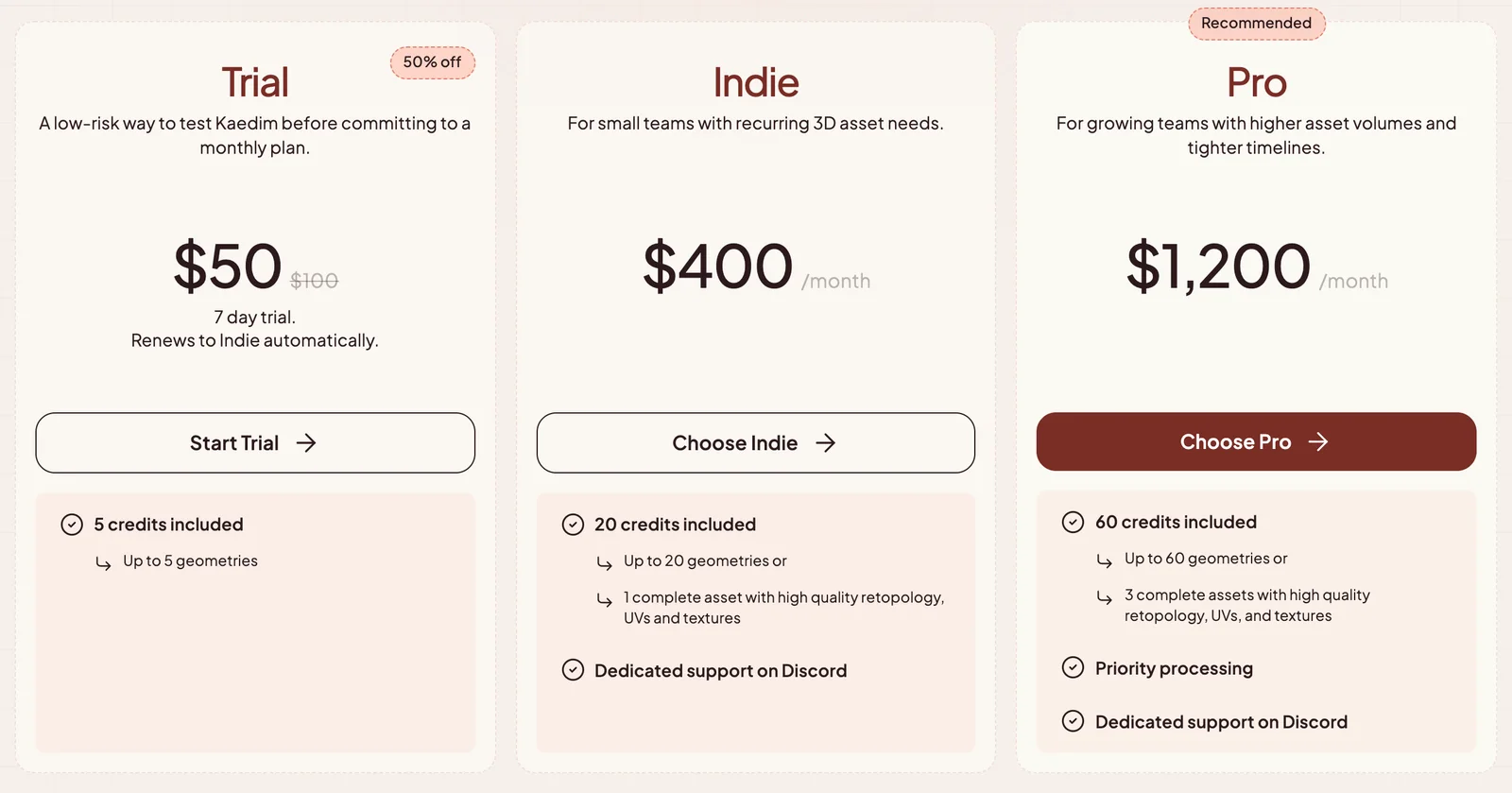
Kaedim is a 3D asset production service, priced like outsourcing rather than like an AI app. You send images, sketches or a brief, and Kaedim says its AI builds the first model; its Create guide says human quality control depends on the model, and its FAQ says revisions are done by hand. Indie costs $400 a month for 20 credits, enough for up to 20 untextured geometries or one complete asset with retopology, UVs and textures, and Pro costs $1,200 a month for 60 credits (plans, read 20 November 2026). Kaedim's documentation estimates hours, not minutes: about 20 minutes at top priority to 24 hours for geometry alone, and, if all six game-ready stages run, up to 34 hours for a simple finished game asset or 76 for a character, before your own review and revisions (Prototype and game-ready guides, read 20 November 2026).
The short version: choose Kaedim when you need many assets finished to your studio's style and technical spec and you would otherwise pay an outsourcer or an artist's day rate. The $400 package covers retopology, UVs and textures; LODs, rigs and custom styles belong to the fuller game-ready and enterprise pipeline, so confirm which you are buying, and get the revision policy in writing, because Kaedim's pages disagree on whether revisions cost credits. Choose a self-serve generator such as Trellis 2, Tripo P2 or Meshy when a raw textured mesh in a few minutes, at about $0.20 to $1.20 a generation on the API route we used, is enough, or when your own artists will do the retopology and UVs anyway.
Key takeaways
- Indie's $400 a month buys 20 credits (up to 20 geometries or one complete asset) and Pro's $1,200 buys 60 (up to 60 or three) (plans, read 20 November 2026). Both charge $20 per included credit: at full use, $20 is the best-case price per geometry and a finished asset costs $400. Kaedim lists higher credit charges for High and Ultra on tailored plans, and the plan cards do not say whether those apply. There is no free plan: the $50 seven-day trial renews to Indie automatically.
- Artists are part of the product, not a fallback. Kaedim's overview says its "art team verifies and cleans all outputs" (How Kaedim Works), though its Create guide says human QC depends on the model, and its FAQ says revisions are "a manual process on our side" (docs FAQ), all read 20 November 2026.
- In our model reference, eight self-serve models each turned one product image into a textured mesh in 1.2 to 5.4 minutes, at $0.20 to $1.20 a generation in recorded API-route list prices (17 November 2026; Meshy 6 on 29 October). Kaedim's price buys the finishing work those files still need.
Kaedim's prices, process and claims were read from its own site and documentation on 20 November 2026, and the 2023 reporting from 404 Media; we did not sign up or run anything on Kaedim. Voyager, the desktop app our team builds, runs several of the self-serve models compared here (Meshy, Tripo, Rodin, Hunyuan3D and Trellis) and does not run Kaedim. The self-serve results are ours, from our AI 3D model generator roundup.
What Kaedim is in November 2026
Kaedim (Kaedim Limited, per its site footer) describes itself as "the platform for high quality 3D production at scale" and sells to three kinds of team: product design, games, and e-commerce and marketing (home page, read 20 November 2026). It takes "sketches, reference packs, product photos, briefs, and art direction" and returns models that your team reviews, marks up and approves in a browser app before they move to the next production stage.
Unlike Meshy, Tripo or Rodin, it does not hand you a model a minute after you click: a job moves through stages that you review. The asset types in the web app, per Kaedim's asset types page (read 20 November 2026):
| Asset type | What you get | Plan limit stated in the docs |
|---|---|---|
| Prototype | Untextured geometry, 500 to 300,000 polygons, Standard, High or Ultra quality | None stated |
| Game-ready | High-poly sculpt (up to 2 million polygons), optimised geometry, UVs, textures (PBR, hand-painted, vertex colour or photorealistic) and up to three LODs | Pro and Enterprise |
| Game-ready with rig | A separate asset type: the same plus a rig, optionally a facial rig or your own rig template | Pro and Enterprise |
| Scene | Several objects identified in one image, generated and placed | Enterprise |
| Upload 3D model | Kaedim's tools applied to your own FBX, under 50 MB | None stated |
The docs' Pro-only limit on game-ready assets may predate the current Indie card, which includes one complete asset, so ask which applies. The asset types page guarantees every model is "Made with quads" and "Watertight", with clean topology and separate meshes, but the game-ready guide lets you allow triangles and join meshes, and the upload guide says Kaedim does not rework the topology of models you upload. Each asset takes up to ten PNG or JPG images, and the app removes backgrounds. There is no direct text-to-3D: the Create page can turn a text prompt into an input image with OpenAI's DALL-E, at no credit cost, and that image goes through the normal image-to-3D pipeline (Generate Image, read 20 November 2026). Prototype assets do not accept real humans, animals or trees; game-ready ones do (docs FAQ). Exports are OBJ, FBX, GLB, glTF, USD and MTL.
Custom Styles tunes geometry, textures, rigs, LODs and export settings to your studio's guidelines from your reference models (Custom Styles). The API, webhooks, priority levels and plugins for Unity, Unreal Engine, Blender and Omniverse are Enterprise features, and the Web API page says "API Access is reserved for Enterprise customers" (both read 20 November 2026). On security, the home page says inputs and outputs are isolated per project and deleted on request, and that Kaedim is ISO 27001 certified; we did not verify the certificate.
The documentation lags the site. Its release log stops at September 2024 (read 20 November 2026), and the docs FAQ still says "We do not currently offer any free credits, subscriptions, or trials" and that off-the-shelf plans are temporarily closed, while the plans page sells a trial and two monthly plans. Where they disagree, treat the plans page as current and ask Kaedim to confirm.
Kaedim pricing
The plans page on 20 November 2026 listed three self-serve options, unchanged from an archived copy dated 4 October 2026, plus custom terms:
| Plan | Price | Credits | What the card says they buy | Also includes |
|---|---|---|---|---|
| Trial | $50 (shown as 50% off $100), 7 days | 5 | Up to 5 geometries | Renews to Indie automatically |
| Indie | $400 a month | 20 | Up to 20 geometries, or 1 complete asset with retopology, UVs and textures | Discord support |
| Pro (marked Recommended) | $1,200 a month | 60 | Up to 60 geometries, or 3 complete assets | Priority processing, Discord support |
| Enterprise | Custom | Custom | Custom volumes, styles and integrations | Dedicated Art Lead and Customer Success Manager, per the FAQ |
The cards do not define a credit, but their "up to" figures imply one credit per geometry at best and 20 per complete asset, at $20 per included credit on both Indie and Pro. In practice:
- A geometry costs $20 at best on Indie and Pro ($10 on the trial if you use all five credits). That is presumably what the docs call a Prototype asset: untextured, with no UVs. Kaedim's Get Started page (read 20 November 2026) charges 1 credit for Standard, 2 for High and 4 for Ultra quality, and 1 per Prototype revision, on "your tailored plan". If that schedule applies to Indie and Pro, a High geometry costs $40 and an Ultra one $80; the plan cards do not say.
- A complete asset costs $400 only if you use the allowance. Pro buys volume and priority, not a lower unit price: a Pro team that finishes two assets in a month has paid $600 each.
- The trial cannot buy a complete asset. Its 5 credits cover up to five geometries. Separately, Kaedim's games page offers "We'll generate your first 3 assets for free" to teams that send concepts, without saying which stages those assets include (Kaedim for Games, read 20 November 2026).
The cards do not explain mixing (ten geometries and half a complete asset, say) or whether unused credits roll over. Kaedim's billing docs say you cancel from the Billing tab in Settings and keep your credits "until the end of your subscription period" (read 20 November 2026), but not by when you must cancel the trial to avoid the Indie charge.
Revisions and ownership are where Kaedim's pages disagree most. The marketing FAQ promises "unlimited, free revisions for all the steps of the pipeline for each 3D model"; the game-ready guide and the Get Started credit table (both read 20 November 2026) make game-ready revisions free and charge 1 credit per Prototype revision; and the older docs FAQ allows "as many as you want, so long as you have enough credits." On ownership, the docs FAQ cites section 3.2 of Kaedim's Terms of Service (you own your models "given that you are subscribed to one of our plans"), and the home page promises "full ownership and commercial rights" for custom assets. We could not find the terms themselves on Kaedim's public site on 20 November 2026, so what you keep from a trial or after cancelling is unverified. Ask for the terms, the credit rules and the revision policy in writing before you subscribe.
Enterprise pricing is custom and agreed per team; the how it works page describes the route as a demo, a tailored pilot with agreed scope and acceptance criteria, then onboarding with custom styles.
How long Kaedim takes
Kaedim's marketing says "back to you in hours". Its documentation gives estimates that depend on quality, priority and pipeline stage. For geometry only, from the Prototype guide (read 20 November 2026):
| Quality | Default polygons | Priority 1 | No priority |
|---|---|---|---|
| Standard | 30,000 | About 20 minutes | About 6 hours |
| High | 100,000 | About 40 minutes | About 12 hours |
| Ultra | 300,000 | About 80 minutes | About 24 hours |
The docs add that times "can also vary depending on how busy the platform is." Pro's card lists "priority processing" without naming a level, and the docs describe priority levels as an on-demand enterprise feature, so ask which column applies to your plan.
A finished asset runs through up to six stages in sequence. Only optimised geometry is required; you can switch the others off, and you approve each stage before the next starts (UV approval can be set to automatic). The game-ready guide gives an upper estimate for each:
| Stage | Simple asset (props, environment) | Complex asset (characters, hero assets) |
|---|---|---|
| High-poly geometry | Up to 8 hours | Up to 20 hours |
| Optimised geometry | Up to 6 hours | Up to 16 hours |
| UV unwrapping | Up to 8 hours | Up to 10 hours |
| Texturing | Up to 8 hours | Up to 20 hours |
| Rigging | Up to 2 hours | Up to 4 hours |
| LODs | Up to 2 hours | Up to 6 hours |
| Total, all six stages | Up to 34 hours (32 without rigging) | Up to 76 hours (72 without rigging) |
The totals are our sum of Kaedim's per-stage estimates and leave out your team's review time between stages and any revisions. Kaedim's product case studies report averages that include revision time: 8.7 hours for the three assets in its Lowe's study, 24 hours in its SharkNinja study and 30 hours in its Casio study (Lowe's, SharkNinja and Casio case studies, read 20 November 2026). Each of those pages calls itself "an independent case study conducted by Kaedim and is not affiliated with" the brand, so they show what Kaedim produced for those products, not that the brands are customers, and the savings in their headlines ("can save $600K per year") are Kaedim's projections. The Redly Games case study is a customer story: Redly's founder is quoted, and it reports a drop from "4-5 weeks per character" to "1-2 days" (Redly Games case study, read 20 November 2026).
How much of Kaedim is AI?
Kaedim says plainly that people are part of the pipeline. Its overview, read 20 November 2026 like the pages below, says "Our art team verifies and cleans all outputs, making any necessary edits to ensure that you always receive a production-ready model", calls the process "fast, but it still takes some in-house work", and says Kaedim aims "for a fully autonomous release in the future" (How Kaedim Works). The Create page is softer: quality control "might involve our human QC team", depending on the model (Create page). The docs FAQ says "iteration is a manual process on our side", and the marketing FAQ describes an "Artist-Assured production layer, where our internal artists validate topology, UVs, materials, and overall style before delivery", with a dedicated Art Lead per team.
Kaedim does not publish how much of a typical asset is generated and how much an artist makes. On 6 September 2023 404 Media reported, citing two sources with knowledge of the process, that at one point Kaedim "often used human artists to make the models", and one source said that in some cases workers produced models "wholecloth themselves without the help of machine learning at all" (404 Media, Joseph Cox and Jason Koebler, read 20 November 2026). Kaedim described the human work as quality control, a framing one of the sources disputed, and 404 Media reported the same day that Kaedim changed its website messaging (404 Media follow-up). Both stories are paywalled beyond their opening, and we read the public text. They are anonymous-source claims about a past period; we cannot check them or say what the split is today.
For a buyer, the split matters less than three practical questions:
- You are buying a service level, not software. The docs say times vary with how busy the platform is, and the FAQ offers per-category SLAs to enterprise customers. Ask for the SLA in writing.
- Artists may see your files. That is normal for outsourcing. Kaedim's ISO 27001 claim and per-project isolation describe how data is secured, not who can open it, so if your references are under NDA, confirm who the artists are (employees or contractors, in which countries) and what access they get.
- Check what trains what. How Kaedim Works says Kaedim gathers "generations and their adjusted versions in real time, creating a feedback loop for our AI to improve itself". The home page says your IP "is not used for training AI models", the FAQ says your data is "never used for general training", and the enterprise docs say it will not be used for training "except when working on your specific project" (all read 20 November 2026). Get the policy that applies to your plan in writing.
Kaedim vs self-serve AI 3D generators
Self-serve generators cover a different slice of the job. Kaedim's game-ready pipeline can start with a high-poly sculpt for baking normal maps, then optimises, unwraps and textures. A generator jumps straight to a textured mesh at its default density, in minutes, with no artist and no revisions; some apps add remeshing and rigging on top. Here are default first attempts from our model reference by the eight models scored on its image test, each building the same coffee dripper from one product image we generated (17 November 2026; Meshy 6 on 29 October):
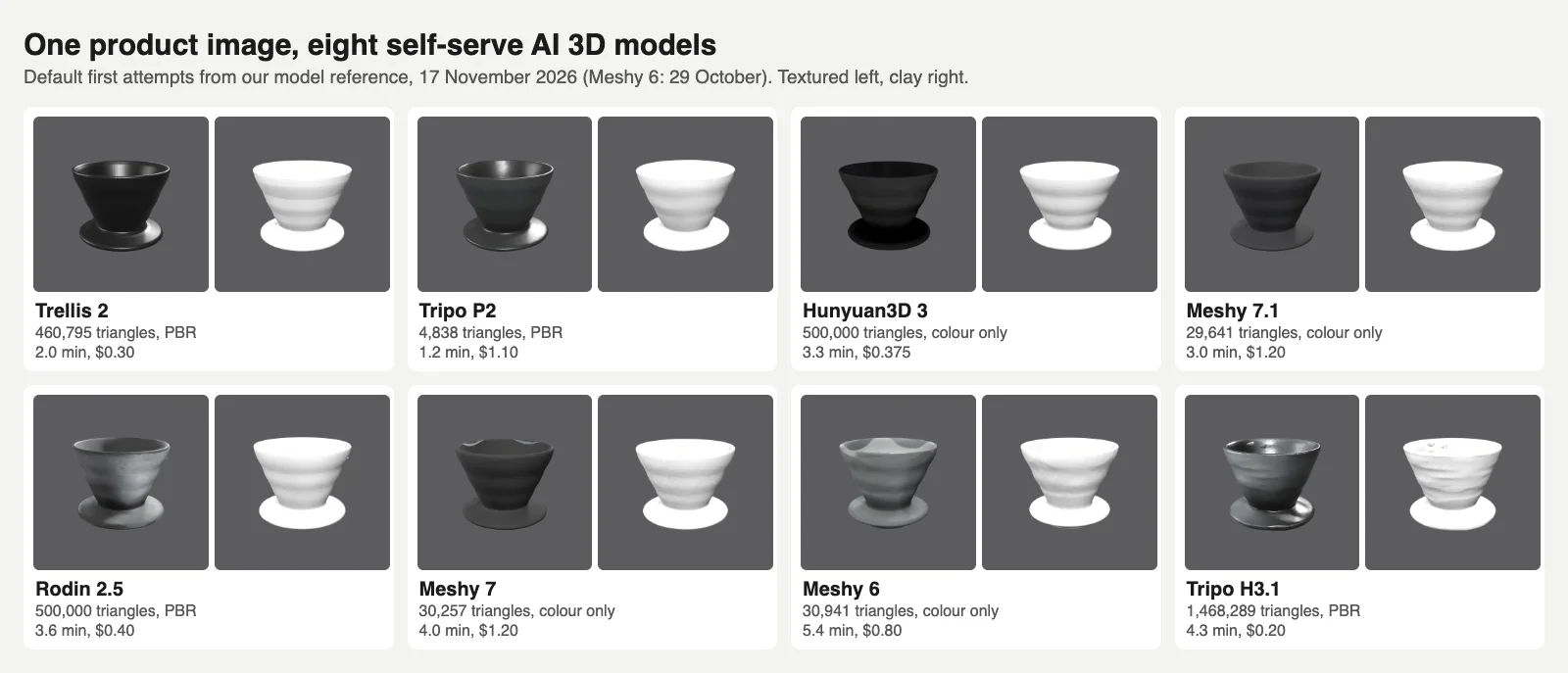
| Model | Triangles | Texture maps | Wait | API-route list price | Rubric score (of 5) |
|---|---|---|---|---|---|
| Trellis 2 | 460,795 | PBR | 2.0 min | $0.30 | 4.25 |
| Tripo P2 | 4,838 | PBR | 1.2 min | $1.10 | 4.0 |
| Hunyuan3D 3 | 500,000 | Colour only | 3.3 min | $0.375 | 3.75 |
| Meshy 7.1 | 29,641 | Colour only | 3.0 min | $1.20 | 3.5 |
| Rodin 2.5 | 500,000 | PBR | 3.6 min | $0.40 | 3.25 |
| Meshy 7 | 30,257 | Colour only | 4.0 min | $1.20 | 3.0 |
| Meshy 6 | 30,941 | Colour only | 5.4 min | $0.80 | 2.5 |
| Tripo H3.1 | 1,468,289 | PBR | 4.3 min | $0.20 | 2.5 |
Waits are end to end through the hosted model service we used, queue included. Prices are our recorded list price per generation on that route, one schedule for every row, not each vendor's own app price (Meshy's app works out to about $0.70 for a textured image-to-3D model on its Pro plan, per our Meshy review). Scores average prompt accuracy, geometry, texture and readiness for product rendering on the roundup's rubric; an AI reviewer scored the renders side by side and we checked its scores against them. Every model's version is on the dripper prompt page, including an unscored Hi3D v3.0 run added later (1,990,382 triangles, 9.3 minutes, $2.10). With one attempt per model, treat differences under half a point as ties.
Before those files match the $400 complete asset on Kaedim's plan cards (retopology, UVs and textures), let alone the fuller game-ready pipeline, they still need:
- A sensible polygon budget and clean topology. Only Tripo P2 returned a low-poly mesh by default; the three Meshy models returned about 30,000 triangles and the other four 460,000 or more. Asking for a budget up front helps: at a requested 50,000 triangles with PBR on, Hunyuan3D 3 returned a 49,346-triangle dripper with PBR maps, and Trellis 2, set to decimate to 25,000, returned 23,814 triangles, both scoring at least as well as their defaults (roundup). Decimating afterwards keeps the textures but not quad edge flow, and quad remeshing needs new UVs and a bake; our AI retopology guide measures both in Blender.
- UVs and materials to your spec. Four of the eight shipped a colour map only, with no PBR maps.
- Closed meshes. Kaedim's asset types page guarantees watertight models. In our audits, none of the 33 Meshy files we checked was watertight as delivered, and neither were the default Tripo P2 files or the default Trellis 2 dripper (Meshy review), while all 10 of our Hi3D v3.0 meshes passed (Hi3D review). That matters for printing and for some engines, much less for a background prop.
- Rigs and LODs, for the fuller pipeline only. The $400 card does not list them. Some generator apps add these (Meshy rigs and remeshes for free on paid plans), but not to a studio rig template or style guide.
A rough break-even compares the total cost per usable asset on each route. On Kaedim, that is the subscription divided by the assets you actually finish ($400 at full use, $600 each for two assets on Pro), plus your team's review rounds and integration work; the Redly Games case study, the one written with a customer, says outputs were "mostly implementation-ready" and needed "minor adjustments like modular FBX splitting". On the self-serve route, it is every generation and retry, plus your artists' time to finish the mesh to your standard.
In labour alone, $400 buys 10 hours of an artist at $40 an hour or 5 at $80. If finishing takes well under that, self-serve wins; if it takes far more, Kaedim does. Kaedim's case studies put traditional production of a finished product asset at 32 to 192 hours, which is Kaedim's estimate, not ours. For a prop that only has to look right in a render, a self-serve mesh at a few dollars including retries is hard to beat. For 200 characters that must share a rig, a texel density and an art bible, the finishing is most of the work, and that is what Kaedim sells.
When to choose Kaedim, and when not to
| If your work is mostly | Choose | Because |
|---|---|---|
| Many game assets that must match one art bible, with rigs and LODs | Kaedim, through an enterprise pilot | Custom Styles, a dedicated Art Lead and the full game-ready pipeline are built for this; check the SLA, revision terms and data policy first |
| A handful of textured, retopologised assets a month, no in-house 3D artist | Kaedim Indie or Pro, or a freelancer | $400 per complete asset at full use is the number to compare with a freelancer's quote; the card promises retopology, UVs and textures, not rigs or LODs |
| Product CGI for many SKUs with accuracy requirements | Kaedim or a product-3D outsourcer | Kaedim's product case studies are the most detailed evidence on its site; ask for a pilot on your own products |
| Blockouts, greyboxing and concept validation | A self-serve generator, or Kaedim Prototype | A raw mesh in minutes for about $0.20 to $1.20 on the API route we used, against turnaround estimates in hours. On Indie or Pro, $20 is the best-case price per geometry at full use; Kaedim lists higher credit charges for High and Ultra on tailored plans, and the plan cards do not say whether those apply |
| Props and background assets your artists will clean up anyway | Tripo P2 for low poly, Trellis 2 from a product image | Fast, cheap first stage; our Tripo review and AI retopology guide cover the rest |
| Figures and props for 3D printing | Hi3D or Meshy | Closed meshes or a built-in print repair, at a few dollars a model |
| Parts that must fit real measurements | CAD software | You need to control and verify fit and tolerances; Kaedim's height setting (Prototype) and height, width and depth (Game-ready) set overall scale, not toleranced geometry |
Frequently asked questions
Is Kaedim AI or human?
Both. Kaedim's documentation says its machine learning makes a first 3D reconstruction, its "art team verifies and cleans all outputs", and revisions are "a manual process on our side" (How Kaedim Works and docs FAQ, read 20 November 2026). It does not publish the split, and its Create guide says human QC depends on the model. In 2023 404 Media reported, from anonymous sources, that artists at one point often made the models; Kaedim described its use of people as quality control, and one source disputed that (404 Media follow-up).
How much does Kaedim cost?
Indie is $400 a month for 20 credits (up to 20 geometries or one complete asset) and Pro is $1,200 a month for 60 credits (up to 60 geometries or three complete assets). Both charge $20 per included credit, so a geometry costs $20 and a finished asset $400 at best, if you use the whole allowance (plans, read 20 November 2026). Kaedim's docs charge 2 or 4 credits for High or Ultra geometry on tailored plans (Get Started, read 20 November 2026), and the cards do not say whether that applies to Indie and Pro. Enterprise pricing is custom and not published.
Is there a free Kaedim trial?
Not on the plans page: the trial costs $50 for seven days and 5 credits ($10 per included credit), enough for up to five geometries, and renews to Indie at $400 a month automatically (plans, read 20 November 2026). Kaedim's games page does offer to generate a team's "first 3 assets for free" if you send concepts through sales (Kaedim for Games, read 20 November 2026).
How long does Kaedim take?
Kaedim's docs estimate about 20 minutes (Priority 1) to 24 hours (no priority, Ultra) for an untextured Prototype model. Adding up the six game-ready stage estimates gives up to 34 hours for a simple finished game asset or 76 hours for a character, before your review time and any revisions (Prototype and game-ready guides, read 20 November 2026). Its own product case studies report averages of 8.7 to 30 hours per finished asset, revision time included.
Can Kaedim make 3D models from text?
Not directly. Kaedim's Create page can turn a text prompt into an input image with OpenAI's DALL-E, free of credits, and that image then goes through the normal image-to-3D pipeline (Generate Image, read 20 November 2026).
What file formats does Kaedim export?
OBJ (also before modifiers), FBX, GLB, glTF, USD and MTL, per How Kaedim Works (read 20 November 2026). Uploads of your own models for Kaedim's tools must be FBX under 50 MB.
Is Kaedim legit?
Kaedim is an established company with named customers, including Redly Games, whose founder is quoted in a case study, and it says it is ISO 27001 certified (home page and Redly Games case study, read 20 November 2026). Read its marketing with care: its Lowe's, SharkNinja and Casio case studies are labelled as Kaedim's own studies, not affiliated with those brands, and we could not find its Terms of Service on its public site on 20 November 2026. Ask for the terms before you pay.
What are the alternatives to Kaedim?
Hire a freelancer or outsourcing studio when you need finished assets and someone accountable for them. Use a self-serve generator such as Trellis 2, Tripo P2, Meshy 7.1 or Rodin 2.5 if a raw textured mesh is enough. On our default first attempts from one product image, those four took 1.2 to 3.6 minutes at $0.30 to $1.20 each in recorded API-route list prices. The AI 3D model generator roundup compares them on five objects (Trellis 2 on the image test only).
Voyager is a desktop AI agent for creative work
Describe what you want to make; Voyager plans it, uses your apps and tools, and keeps everything editable.

Co-founder, Voyager
Ravi is a co-founder of Voyager. Before that, Ravi co-founded heap.io and was an EDM producer.